

There is a question you have been avoiding
your entire life. It will not wait forever.
What is your own SELF worth?
If this were the last day, what would you stop worrying about?
Outward, the answer keeps changing. Inward is the one place you haven’t asked.
In one paragraph: *SELF is a self-enquiry framework — a synthesis of Vedanta, Stoicism, Jungian psychology, and modern neuroscience, built around the practice of noticing the gap between a trigger and your reaction to it. It exists as a free website, a paid write-in workbook, and a free web companion — with a token launching soon to fund and stress-test it in public. These are related but not the same, and you don’t need all of them to use any one.
Just curious
You want to understand the model before deciding anything. No commitment, no signup.
Read the Framework →Here about the token
Launching soon. You'll be able to find the contract and supply here once it's live.
Go to the Contract →Who this isn’t for, right now
If you’re in acute emotional crisis, this site is not the right first stop — talk to a mental health professional or a crisis line first. This framework is a lens for reflection, not treatment. More on that distinction in the full disclaimer.
Human birth is a rare opportunity for Self-Realization — everything else we seek is, at bottom, sought for the sake of the SELF.
Why Realize the SELF? Because what you’re actually looking for — joy, peace, wholeness — isn’t a destination built from achievement, relationships, or the next milestone. Everything built that way changes. This too shall pass. Lasting freedom begins when your identity stops depending on what changes.
An Olympic athlete doesn’t stop eating to win gold — eating becomes a sub-goal serving the ultimate one. Career, family, ambition: all valid sub-goals, on two conditions.
- Rule 1:a sub-goal can’t conflict with the super-ordinate goal.
- Rule 2:it can never replace it.
The super-ordinate goal is knowing your SELF — the only gold that never depreciates.
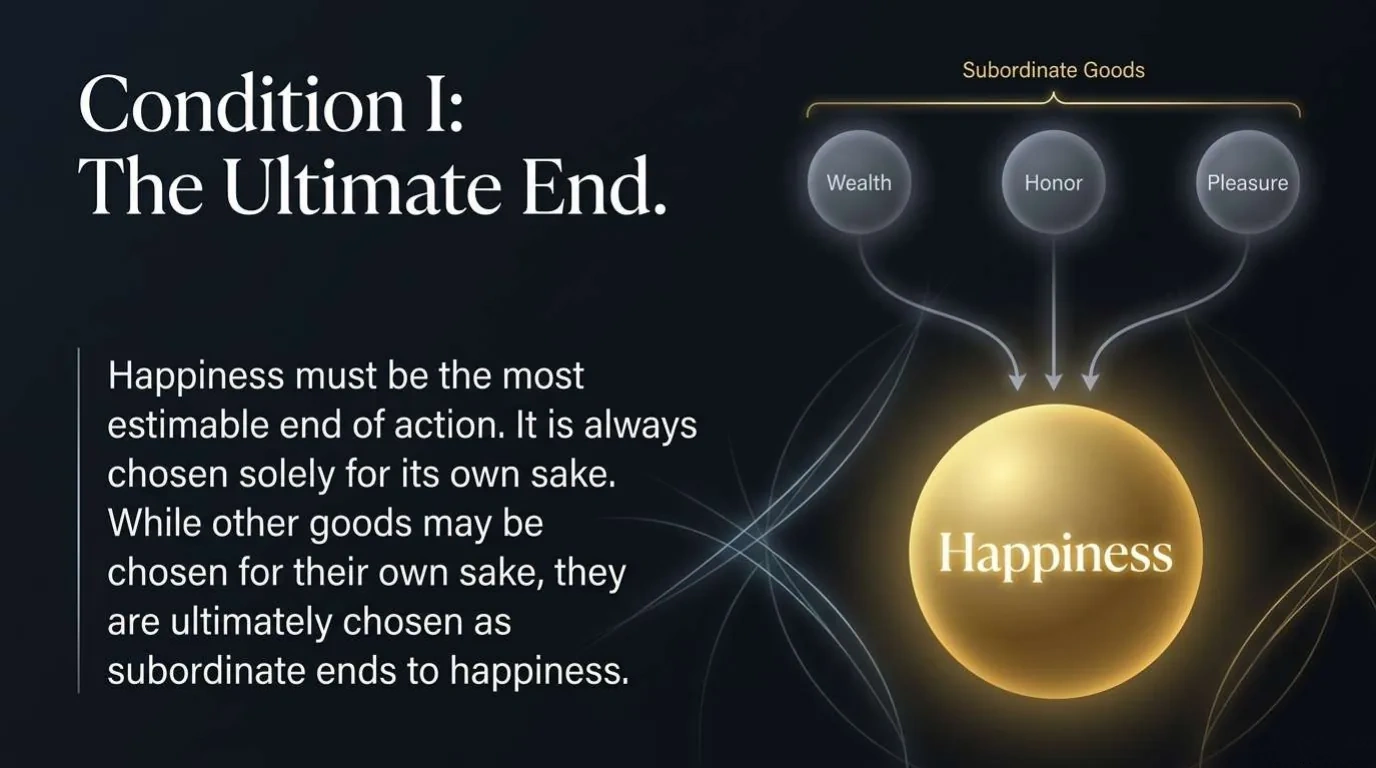
Pick anything you want. Ask: for the sake of what? Money, for security. Security, for peace. Honor, for being at ease among people. Follow any want far enough and it hands you to the next one. Aristotle noticed that the chain has a last link, the one thing never chosen for the sake of anything else, and that every other good is a step toward it.
Run your own chain, from whatever you want most this week. Where does it stop?
After Aristotle, Nicomachean Ethics I.
“The privilege of a lifetime is to become who you truly are.”
— Carl JungThe chart moves. The price moves. The world moves.
None of it was ever yours to govern.
The one territory that answers only to you.
How you meet what happens, not what happens.
What you reach for, and what you flinch from.
Spent trying to govern this, peace leaves with it.
“Seek not that the things which happen should happen as you wish; but wish the things which happen to be as they are, and you will have a tranquil flow of life.”
— EpictetusMost people treat anxiety as a malfunction.
Many Eastern traditions treat it as a message.
It can be a valid signal — pointing at a misalignment, not a flaw. The fix is not to silence it, but to understand what it is pointing at.
“The world will ask you who you are, and if you don’t know, the world will tell you.”
— Carl JungYou knew something was off.
You just couldn’t name it.
You tried to fix it outside.
Wealth. Health. Status.
When outside stops working,
something deeper starts talking.
Every tradition has a name for what comes next.
This section speaks to existential ache, not diagnosable illness. If what you’re carrying includes persistent depression, trauma, or thoughts of harming yourself, please treat that clinically first — see the full note on care.
“It is not a breakdown. It is a breakthrough wearing a disguise.”
The universal initiation no tradition calls optionalTreating a genuine call for deeper meaning as noise to silence with the next distraction.
It is initiation — the forge in which a deeper life becomes possible. It does not end. It graduates.
Two people can meet the same collapse. One is left smaller. One is left larger. What decided it was never the size of the blow.
No one is holding the other end of the rope. Identity shrinks to whatever will survive. What’s left is a wound with nowhere to go.
Someone or something is holding the other end — a person, a practice, a place you keep returning to. The same fall becomes a passage instead of a wound.
The lotus does not grow despite the mud. It grows because of it. There is no clean version of this path — no dimension where the suffering has been edited out. The dark night is not a detour around the work; it is the work’s raw material. You are not waiting for the mud to clear before the flower can open — the flower is what the mud becomes, once something is willing to grow through it.
The dark night doesn’t ask you to survive it alone. It asks what you’re willing to let hold you while you’re in it.
Nelson Mandela
27 years. Not cured. Not escaped. Graduated. What emerged was not the man who entered.
If you have experienced something like this — your journey toward Self-Realization has already started.
Give that ache a name.
The void.
Not a flaw — a signal, pointing in a different direction.
You got what you wanted.
The money. The milestone. The achievement.
Did the void disappear?
The *SELF operating system. Eight layers.
“Until you make the unconscious conscious, it will direct your life and you will call it fate.”
— Carl JungTap to expand — the eight layers of the SELF OS
The Default OS
The chatter beneath every reaction
Stimulus. Response. Repeat. The autopilot running underneath every choice, every decision, every reaction — and most people never notice it running.
In Sanskrit: Vritti+A fluctuation or wave of the mind-stuff (Chitta) — stirred up by the senses, rippling across an otherwise still lake of awareness. — the constant stream of neutral mental chatter, images, and fleeting concepts. Raw, unfiltered data before meaning is attached.
The Courier and the Wife
Contact was never the missing piece
A courier hands a package to a man in the park. Correct address, correct signature, exchange complete — he has no idea the man is the district manager of the company that employs him.
That evening, the same man walks through his own front door. His wife looks up and knows him instantly, not as a stranger who happens to live there, but as her husband. Same person. Same body. Nothing about him changed between the park and the door.
What changed was which side of the encounter carried awareness.
Traditional Source
The Kena Upanishad uses this exact image for the Self: everyone is already in contact with it — it's what's doing the thinking, seeing, and acting, all day, every day. The Default OS runs on contact without recognition. That's the courier's half of the exchange, repeated for years at a stretch.
The Arrival Fallacy
Why the next milestone never satisfies
The false belief that the next milestone will finally bring peace. The brain is wired for the chase, not the catch. Dopamine rewards effort and progress — when the goal is achieved, production drops, leaving an acute emptiness.
In Sanskrit: Bhava+Sanskrit: state of being, feeling. Here, the felt, energetic weight a thought or state carries — not the thought itself, but the charge riding on it. — the somatic and energetic weight attached to thoughts. Nostalgia for the past. Anxiety about the future. Feeling lost after an achievement is not failure.
It is a symptom of an identity built on outcomes rather than essence.
Traditional Source
Maitreyi asked Yajnavalkya the same question in older clothing: if she owned the whole earth's wealth, would that make her immortal? His answer was one word — no. Wealth can make you comfortable. It was never going to make you complete — the same gap dopamine's post-goal crash reopens on a shorter, modern timescale. Epictetus ran the same drill daily, in reverse: love the cup, but call it ceramic first, so its breaking doesn't break you. Under both traditions sits one more claim — that the chase itself, every action a person takes, is driven by the same pursuit of happiness. Not a flaw to fix. The mechanism the Four-Phase Loop below runs on.
The Four-Phase Loop
It isn't a one-off failure — it's a closed loop, not a straight line toward satisfaction
The ego feels incomplete, precarious.
Greed for more stimulus, more possessions.
A brief hit of achievement or consumption.
Hunger returns. Back to Phase 1.
The same loop runs at the scale of a whole economy. Fulfillment rises with spending from survival through comfort — then flattens. Past a threshold, more money spent buys less felt satisfaction, not more. The curve doesn't reward stopping; it rewards noticing where “enough” already was.
Modern Research
Global wealth has multiplied several-fold since 1950, while reported life satisfaction has not moved with it — the Phase-4 restlessness above, measured across an entire economy instead of one person's next purchase.
Traditional Source
The loop feeds on the fruit. The Gita’s answer is one line (2.47): your claim is to the action alone, never to its fruits.
The Threefold Test
Apply it to whatever you're chasing right now
Three questions, asked of any goal, purchase, or relationship you expect to satisfy you:
| Sat+Being — that which does not come and go. | Chit+Consciousness — that which does not grow stale with repetition. | Ananda+Bliss — that which needs nothing added to feel complete. |
|---|---|---|
| Does it still hold by Monday morning? | Is the tenth time as alive as the first? | Does it ever feel like enough, on its own? |
| Permanent? | Ever-fresh? | Self-sufficient? |
⟳ Tip: turn your phone to landscape for a wider view of this table
Traditional Source
The tradition names Sat-Chit-Ananda as what the Self actually is — not a mood to chase but a standing that doesn't depend on conditions. The old invocation says the third column as arithmetic (Brihadaranyaka 5.1.1, and the traditional opening of the Isha Upanishad): that is full, this is full; take fullness from fullness and fullness remains. Nothing added completes it; nothing lost empties it. This test doesn't tell you the answer. Run it on the last thing you thought would finally be enough, and see what it turns up.
Preya and Shreya
The pleasant, and the good
Every choice offers two paths. One is pleasant now and turns bitter later. The other is bitter now and turns sweet later. The loop above is the first path, repeated; here it's the shape of a single decision.
In Sanskrit: Preya+The pleasant — what is agreeable to the senses in the moment, regardless of where it leads. / Shreya+The good — what serves lasting well-being, whether or not it is agreeable at first. — the same fork modern research calls hedonia and eudaimonia: a dopamine-driven consumer versus a serotonin-driven contributor.
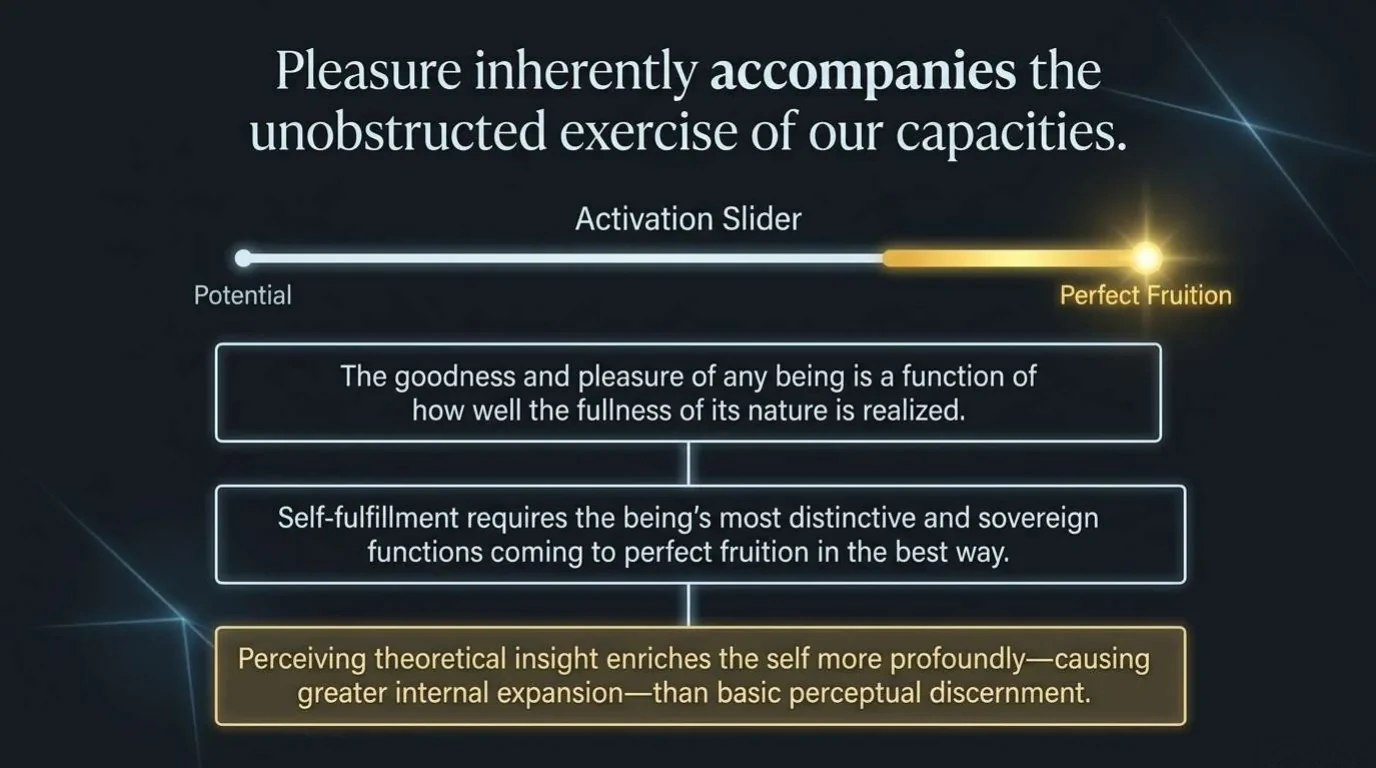
Aristotle drew the same fork from the other side. Pleasure is not the target. It is what arrives when something you are built for is used without obstruction. Aim at the pleasure and you are on the Preya road. Aim at the use, and it comes along unasked.
When did you last forget to ask whether you were enjoying it?
Traditional Source
The Prashna Upanishad draws the same fork as a map. In its first answer, Prajapati+The creator figure of the Vedic texts — in the Prashna Upanishad, the one who performs austerity and splits into the primordial pair of Rayi (matter) and Prana (life). makes the world by splitting into matter and life — the pair named in The Cosmic Exchange. Those who live by rites and the pursuit of offspring — the outward getting — follow the lunar road, and return. Those who seek the Self through discipline, faith and knowledge follow the solar road, and don’t. Read without the afterlife machinery, it is the Arrival Fallacy in older words: a life organized around getting keeps arriving back at the starting line; a life organized around knowing what was never missing doesn’t. Whether “return” is meant literally is a separate question, and this framework doesn’t rest on it.
Traditional Source
The Katha Upanishad names this the choice Nachiketa is offered by Death itself — and Death tells him plainly that most people choose Preya, mistaking it for Shreya, because it looks the same from the outside.
Refusal Under PressureDeath begs him not to ask. He offers endless wealth, long life, chariots, singing women. Nachiketa’s reply: the pleasures of this world don’t last, and they wear away the lustre of all the senses. A man is never satisfied with wealth. Then he asks the same question again.
What would you have to be offered before you stopped asking yours?
The Sea Squirt
What settling on a rock can cost
A sea squirt larva swims until it finds a rock with food. Then it attaches for good and, as the story is usually told, absorbs the nervous tissue it no longer needs for moving. With nothing left to go anywhere, nothing is left to go with.
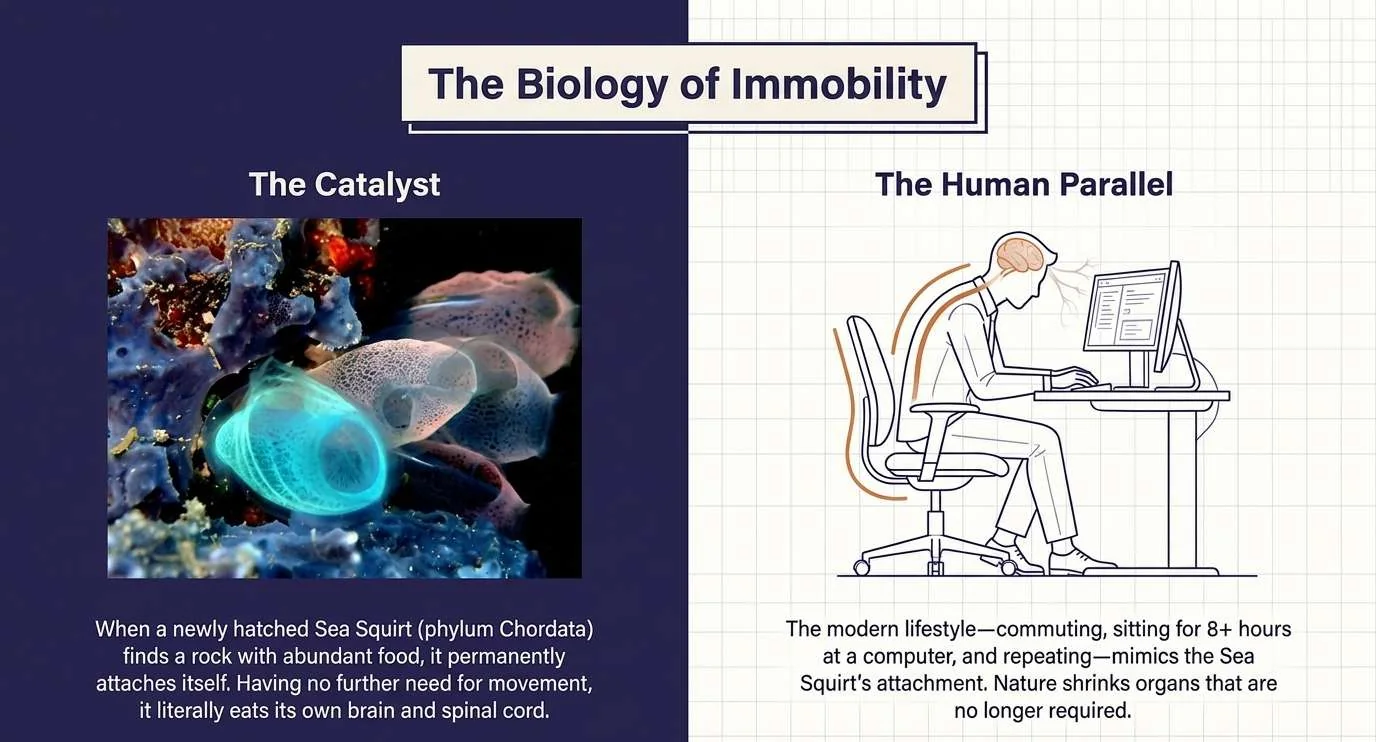
Which of your rocks is the one you stopped swimming for?
Honest limit: the larva does absorb its larval nervous system when it settles, but the adult keeps a small ganglion, so the slide’s “literally eats its own brain” is the popular compression. And it is a parable. It shows a principle; it is no evidence about what sitting does to a human brain.
The Ego
How desire becomes “I”
The mask the “I” wears. Your name, status, achievements, wounds, the story you tell about yourself. The false self that keeps seeking outside. To know your true SELF, you first have to see through it.
In Sanskrit: Kama+Desire — wish, longing, or sensory pleasure; one of the four traditional aims of life alongside duty, prosperity, and liberation. Here, the raw craving that hardens into the next column. → Ahamkara+Literally “the I-maker” — the function of mind that stamps “me” onto raw experience, manufacturing a sense of separate identity. — desire collects into a constructed identity that claims ownership: “I want this, I feel that.” The I-Maker claiming all experience as its own.
Traditional Source
Epictetus makes the same point with a horse: if it bragged about its own beauty, you'd find that absurd. Bragging about your wealth or title is the same trick in different clothes — taking credit for something Ahamkara only stamped as “mine.” The Gita names the remedy for the comparing that follows (3.35): better your own dharma, imperfectly done, than another’s done well.
Staring Over the Fence
Comparison is attention pointed the wrong way
Comparison feels like a judgment about someone else. Mechanically it is attention, aimed outward at a life you can't edit, while the one you can edit goes unwatched.
Staring at the neighbour’s grass. It always looks better from here: you see the surface and none of the upkeep.
Watering the grass you stand on. The only lawn where an hour of attention turns into something.
The Gita line above is the same redirect in one sentence. The envy is a signal, not a verdict: it shows where your attention just went.
The next time it shows up, what is waiting for you at home, unwatered?
The True “I”
Sat-Chit-Ananda, explained
Your pure, underlying conscious awareness. The silent observer behind every thought. The screen, not the movie — unchanged by whatever plays on it. Many traditions point to the same address.
SAT-CHIT-ANAND.
Existence. Consciousness. Bliss.
Bliss, the third word, is easy to hear as something added on top. An old image says otherwise: sugar is pervaded by the taste of sugarcane, edge to edge. Look at whatever you call “I.” Is the sweetness added, or is it already all through it?
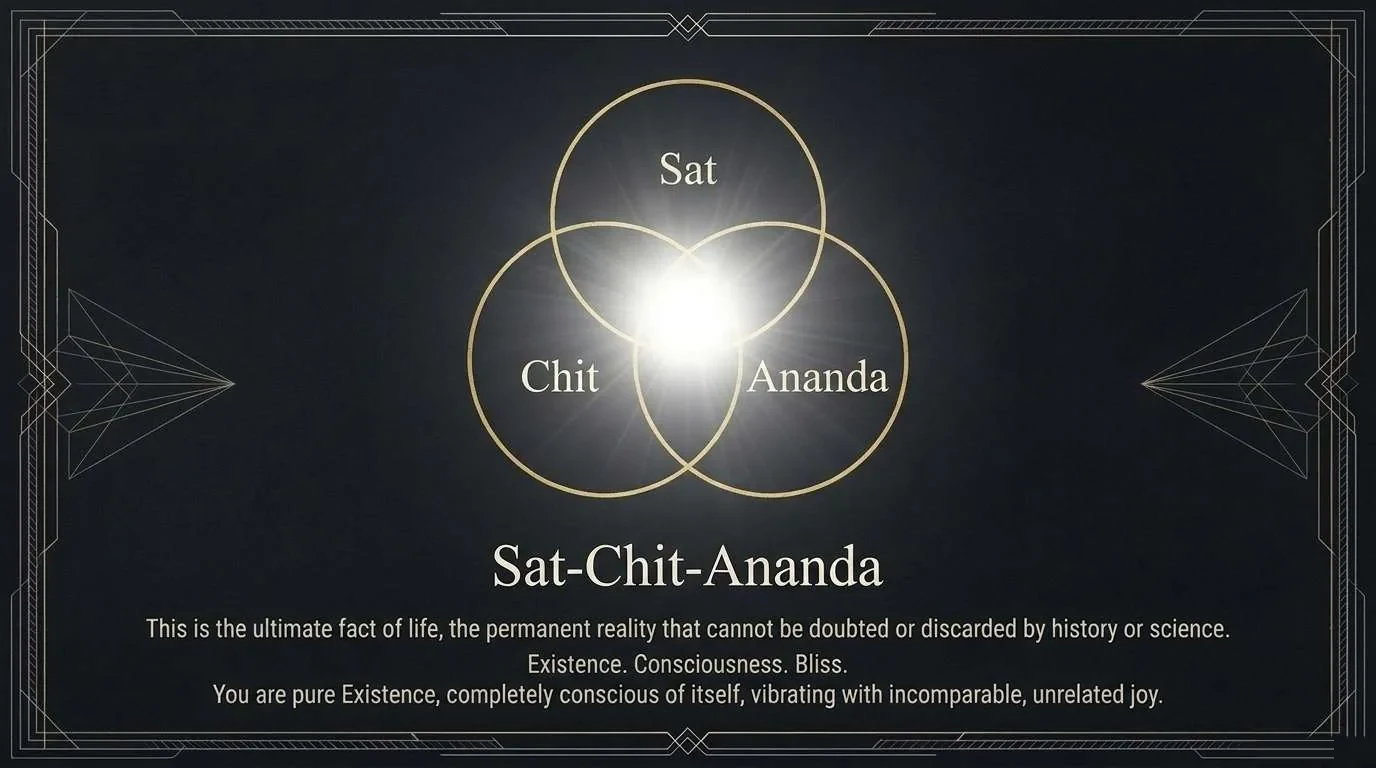
Three circles, one point of light where they overlap: not three things but one fact seen from three sides. The caption under it is the whole card in a sentence — you are existence, conscious of itself, vibrating with joy that depends on nothing.
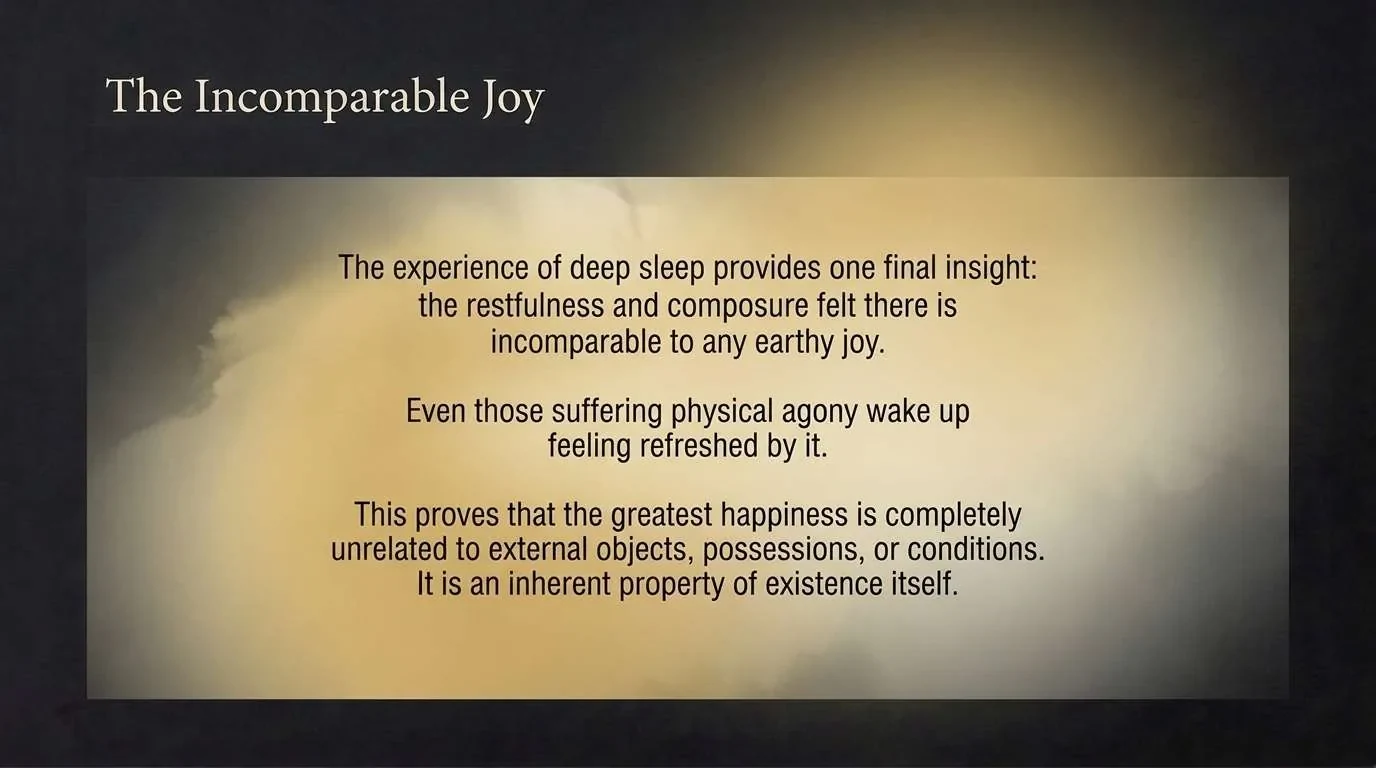
Where the third word comes from, by the deep sleep route. The rest felt there is out of proportion to anything in the day, and it arrives with no object, no possession and no condition met. Even someone in physical pain wakes refreshed by it. So the claim is that happiness is not made by objects but belongs to existence itself.
Honest limit: sleep’s restfulness also has plain physiological causes. The argument is that it is a clue, not that it is proof.
Traditional Source
The Gita gives the screen and the movie their own names in its thirteenth chapter: the body, with everything that happens in it, is the Kshetra+Field — in the Gita’s thirteenth chapter, the body together with mind and senses: everything that can be experienced and known. (field), and the one who knows it is the Kshetrajna+Knower of the field — the one who knows body and mind as objects of awareness; the witness behind experience. (knower of the field) (13.1–2).
The Equation — Atman = Brahman
The Sanskrit name for “I am Brahman”
Atman+The individual self, in Advaita Vedanta — held as identical to, not separate from, universal consciousness. (Individual SELF) = Brahman+The ground of all reality in Vedanta — not a deity to petition, but the substrate everything, including you, is made of. (Supreme Reality)
Traditional Source
That equation has a Sanskrit name: Aham Brahmasmi+Word by word — Aham (“I,” the individual self), Brahman (the ultimate, unchanging reality), Asmi (“am,” “exist”). One of the four Mahavakyas — “great sayings” — found in the Brihadaranyaka Upanishad of the Yajur Veda. — “I am Brahman,” or “I am the divine absolute.” Not an ego claim — the name, the body, the story from Card 03 is not what's speaking here. It describes the enlightened recognition that your deepest essence was never separate from universal consciousness to begin with, the same non-duality Tat Tvam Asi states from the teacher's side, spoken here from the individual's.
In Sanskrit — Maya / Avidya
The lens of separation
Maya+Usually translated “illusion,” though “the measuring-out” is closer — the way one undivided reality appears to us as separate things, separate selves, and passing time. / Avidya+Literally “not-knowing” — the root ignorance that mistakes the temporary, changing self for the true, unchanging one. — the lens of separation — is dissolved when you recognize you are not the projection, but the screen. That is who you actually are.
The Gap — RRRR Protocol
The RRRR practice for the gap
The space between trigger and response. Moving from reactive to intentional.
V1 — Stop the Impulse
Recognize — Name the trigger.
Resist — 60-second pause. Do not act.
Return — Breathe. Walk away.
Release — Reset from clarity.
V2 — Process the Emotion
Recognize — Notice without judgment.
Reflect — What is the deeper trigger?
Reframe — Shift from victim to witness.
Respond — Choose from clarity, not the wound.
What Gets Reached For Instead Of The Gap
Three excuses, and the gap underneath each one
The Excuse
“This is just who I am.”
The Gap
A pattern, not a sentence — it was built, so it can be noticed while it's firing.
The Excuse
“It's my prārabdh karma+The destiny allotted at birth based on past karmas..”
The Gap
The hand dealt isn't in question. What you do with this specific moment of it is.
The Excuse
“Time will sort it out.”
The Gap
Time only passes. The response inside this gap is the only thing actually doing anything.
Each excuse points somewhere outside the gap — character, fate, the calendar — anywhere but the one place a response is actually available: right here, between the trigger and the reaction.
The Dichotomy of Control
What's yours to hold, and what was never yours
Some things are within your power — your judgments, your desires, your aversions. Everything else — your body, your reputation, what other people do — is not. The gap above is where that distinction actually gets used: pausing before responding is easier once you can name which half of the situation is yours to work with.
In Greek: Prohairesis+The faculty of choice — the one thing Epictetus held to be entirely up to a person, regardless of circumstance. — the seat of judgment and choice. Not the mind's content, but its capacity to assent or withhold assent from what arises in it.
Traditional Source
Epictetus opens the Enchiridion with this split, then spends fifty-three chapters returning to it from every angle — the same witness this site describes as unmoved by the movie, pointed to from a slave's position in Rome, just named through choice rather than consciousness.
The Dog and the Cart
Trot alongside, or be dragged
Ancient reports credit the early Stoics, Zeno among them, with a picture of a dog tied to a moving cart. The cart goes where it goes. The dog can trot alongside or dig in and be dragged; either way it ends up in the same place. What stays in its hands is the manner of the trip.
The Stoics used it to say something about the ordered universe they called the Logos+Greek for “reason” or “account” — in Stoicism, the rational principle that orders the whole universe, also called Nature, Providence or God.: events already underway are not up for negotiation, but your response to them is. It is a close cousin of how this site treats Prarabdha — the hand already dealt, with the playing still yours. Where the Dichotomy of Control sorts what is yours from what is not, this picture is for the things already in motion.
Traditional Source
The image is reported of the early Stoics by later writers, and Marcus’s own advice to go willingly with what the whole is doing is its echo in the Meditations. Honest limit: the cart is what has already happened or cannot be changed — a diagnosis, a layoff, a death. It is not a reason to stop acting where action is possible; the Stoics themselves insisted on action and justice. And it is a picture of how to carry what is fixed, not a proof that every event is for the best.
Feeling Is Not the Fault
Arjuna drops the bow. What happens next is the gap.
Arjuna sets down his bow because he can see the cost of what he is about to do. That is conscience, not weakness. The Gita opens on his grief and does not tell him to stop feeling it. It asks what he will do with it.
Feel it fully. Name it. Then ask once: is this feeling helping me see the situation, or has it become the situation?
Traditional Source
Bhagavad Gita, Chapter 1, named for Arjuna’s despondency. The teaching only begins in Chapter 2, after the grief has been allowed to stand.
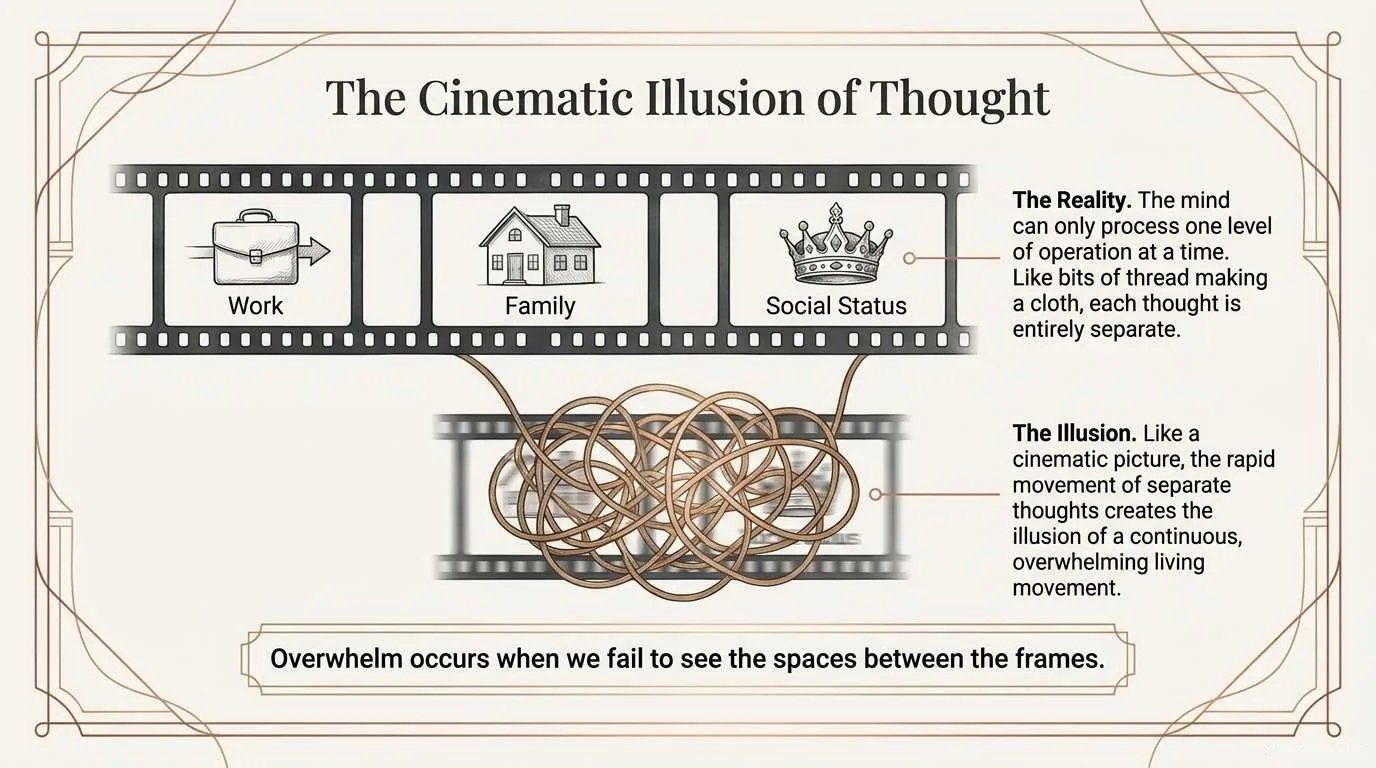
Separate frames, run fast, read as one overwhelming movement. The gap is the space between the frames. Can you find one?
Self-Realization
Why delusion needs the dark
Not expected to be achieved in one lifetime. That is not a failure — that is the point. The goal was never arrival. The question is: are you pointed in the right direction?
In Sanskrit: Moha+Delusion — the basic clouding of judgment that mistakes the false for the real. / Vipallasa+Pali (Sanskrit viparyāsa) — a perceptual distortion in Buddhist psychology — seeing the impermanent as permanent, the impure as pure. — delusion is the ultimate end of unchecked conditioning. The loop only functions in the dark. Recognition is liberation. The architecture cannot survive awareness.
Life vs. Life Situation
Life vs. “my life”
What you casually call “my life” is usually just your life situation — a mental narrative built on circumstances, full of problems and resistance, existing only in psychological time. Life itself is different: it exists only in the eternal Now, problem-free, internal, and indestructible.
Situations are either accepted or acted upon — never turned into “problems.” The moment you say and believe “my life,” you’ve split yourself from life itself. There is no such split. You don’t have a life. You are life.
A memory, recalled Now.
The only place life happens.
An anticipation, arriving as Now.
The division of life into past, present, and future is mind-made. What you remember is an event that took place in the Now — and you are remembering it Now. The future, when it comes, is the Now. Life is never not “this moment.”
The Alphabet and the Word
What's given vs. what's built
Life hands you the letters — the events, the losses, the circumstances you didn't choose. It never hands you the word. Meaning is not found lying in the tray; it's assembled, tile by tile, out of the same raw alphabet that also spells pain and loss.
This is the dichotomy of control from a different angle: the letters on your rack are not in your hands. But the words you construct — and where you place them — are a matter of skill and practice, not luck.
Manufacturing vs. Growing a Life
Two metaphors for effort
| The Manufacturing Metaphor | The Agricultural Metaphor | |
|---|---|---|
| Verbs | Making money, making time, making friends | Growing, nurturing, flowing |
| Life as | A machine you assemble | A seed already carrying what it will become |
The river runs independently of your preferences. Whether you fight the current or swim with it is the only real choice on offer.
The Blueprint and the House
Paper and fire, seen as one process
A blueprint shows paper and fire as two separate things — a wall here, a hearth there, fixed and labeled, sitting apart on the page. That's the conceptual world: separate entities, filed and named.
A house actually being lived in doesn't work that way. Light a fire near paper long enough and there's no clean seam left between them — paper is fire, fire is paper, one continuous event. Living was never going to happen on the blueprint. It only happens in the burning.
Most of a life is spent re-checking the blueprint instead of stepping into the house that's already on fire.
The Four Defects of Perception
Why the mind keeps mistaking form for content
Formless truth passes through the mind like light through a prism — and comes out split into measurements, forms, and calculations. Not because the truth was ever like that. Because the prism is built with four specific defects.
The Four Defects, One By One
How the prism splits formless truth into form
Reality reduced to physical mass — bodies, money, land. Since none of it can be held forever, it becomes a standing source of unease.
Quality can't be perceived on its own — only by contrast. It quietly becomes just another camouflage for quantity.
The mind tries to physically fuse separate things — two bodies, two lives. An illusion: no two physical things ever organically become one.
Every quantity gets forced into a condition — up or down, moving or still, heavy or light — as if the label were the thing.
Nothing here is being called wrong. This is just the hardware doing what hardware does — running commercial logic on something that was never a commodity to begin with.
Nothing here was invented for this project. It's a distillation, four layers deep.
Easy to mistake any one teaching for a standalone opinion. It isn't. Here's the actual lineage — the same conclusion, distilled down to four progressively more usable forms.
The eternal, vast body of revealed knowledge — too immense for one lifetime to work through directly, even in translation.
The philosophical cream, drawn off the ritual portions — the part asking what's actually real, not how to correctly perform a rite. The Isha even sits inside a ritual text, as the 40th and last chapter of the Shukla Yajurveda; Shankara noted its mantras weren't used in rituals. Source
Ved Vyas's own codification of the Upanishads into one airtight argument — written in a sutra shorthand almost no one outside a trained lineage can read unassisted.
The Gitopanishad+Literally “the Upanishad sung as a song” — a traditional epithet for the Gita, marking it as carrying the same authority as the Upanishads themselves. — the same conclusion, made universally accessible: spoken aloud on a battlefield, in dialogue, and folded into the epic Mahabharat instead of sealed off as ritual scripture.
Why The Fourth Layer Can Be Trusted
The funnel above shows descent — one thing distilled into four. It doesn't show why anyone should trust the distillation. That answer is a separate structure: Shankaracharya+8th-century philosopher-monk whose commentaries systematized Advaita Vedanta; his Brahma-Sutra-Bhasya is the reference point for this section.'s commentary on the Brahma Sutras doesn't just add a fourth opinion — it cross-checks three independent canons against each other and shows they all converge on the same non-dual reality.
The Upanishads — the raw revelation, unmediated.
The Bhagavad Gita — the same content, restated.
The Brahma Sutras — the same content, argued.
Three canons, three different jobs — one heard, one told as a story, one proven by logic. Vedanta, quite literally “the end of the Veda,” is the single point all three were always pointing at. A claim resting on independent confirmation across all three isn't scripture asking to be taken on faith alone. It's scripture that already passed its own cross-examination.
Who Else Read It
Nothing above needs an outside witness. But it is fair to ask whether anyone from outside the tradition sat down with these texts and came away changed. Some did, and said so in print. Two are enough to show the shape.
He met them in a Latin rendering of a Persian translation, and still called them the solace of his life and said they would be the solace of his death.
Introducing a 1944 translation, he called it one of the clearest and most complete summaries of the perennial philosophy ever made — the claim that a common core runs under every tradition.
Stated plainly: a reader’s admiration is a fact about the reader. Schopenhauer built a system of his own and never became a Vedantin, and Huxley wrote as a comparativist. What this shows is narrow — that these texts held up under serious outside reading, not that what they say is true.
Source: Schopenhauer, A. (1851). Parerga and Paralipomena, vol. 2. Huxley, A. (1944). Introduction to Prabhavananda, S. & Isherwood, C., The Song of God: Bhagavad-Gita.
Same author, same realization, four attempts at the right altitude for a listener to actually receive it. That's the whole function of this page too — not a fifth, competing layer, but one more attempt at translation, aimed at whatever altitude you happen to be standing at right now.
Before the cure, the actual disease.
The Veda's diagnosis of the human condition isn't circumstantial — a bad job, a bad year, a bad relationship. It's structural. Samsara+The cycle of birth, death, and rebirth — the ceaseless churn of conditioned existence every layer below the Self remains bound to. isn't only the biological wheel of birth and death. It's a five-step engine, cycling underneath an ordinary Tuesday, that manufactures the felt sense of incompleteness fresh every day — and then hands you the bill for trying to fix it from the wrong end.
Tap to expand — the five-step engine underneath the diagnosis
Avidya+Literally “not-knowing” — the root ignorance that mistakes the temporary, changing self for the true, unchanging one.
Ignorance
“I do not know who I truly am.” Not a gap in trivia — a gap in the one piece of self-knowledge everything else gets built on top of.
Adhyasa+Superimposition — mistaking the attributes of one thing for those of another, the way dim light lets a rope be mistaken for a snake. Here, the attributes of a limited body-mind get superimposed onto the limitless Self.
Wrong Identification
“I am this limited body/mind.” The gap from Step 1 doesn't stay empty — something rushes in to fill it, and what rushes in is always a smaller, borrowed identity.
Raga-Dvesha+Attraction and aversion — the paired reflex of reaching for what seems to complete a felt lack, and recoiling from what threatens it, once that lack has been mistaken for who you are.
Desire & Aversion
“I need things to complete me.” A body-mind, mistaken for the whole Self, experiences itself as partial — and partial things reach for completion outside themselves.
Karma+Action, and the law that every action leaves a residue — a seed — that ripens later, shaping future circumstance and future tendency alike.
Action
Compulsive striving in the world. Desire and aversion don't stay as feelings — they discharge as action, chasing what pulls and fleeing what threatens.
Phalam+The fruit or result of an action — including the subtle residue it leaves behind, independent of whether the action succeeded at its stated aim.
Results
Every action deposits a Vasana+A subtle latent tendency or impression, left behind by past thought and action, that inclines the mind toward repeating the same pattern. — a groove that feeds straight back into Step 1, deepening the same ignorance it was supposed to relieve.
The Veda's word for the baseline human state is bondage — and not primarily the physical fact of birth and death, but the psychological gnawing of incompleteness that runs underneath a life that, from the outside, is going fine.
A finite fix cannot cure an infinite misdiagnosis. If the disease is mistaken identity, the only cure is Moksha+Liberation — release from the cycle of Samsara through the correct recognition of one's true nature, not through any change to circumstance. — not better circumstances inside the cycle, but correct identity, which stops the cycle from having anywhere left to run.
The Shiva Sutras name this same shrinking a different way — The Bondage of “Knowing”.
Laid out layer by layer, this same bondage is the walk through Layers 1–6 of the Master Matrix — and Layer 7, the Self, is Moksha itself: the only way out.
The Same Motion, Twice
The Swing
Step 3 names two reflexes. Look at them together. Reaching for what promises completion and recoiling from what threatens it are one motion, felt from either end. A pendulum pulled hard to the right is storing exactly what it needs to swing left.
Traditional Source The Gita says it as a rule of living. Yoga is not for the one who eats too much or too little, sleeps too much or too little (6.16). It belongs to the one who is moderate in eating, recreation, action, sleep and waking (6.17). Elsewhere it calls evenness in success and failure yoga itself (2.48).
Stated plainly: the pendulum is an image, not a mechanism from the texts. The texts give the moderation and the evenness. The picture is one way of seeing them.
Not a claim to accept. A place to look. Which end is it swinging toward now, and what is that storing?
Source: Bhagavad Gita 2.48, 6.16–6.17.
Where The Bill Actually Comes From
The Threefold Miseries
Phalam, above, explains how the bill is generated. This is a sort of the bill itself — every form of dissatisfaction this tradition recognizes, filed into exactly three sources.
Disease, mental anxiety, grief — generated by the very body and mind claimed as “mine.”
Whatever a rival, a pest, or an enemy inflicts — any misery routed through someone else's choice.
Storms, earthquakes, heat, cold — whatever arrives from forces no individual will was ever going to negotiate with.
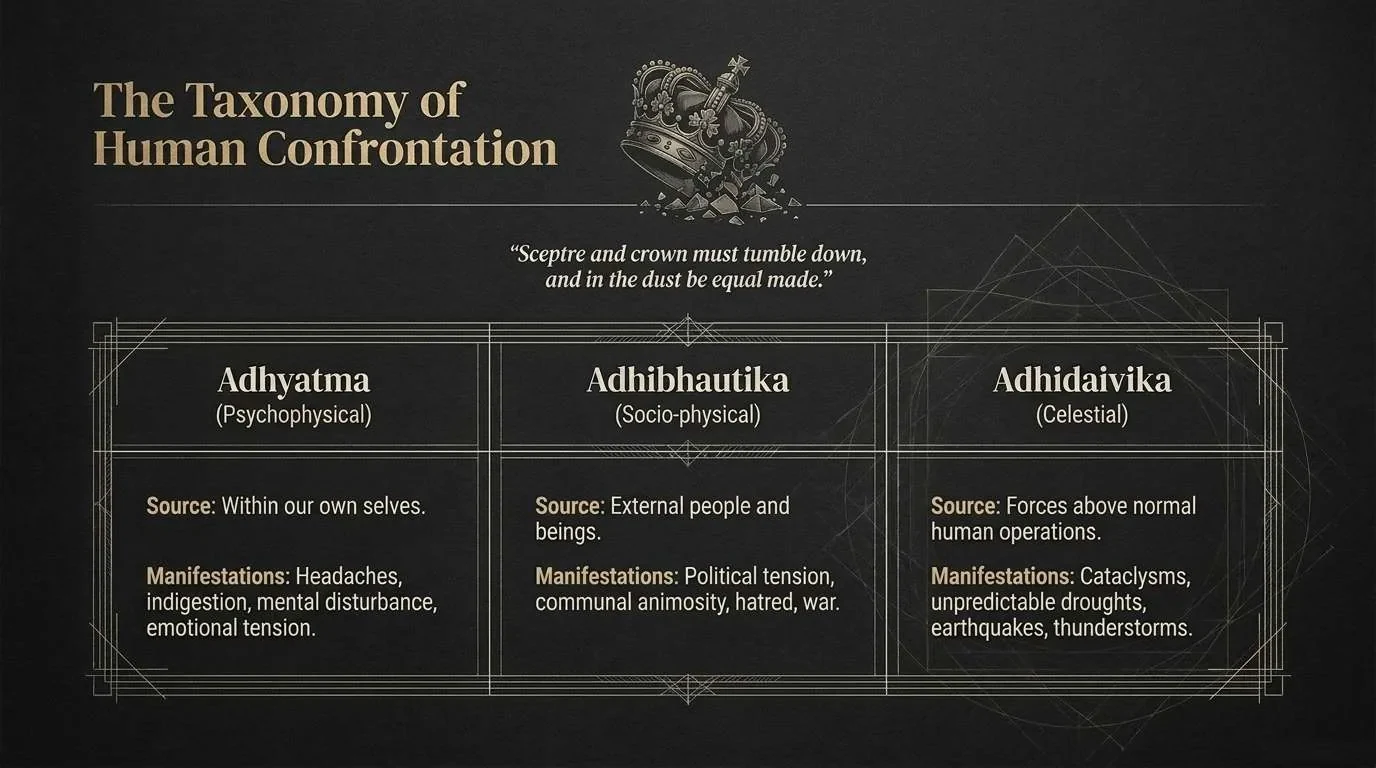
The same three-way sort, drawn as a table. It adds what the cards above leave out: a plainer English name for each source (psychophysical, socio-physical, celestial) and a row of everyday examples — headaches and indigestion, communal animosity and war, droughts and earthquakes. The toppled crown over the table is the quiet point: no rank exempts anyone from any of the three columns.
Every complaint ever filed sorts into one of these three. Which is also the point: rearrange the furniture of a life indefinitely, and it only ever redistributes which of the three does the hurting — it doesn't touch why an identity this fragile went looking for permanent comfort in impermanent material in the first place.
What The Hunger Is Actually After
The Three Eshanas+Literally “wishes” or “driving hungers” — the three root longings the Upanishads trace beneath every ordinary want.
Desire looks like a thousand different things. Traced down, it is three. Each one is a finite someone trying to become infinite.
Wealth, land, authority. A small self made large by what it holds. Kings are never finished. Neither is anyone who counts. What number would be enough?
Children, lineage. Time cuts the line; biology draws it again. A family continuing is not you continuing. Who exactly is meant to survive?
Name, standing, legacy. The body goes hungry for a reputation it will never hear. Why care what is said after you are gone? Who is that for?
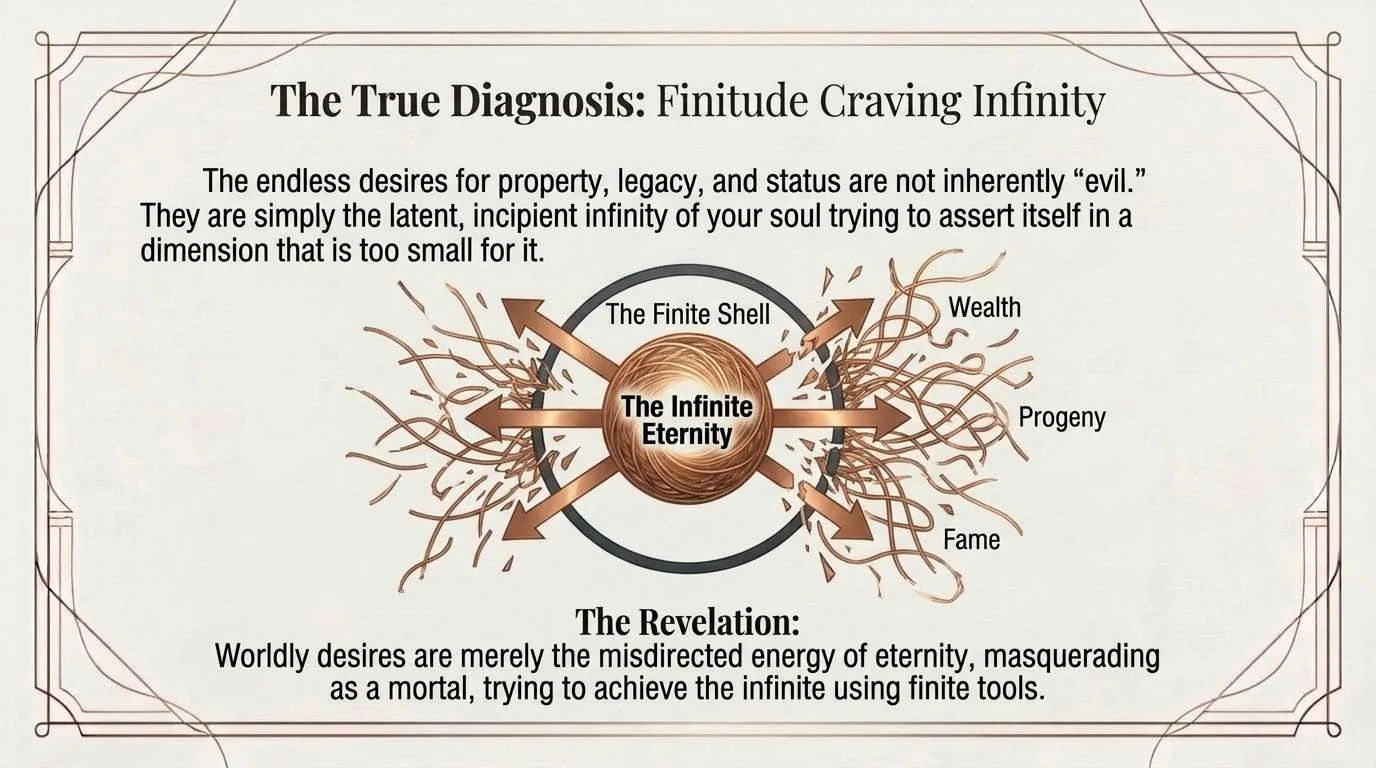
The same three hungers, drawn as pressure on a shell. The arrows push out. The ring is the limit. Which arrow is yours pushing hardest?
Not evil. Misdirected. The same energy, aimed at the wrong dimension, using finite tools for an infinite errand. Look at the thing you want most. What is it trying to make permanent?
Wherever there is a second, there is fear. Wanting is how the second gets pulled in close. The Root Diagnosis shows the engine; this is what it runs on.
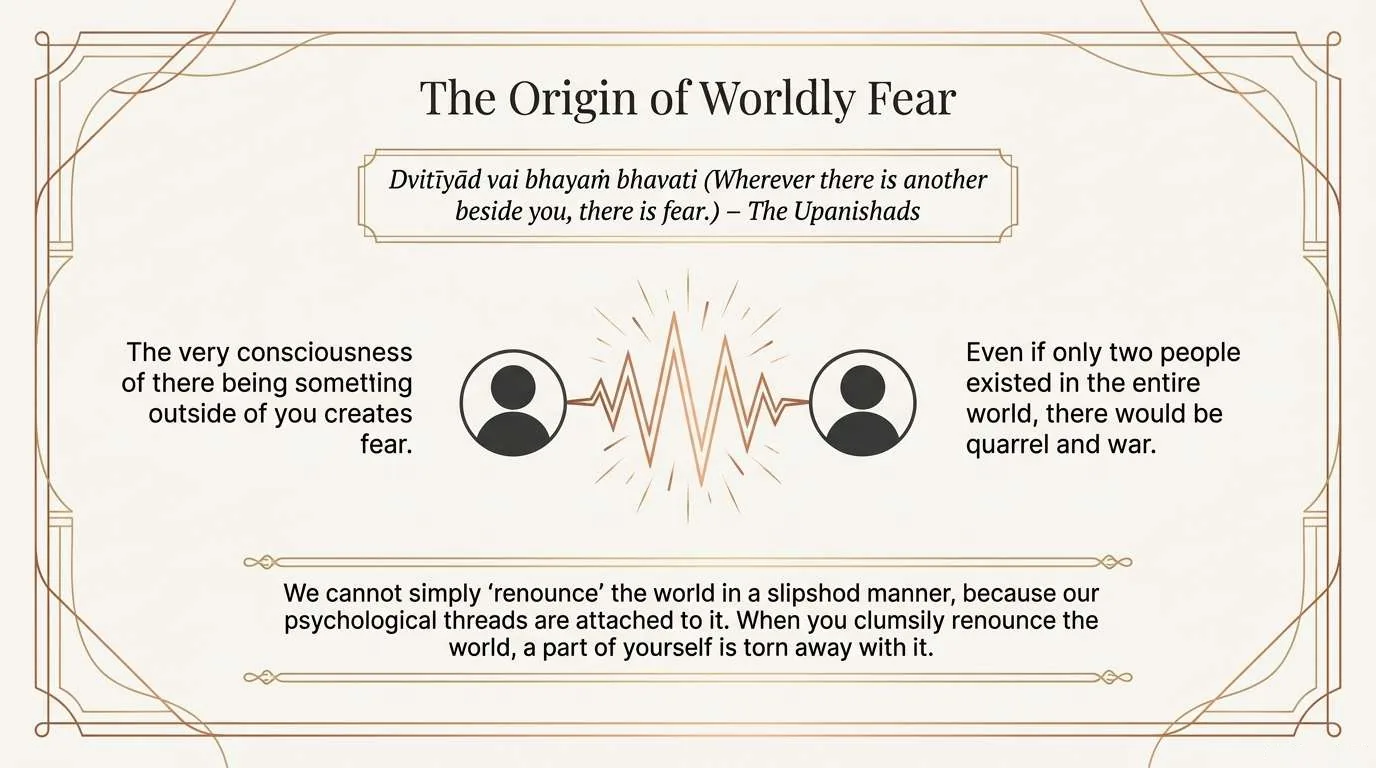
Source: Brihadaranyaka Upanishad 1.4.2, 3.5.1. 42SELF Interpretation
Three Ways To Hold A Thread
Attach · Sever · Release
Most people think the only choices are cling or cut. There is a third.
Involved, reactive, driven by desire. The mind is glued to the thing. Every pull on it pulls you.
Cut off, avoiding, forced. The thread tears and leaves a scar. Running from a thing is still being tied to it.
Free of the association without fleeing it. The thread runs alongside. Nothing is cut. Nothing is pulling.
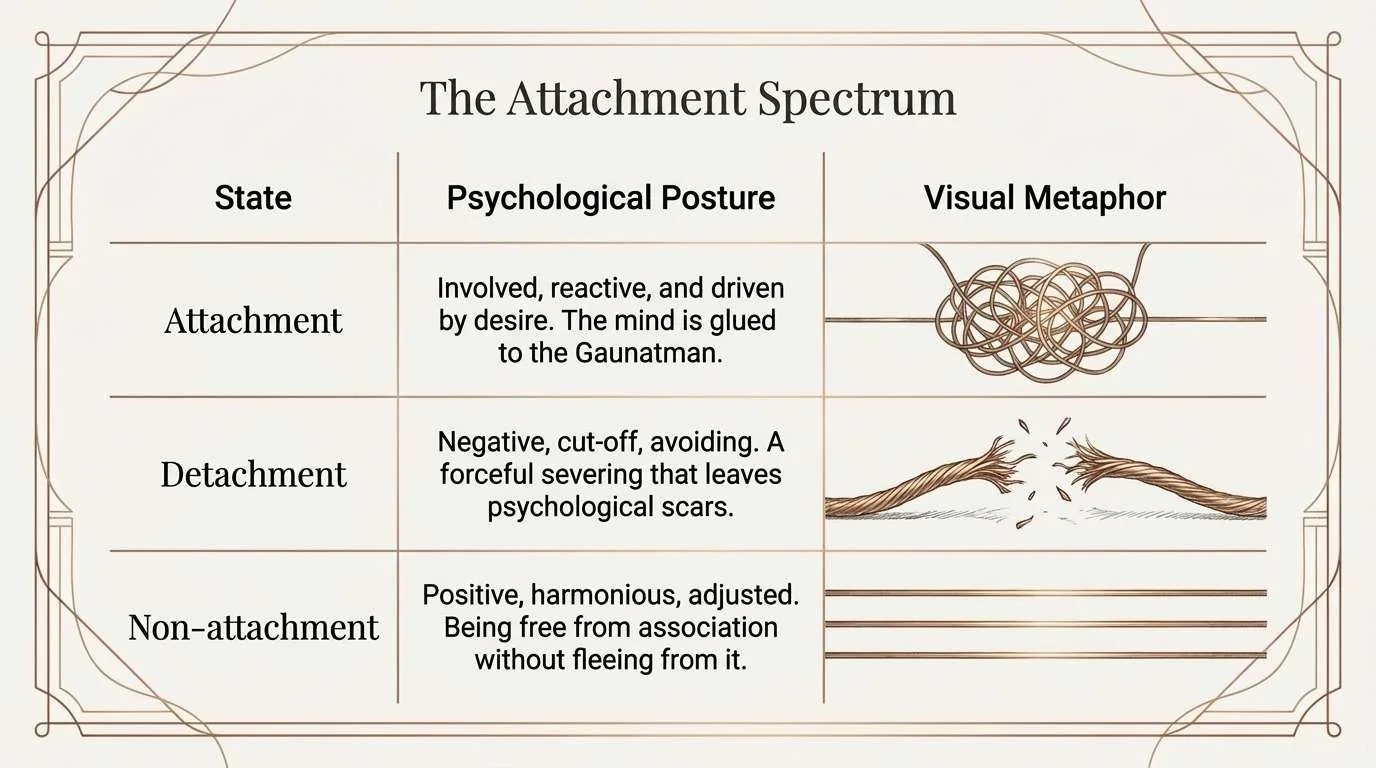
The same three postures, drawn as thread: tangled, snapped, parallel.
Cut a desire and it goes underground. Understand why it arose and it loosens on its own. Which one is your habit with the thing that costs you sleep?
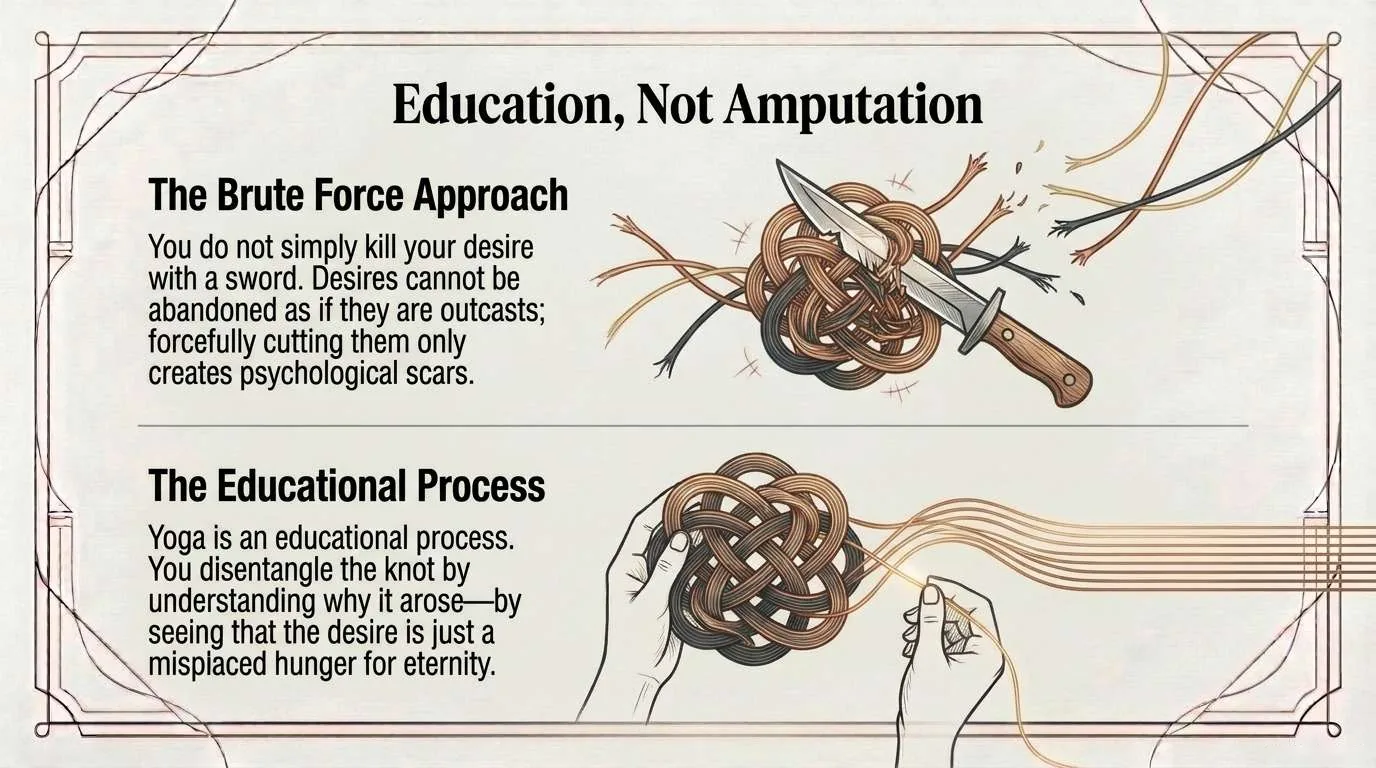
One knot, two ways in. The blade leaves frayed ends. The hands ask how it got tied.
The same shape as Vairagya: the open jar, not the emptied room. Here it sits next to the Eshanas that make the threads.
Source: Yoga Sutras 1.15. 42SELF Interpretation
Everyone Already Serves Something
The Paradox of Control
“Free agent, serving no one” was never actually on the menu. Suffering doesn't start with serving something — it starts with the choice of master.
Refuses higher authority, tries to master the material world directly — and ends up governed by whichever of lust, anger, or greed shouts loudest. The rebellion succeeds. The freedom it was supposed to buy never arrives.
Accepts servitude to something higher — and that acceptance is exactly what hands back command of the senses it was supposedly giving up. Control was never available by demanding it directly.
Which is also the same shape as Purushartha and Sharanagati elsewhere on this page, in blunter language: the one demanding mastery ends up owned by what it was chasing. The one offering service ends up free.
A wet matchstick cannot catch a spark.
Vedic inquiry is not withheld out of secrecy. It's withheld the way a fire is withheld from wet wood — not as punishment, but as physics. An undisciplined mind can be shown the truth directly and still not catch it, the same way a wet matchstick can be struck against the truth itself and still not light. Sadhana Chatushtaya+The “four means of practice” — the traditional set of qualifications said to prepare a mind for Vedantic inquiry, without which the teaching has nothing to take hold of. is the drying process. Four qualifications, each building on the last.
Tap to expand — the four qualifications, base to apex
Viveka+Discrimination — the capacity to tell the eternal (Nitya) from the ephemeral (Anitya). The bedrock qualification; the other three are built on top of it.
Discrimination — the base of the pyramid
The capacity to tell the Nitya+The eternal — what does not come and go, was not born and does not end. from the Anitya+The ephemeral — whatever begins, changes, and ends, however long the timescale. — the changeless from the changing. Not a mystical skill: the ordinary discernment that a promotion, a relationship, even a good decade, is not built to outlast time, and that something in you evidently is (it's the one noticing all of the above come and go).
Discrimination isn't all-or-nothing. A traditional ladder of animals shows it maturing in three grades:
The Tortoise — protective. Pulls back from whatever unsettles it and ignores outside ridicule, just to hold steady. Stability first, no sorting yet.
The Duck — practical. Learns what to take in and what to reject, but on a worldly, functional level: useful or harmful, not yet lasting or passing.
The Swan — complete. The legendary bird that separates milk from water. Here the sorting is between the permanent and the transient, which is Viveka proper — and the real beginning of the journey, not its end.
Vairagya+Dispassion — the mature, non-forced loosening of dependency on ephemeral things, once Viveka has made their impermanence obvious.
Dispassion — the second tier
Calm, mature renunciation of dependency on the ephemeral — not white-knuckled abstinence, and not a forced move to a cave. It's what naturally follows real Viveka: once something is clearly seen as temporary, leaning on it for permanent peace stops making sense, the way leaning a ladder against smoke stops making sense.
Shatsampatti+Literally “the six treasures” — a set of six inner disciplines, traditionally grouped between Vairagya and Mumukshutvam, that stabilize the mind for inquiry.
The Six Treasures — the third tier
Mental and emotional discipline, in six parts:
Control of the mind.
Control of the senses.
Withdrawal from distraction.
Endurance of opposites.
Faith in the teaching.
One-pointed focus.
Mumukshutvam+The burning desire for liberation — not curiosity about liberation, but the same intensity of wanting normally reserved for survival.
Burning desire for liberation — the apex
Relentless, single-minded focus for Moksha+Liberation — release from the cycle of Samsara through the correct recognition of one's true nature, not through any change to circumstance.. The first three qualifications dry the wood. This is the spark that actually needs somewhere dry to land — without it, a perfectly disciplined mind can still sit indefinitely, never striking the match.
That's all four. One loose thread remains — Shatsampatti's fifth treasure, Shraddha, is faith placed in someone. The next card isn't a fifth qualification of the seeker; it's about the other party in that relationship.
Sadguru+Literally “true teacher” — not any instructor, but one who has themselves realized what they teach.
Who Shraddha is actually faith in
The four qualifications above describe the seeker. They say nothing about who the seeker's Shraddha+Faith — provisional trust in the teacher and the teaching, held long enough to actually test it, not blind belief held instead of testing it. is supposed to be placed in — and Vivekachudamani+“Crest-Jewel of Discrimination” — a foundational Advaita Vedanta text attributed to Adi Shankaracharya, on the qualifications and inner work that lead to direct Self-knowledge. is specific that not just anyone qualifies:
Versed in the Vedas; a knower of Brahman, not merely a scholar of texts about Brahman.
Sinless, unsmitten by desire — nothing left to be earned or protected through the teaching.
Withdrawn into Brahman, the way fire settles once it has consumed all its fuel.
A reservoir of mercy that needs no reason — a friend to anyone who comes for shelter.
The distinction matters because Shraddha, above, is provisional trust held long enough to test — which only works if there's something at the other end actually worth testing against.
None of this is a gate keeping the truth away from you. It's a description of what a mind actually needs, structurally, before a non-dual teaching has anything to grip — the same reason the driest kindling, not the most enthusiastic match-striking, decides whether a fire starts.
Why The List Above Is Worth Acting On
The tradition doesn't just list what a seeker needs. It names three things that have to coincide before the list above is even usable — and treats their coincidence as rare enough to be worth stating outright.
And, further, the aptitude and discipline to actually study what's been handed down — not a given, even once the first condition is met.
Wanting it the way one wants air, not the way one wants a book finished.
Someone who has already arrived, willing to point the way — not assumed to be available on demand.
To have all three at once and spend them on anything other than this inquiry isn't neutral, the tradition says — it's closer to injuring yourself over something that was never real to begin with.
Everything else in life responds to effort. This is the one exception.
Before inquiry can even start, it helps to be clear about what kind of thing it's chasing. Liberation gets talked about like an achievement — something earned through enough practice, enough merit, enough time. Vedanta's classical argument says that framing is a category error, and it makes the case on two separate fronts.
Front One — What Each One Depends On
A man can choose to walk, ride, or stand still. Every action bends to whether someone decides to do it, alter it, or skip it entirely.
You cannot choose to see a man where a stump actually stands. Valid knowledge answers to what's there, not to what anyone would prefer to see.
Liberation is the removal of a specific error — mistaking a limited self for the limitless one. Errors get corrected by seeing what's actually there, not by an act of will. Which means, structurally, liberation was never in the will's jurisdiction to grant to begin with.
Front Two — The Four Things An Action Can Do
Every result an action can ever produce falls into exactly four categories. Liberation fits none of them.
Liberation isn't manufactured from nothing — the Self it points to already exists, eternally.
The Self was never dirtied. Action can polish the body or the ego. It can't polish what was already spotless.
Brahman is immutable and without parts — there's no version of it left to change into something else.
You can't obtain what's already all-pervasive. Nothing needs to travel anywhere to reach what was never absent.
Practice still matters enormously — it's what clears the debris blocking the view. But the seeing itself, when it finally happens, isn't the trophy at the end of the effort. It's the recognition of what the effort was clearing the way toward the whole time.
The Same Argument, As A Direct Comparison
The two fronts above are a logical case. The tradition also just states the comparison outright, action against inquiry, with nothing softened.
Its method is doing — countless acts, repeated. Its result is a cleaner mind and some personal enjoyment along the way. Its ceiling is fixed: no amount of it was ever going to end in freedom.
Its method is reasoning, tested against those who've already seen clearly. Its result is recognizing identity with the Atman. Nothing else this direct is on offer anywhere in the first column.
Action can clean the room. It takes discrimination to notice the snake on the floor was a rope the entire time.
Mundaka Upanishad · The Question That Asks For One Thing
Shaunaka, a great householder, comes to the sage Angiras with one question: what is the one thing, known which, everything is known? He doesn’t ask what else to study. He asks for the thing the rest depends on.
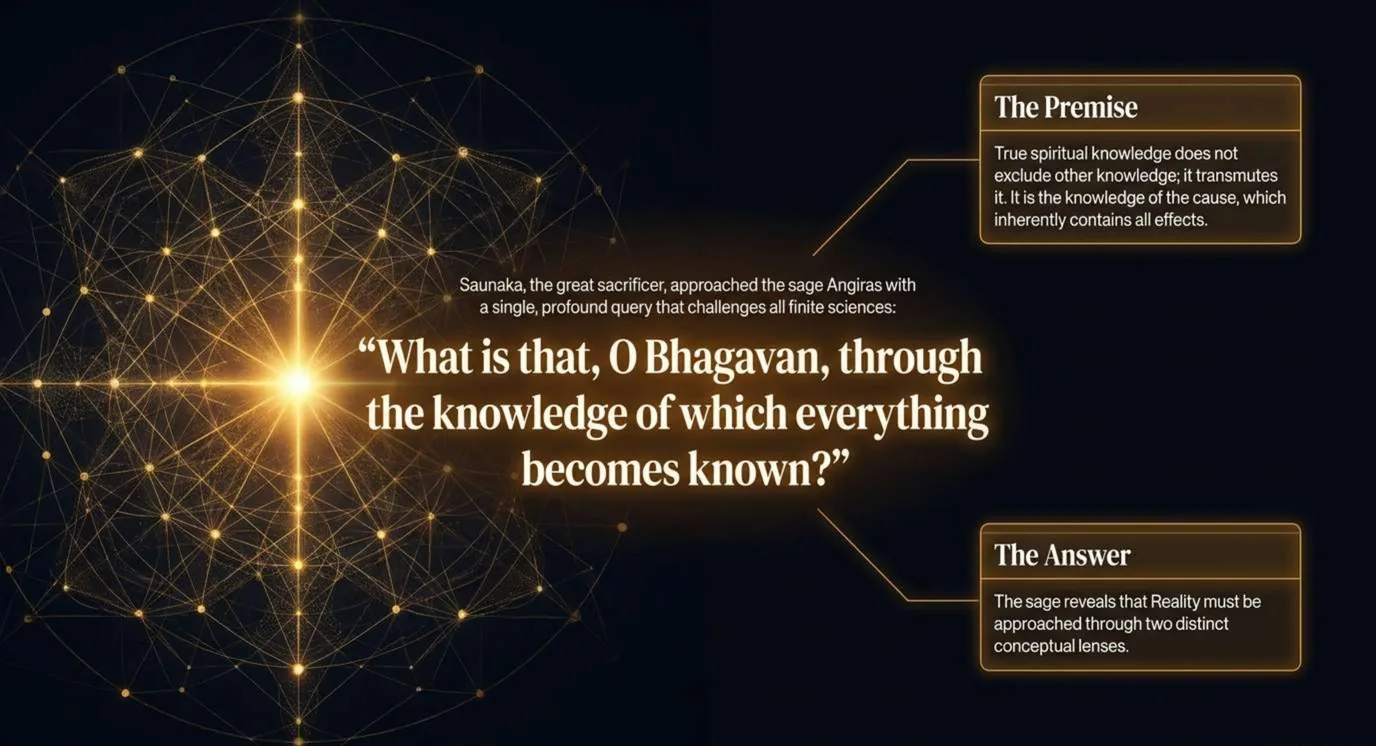
The teacher doesn’t hand back one answer. He says there are two kinds of knowing, and sets them side by side.
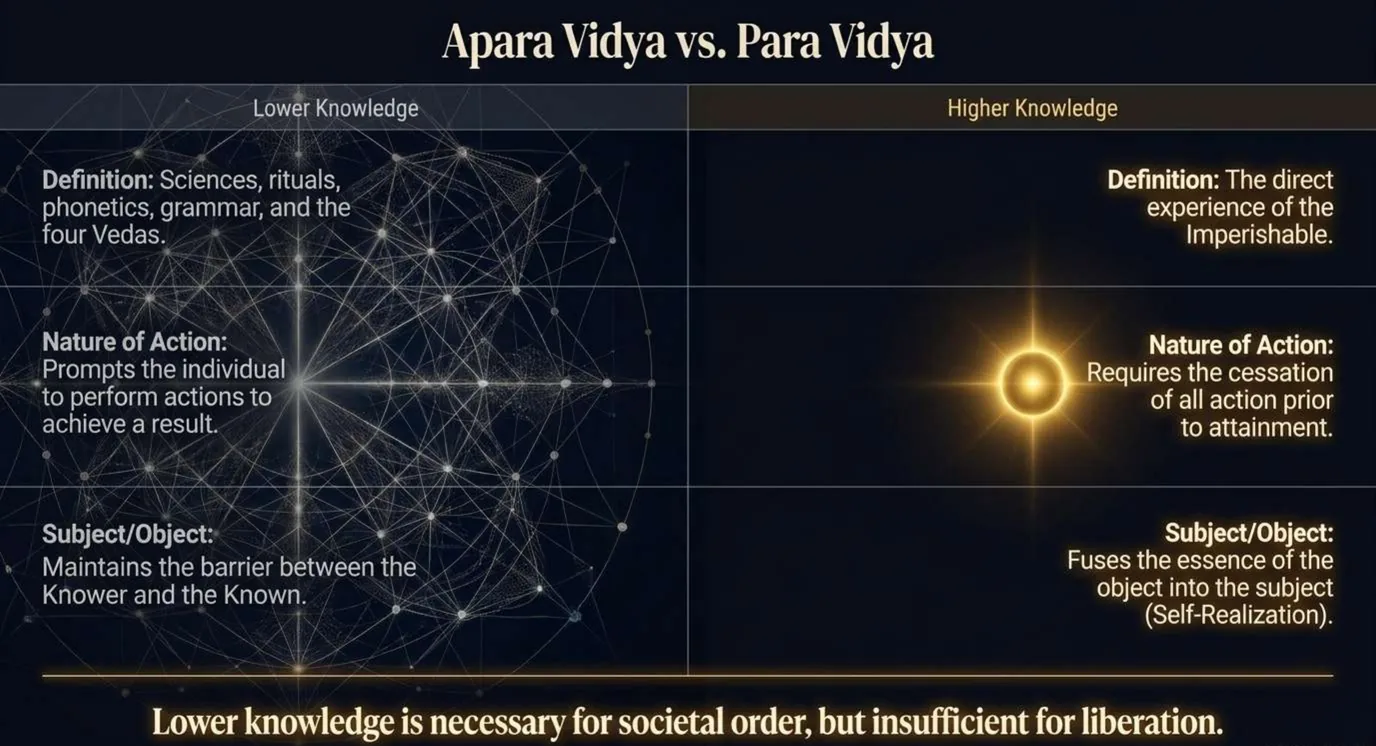
Apara Vidya keeps the knower and the known apart: the sciences, the rituals, the four Vedas. Para Vidya is the knowing of the Imperishable itself, with no gap left between the one who knows and what is known. The glossary holds the short version of both. Necessary for a working life. Not what his question was after.
Which of your questions can more information answer, and which can’t?
Source: Mundaka Upanishad 1.1.3–1.1.5
Debris doesn't clear itself by being told to.
So what does the clearing actually consist of? Sankaracharya gives it a deliberately unglamorous image: buried treasure, not lightning.
The Self isn't hiding — it's covered, the way a treasure is covered by the earth sitting on top of it. Nobody digs it up by standing over the spot and saying its name. Four things have to happen, in order, none of them optional:
A Guru who has already found the spot points to it exactly — not a general direction, a location.
Sravana+Hearing — attentively taking in the teaching directly from a qualified teacher, the first of the three classical steps toward realization. and Manana+Reflection — reasoning through the teaching until every doubt about it is personally resolved, the second of the three classical steps. — hearing the teaching, then reasoning through it until it's not just believed but actually understood.
Nididhyasana+Sustained, unbroken meditation on the truth already heard and reasoned through — the third classical step, where understanding is worn smooth into direct seeing. — sustained meditation, clearing away the specific obstacles Maya and old habit keep dropping back into the hole.
Direct realization. Reaching in and taking hold of what was, technically, always sitting right there.
Skip a step and the other three don't compensate. A perfect map with no digging finds nothing; digging with no map finds the wrong hole.
Where Step Four Actually Ends
Vivekachudamani names the far end of that fourth step directly: Nirvikalpa Samadhi+Literally “absorption without alteration” — the culmination of Sravana, Manana, and Nididhyasana, in which the distinction between knower and known dissolves entirely. Sits beyond Savikalpa Samadhi, the preceding stage in which that distinction, however subtle, still persists., absorption “without alteration.” Not a state layered on top of ordinary experience, but the point where the last seam between the one experiencing and the thing experienced gives out.
Existence-Knowledge-Bliss, realized directly rather than described. And a closing line worth sitting with rather than resolving: none but one's own self can remove this bondage — not the Guru who pointed, not the teaching that was heard, not even the meditation that dug. Every one of the first three steps only ever prepared the hand. The grasping was always going to have to be done by the one grasping.
Not all thinking is trying to win an argument.
The tradition names three kinds of logic. Only one of them goes anywhere.
| Tarka+Standard reasoning, debate, and analysis — useful, but it shifts every time a new fact arrives. | Kutarka+Fault-finding aimed at good intentions, twisted purely to win an argument — breeds paranoia, destruction, and ignorance. | Vitarka+Thought without the need to win anything — asking unanswerable questions like “Who am I?” that exhaust the ego and open onto Self-knowledge. |
|---|---|---|
| Standard reasoning, debate, analysis | Fault-finding aimed at good intentions, twisted to win | Thought without the need to win anything |
| Useful, but shifts with every new fact | Creates paranoia, destruction, ignorance | Asks what can't be settled — “Who am I?” |
| Normal logic | Wrong logic | Special logic |
⟳ Tip: turn your phone to landscape for a wider view of this table
“Who am I?” has no side to argue. That's exactly what lets it exhaust the ego instead of feeding it.
Jnanam bandhah+A Shiva Sutra: limited knowledge itself creates bondage — the instant something is called “known,” its living, changing range narrows to fit a fixed, past-based definition. — limited knowledge creates bondage.
The moment something gets labeled, the mind stops looking at it.
Reality stays in a state of constant, vast newness — until the ego reaches for a label. The instant something is called “known,” the range of what it could be shrinks to fit a rigid, past-based definition. That's the bondage: not ignorance, but a definition that stopped updating.
Vismayo yoga bhumikah+A Shiva Sutra: wonder is the foundation for union — knowledge held with amazement stays open; knowledge held as settled certainty closes the door to reality. — Wonder is the Foundation
Knowledge without wonder doesn't sharpen life — it dulls it. Saying “I know” closes a door. Looking at the same thing with amazement, known or unknown, keeps it open.
Traditional Source
The Shiva Sutra says limited knowledge binds. The Kena Upanishad says where that ends up when the object is the knower itself, and it puts it as a paradox. Not false modesty: the Self can never be an object, so any claim to have it is already a claim about something else. The Kena section below runs the same argument as a story.
He who thinks he knows It, knows It not. He who knows that he does not know It, knows It.
— Kena Upanishad 2.3SELF isn't handing you the answer. That would just be one more door closing.
The Veda maps this same shrinking as a five-step engine — The Root Diagnosis.
Every claim about reality gets built one of exactly two ways.
One climbs up from the senses. The other comes down from a source that was never theorized at all. Worth seeing plainly which one this tradition leans its weight on, and why, before anything downstream depends on it.
Senses → Mind → Intellect
Built upward by a limited instrument, checking itself as it goes. Useful, and constantly revised — Greek atoms became Rutherford's model became quantum theory, each true enough to work until the next correction arrived. Nothing wrong with the method. It simply can't finish, because the thing doing the measuring is inside what's being measured.
Perfect Source → Oral Tradition → Hearing
Not derived from anywhere below it; only received and passed on intact, teacher to student, for as long as the lineage has existed. Nothing left to revise, because nothing was ever theorized to begin with — only heard, and handed on unchanged.
This isn't a claim that thinking is worthless — it's a claim about scope. One path was built to handle a changing, external world, and does that well. The other was never trying to be a theory of anything. It's closer to a report from a source the theorizing was never going to reach on its own, no matter how many centuries it ran.
Path A has run into this limit from inside, too — see Angle Eleven for what physicists made of it, and how much of that holds up.
Where Path A Stands On Consciousness
Within Western philosophy and science there is no single answer, only a handful of standing positions. Each is a serious attempt, and each is argued over — the “hard problem” (Chalmers, 1995) is the name for why none has settled it.
Only the physical exists. Consciousness is produced by brain activity and ends when the brain does. The current mainstream.
Matter and consciousness are two different substances, neither reducible to the other. Descartes’s view.
Consciousness arises as a nonphysical property of sufficiently complex physical systems.
Consciousness is a function the brain performs — not a separate substance, and not tied to one kind of material.
Only consciousness is ultimately real. Matter is an appearance within it (vivarta), not its source.
The first four all begin with matter and ask where mind comes in, or whether it does. Advaita begins with consciousness and asks how matter comes to appear. That is a different starting point, not a fifth entry on the same menu — and, like the others, a position to test against what you find when you look.
Source: Chalmers, D. (1995). Facing up to the problem of consciousness. Journal of Consciousness Studies, 2(3).
The Bridge Between The Two Paths
Para and Apara Vidya already say that only direct self-knowledge reaches root ignorance. The Panchadasi adds how the handover happens, with two working names: paroksha, knowing through a medium, and aparoksha, knowing with no gap between knower and known. Not to be confused with Pratyaksha above, which is direct sense perception — aparoksha involves no senses at all.
Words, inference, a teacher’s report. Path B’s testimony begins here, and so does everything on this page.
In the Tenth Man, the passerby adds no fact. The man had every fact already. The sentence removes one mistake, and the knowing turns immediate at once.
The recognition itself is instant — nothing is built up to it. The preparation that clears the view is gradual; see Two Ways to Meditate.
The same split separates God from the individual in the Panchadasi: Ishvara knows everything immediately, as identical with Himself; the individual knows in fragments, through senses, one object at a time. The difference is not intelligence. It is whether a gap sits between knower and known.
This page is paroksha by construction — words about the hinge. Whether it becomes aparoksha is settled only in your own looking.
Source: the Panchadasi (Vidyaranya).
Why point at a text instead of just thinking this through?
Fair question. Two tools of knowing carry you through almost everything else in life. Neither was built to reach the one thing doing all the knowing.
The senses meeting an object. Deceivable — and it needs something to point at. The one doing the looking can't also be the thing looked at.
Smoke implies fire — reasoning from a shared mark to what it belongs to. Needs two things to compare. What has no second thing to compare against gives logic nothing to grip.
Words, taken as evidence. The only tool of the three that was never built to examine an object in the first place — which is exactly the shape of the gap it's used to fill here.
An eye lights up an entire room and can't see itself doing it. A candle can't illuminate the sun. That's the actual shape of the problem — not that the Self is hidden somewhere far off, but that it's the one thing perception and inference were never aimed at, because both require standing apart from what they examine, and there's no standing apart from this.
A mirror doesn't invent the face looking into it. It only clears what was fogging the glass.
Nothing below asks to be taken on faith instead of checked. Test it against what you actually find when you look — that's the only lab this ever ran in.
The Argument, In The Text's Own Words
The Kena Upanishad+One of the ten principal Upanishads, from the Sama Veda — a concise 34 verses across four sections, opening with the word "Kena?" ("By whom?"). opens with exactly this question, asked as a question rather than argued as a thesis: by whom does the mind think, the eye see, the ear hear, the breath breathe? Something is clearly directing all four. It's just never itself among the things being seen, heard, or thought.
Failed to burn a single blade of grass, placed in front by the mysterious Yaksha.
Failed to move that same blade of grass, an inch.
The Yaksha vanished before he could even ask. He alone had the humility to keep looking, and learned what the others didn't.
The gods had just won a great victory and credited their own power for it. The Yaksha — Brahman, unrecognized — was a test they failed until Indra, alone, stayed humble enough to keep asking. The lesson wasn't about strength. It was that the power behind every power is never the thing wielding it.
Then comes the part most retellings drop. Indra doesn’t reach the answer by force, and he doesn’t reason his way to it. With the Yaksha gone, Uma Haimavati+The goddess who appears in the Kena Upanishad after the Yaksha vanishes, and tells Indra the victory was Brahman’s. Haimavati means “of the Himalaya”; later tradition identifies her with Parvati, consort of Shiva. appears in the same sky and tells him whose victory it had really been: Brahman’s. Fire and Wind had already failed by trying to conquer it. What worked was staying present until the answer was given. The teacher in this story is the goddess, not the king — the Upanishad’s own version of the Function of Grace card in the Self-Enquiry section.
That which speech cannot reveal, but by which speech is revealed — know That alone to be Brahman, not what people worship as an object.
— Kena Upanishad 1.5Every verse in this section runs the same shape as this one line. Not a new claim — the oldest attestation of the one already made above.
The Kena’s paradox verse, 2.3 — whoever thinks they know It, doesn’t — is cited earlier, in The Bondage of “Knowing”.
Three grades of “real.” Most people only use two.
“What cancels a dream is waking up. Nothing has ever cancelled waking up.”
— the logic behind Satta Traya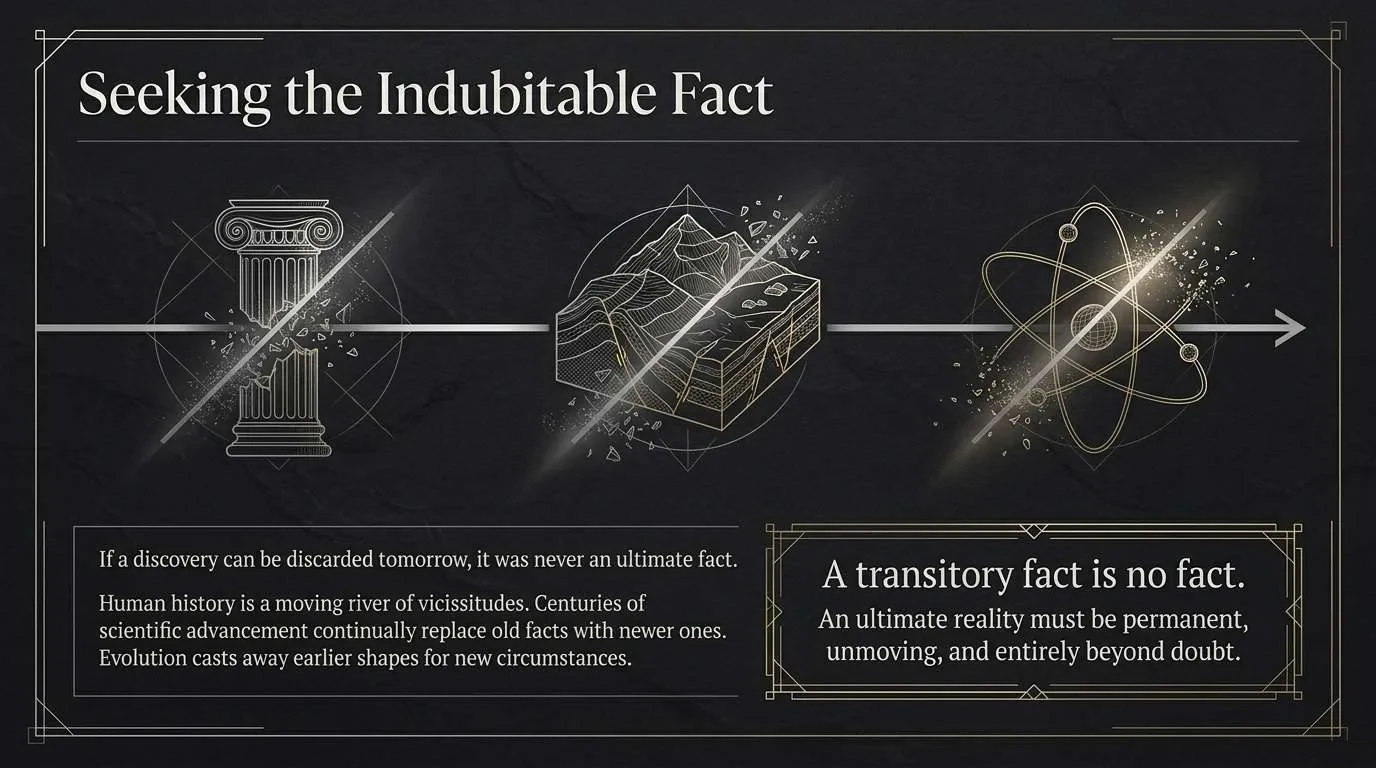
The same test, drawn as three things people lean on as settled: a column, the ground, an atom. Each is sliced by a bright diagonal because history and science keep replacing what was once final. The slide's one-line rule is the Satta Traya logic in miniature: a transitory fact is no fact. What can be discarded tomorrow was never the ultimate, so the ultimate has to be permanent, unmoving and beyond doubt.
A dream feels total while it is running. Waking up does not add anything to disprove it — it just turns out to have been resting on something steadier. Vedanta says the waking world you are in right now works the same way, one level down. Not fake. Not final either.
Advaita means “not two.” Not an observer here, a world there, and something ultimate beyond both — one field, with the lines drawn on top. Look for where the line between the one looking and the thing looked at actually sits.
Try it with two people. For A, A is the one looking and B is the thing looked at. For B, it is exactly reversed. Neither label belongs to the person; it belongs to the position. So who is the permanent object?
Dreams. Mistaking a rope for a snake in dim light. Real only for as long as the specific error lasts — gone the instant it's seen through.
Your body. Physics. Deadlines, traffic, the bus in the street. Shared and consistent — nobody is asked to disbelieve any of it.
What remains once every dream has ended and every transaction has run its course. Never cancelled — because there's no further waking up left to do.
Awakening is not a trip to a fourth location. It's your primary sense of “real” sliding one level down — from the transactional to the absolute — while the transactional keeps running exactly as before, just no longer mistaken for the base.
If Reality Is One, How Does It Look Like Many?
Three answers have been proposed. Two run into the same wall.
A potter shaping clay into a pot. Fails: it puts God and world on separate sides, which means the ground of everything isn't actually one.
Milk becoming yogurt. Fails: if the changeless ground actually changes, it was never changeless to begin with.
A rope, glimpsed in dim light, looking like a snake. The rope never became anything. The One appears as the many without ever ceasing to be one.
This is the specific mechanism behind the earlier line — you are not the projection, but the screen. The screen was never at risk of becoming the movie.
“What is seen is illusion. That through which it is seen, is Reality.”
— a formulation found across the Nisargadatta lineageSame Space. Different Container.
Put a clay pot down in an open field. Space fills the pot exactly as it fills everything around it — the same, undivided space, with a boundary drawn on top by the pot alone. Break the pot. The space inside doesn't travel anywhere to rejoin the whole. It just stops being fenced.
A Upadhi+A limiting adjunct — something that appears to divide or qualify a substance without actually changing what that substance is. The pot doesn't add anything to space; it only appears to enclose some of it. works the same way on consciousness. It adds nothing. It only appears to enclose.
Brahman+The absolute, non-dual ground of everything — not a being among beings, but what all beings are made of. + cosmic Upadhi = Ishvara+Brahman viewed through the cosmic Upadhi — omniscient, omnipotent, the inferred cause, sustainer, and dissolver of the universe. · Brahman+The absolute, non-dual ground of everything — not a being among beings, but what all beings are made of. + individual Upadhi = Jiva+Brahman viewed through an individual Upadhi — the limited, embodied sense of self that experiences itself as doer and enjoyer.
Not two substances. One substance, two containers. Realization is the pot breaking — not consciousness travelling anywhere to become whole.
How The One Becomes Many: Three Images From The Mundaka
The Mundaka answers the Vivartavada question with three pictures: a spider sending out a thread and drawing it back in, plants growing from the earth, hair growing on a living body. In each, what appears is made of what produces it. Nothing is brought in from outside.
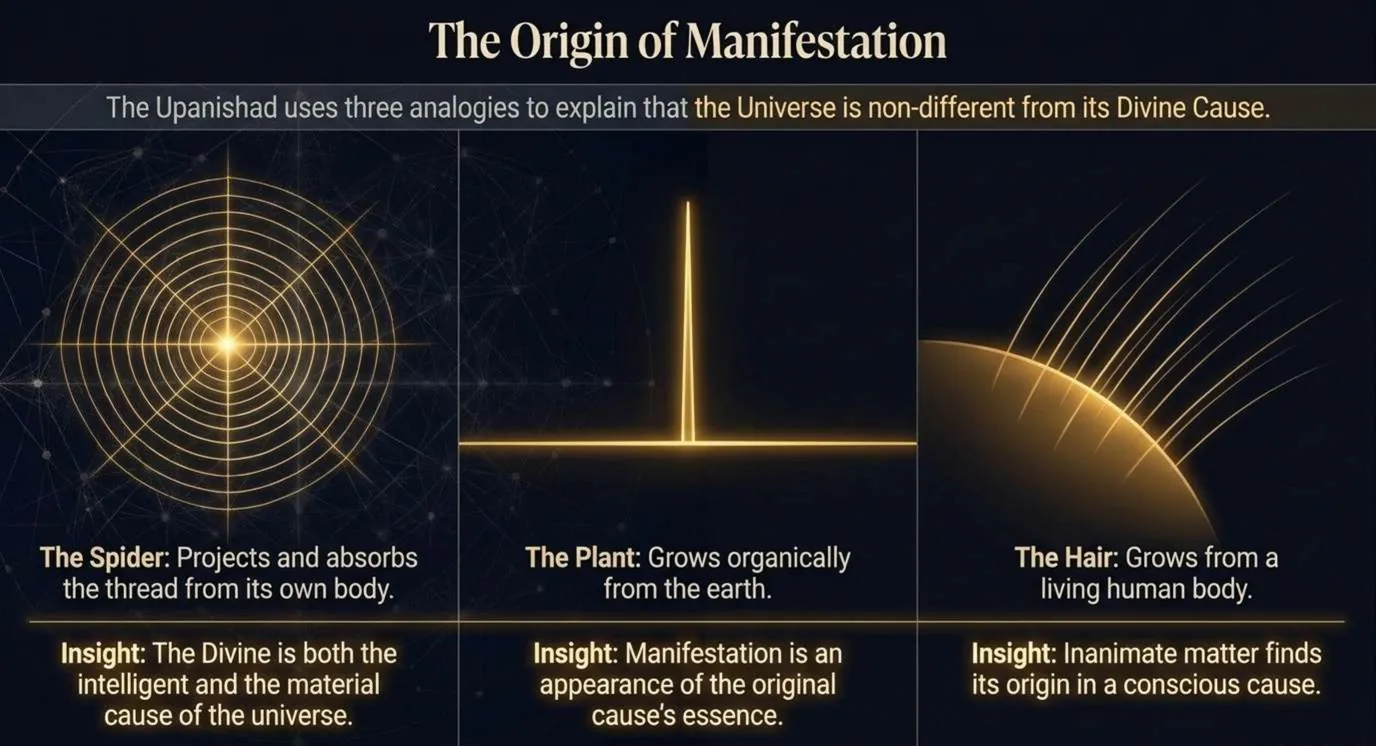
It spins the thread from its own body and takes it back in. The cause supplies the intent and the material.
It grows out of the earth and is made of it. The shoot has no substance the soil doesn’t.
Hair is inert, and it grows from something alive. The conscious is the source of the unconscious, not the reverse.
Honest limit: read alone, these three sound like the cause changing into the world, which is the Parinamavada answer above. Advaita reads them as pointing at non-difference: the effect has no existence apart from its cause, and the cause is not altered.
Where does the thread stop and the spider begin?
Source: Mundaka Upanishad 1.1.7
One More Angle: Are Existence And Consciousness Even Two Things?
If two properties were genuinely separate, it should be possible to find one without the other — somewhere, at least once. Fire is never found without heat, and never found without light, not because heat and light merely tend to travel together, but because there is no third thing called “fire” standing apart from them for them to be properties of. Run the same test on Satyam+Sanskrit for “existence” or “truth” — one of the three faces of Sat-Chit-Ananda. and Jnanam+Sanskrit for “knowledge” or “consciousness” — one of the three faces of Sat-Chit-Ananda..
A rock is offered as the example — it exists, and (presumably) knows nothing. But that rock is only ever encountered as an appearance in someone's awareness. An existence nobody is conscious of, in any sense, has never actually been produced — only assumed.
A thought is aware, but does it not exist while it's happening? The instant it is known, it is — if only for a moment, as a thought. No case of knowing has ever been produced apart from something, however fleeting, that is.
Two things experienced together with zero exceptions, ever, are not two things that happen to agree. They are one thing under two names. What looked like a gap between “the world that is” and “the self that knows” was the same Upadhi at work again — a Rupa drawn across a single, undivided reality, mistaken for a border.
The Chandogya reaches the same place by the opposite road. Uddalaka teaches that in the beginning there was Existence alone, one without a second — and that it saw, and became many (see the argument from design). Shankara’s point: a quality added to something with no second and no parts would break that very description. So consciousness cannot be something Existence has. It has to be what Existence is.
The Method, Not Just The Map
The Master Matrix already maps the five koshas — what each sheath is made of, and what it corresponds to elsewhere. This is the other half: the actual procedure for using that map to locate what none of the sheaths are. The tool is Neti Neti+Sanskrit for “not this, not this” — the Upanishadic method of negation, systematically ruling out every object of experience as a candidate for the true Self, until only the un-negatable witness remains. — not this, not this — applied as a four-question test to each layer in turn:
Is it an object? · Is it composite? · Does it change? · Is it insentient or dependent?
A “yes” to any one of these disqualifies the layer as the true Subject — the one doing the looking can't also be a thing that's looked at, made of parts, subject to change, or borrowing its light from elsewhere. Run against all five sheaths in turn:
Tap to expand — run the test against all five sheaths
Annamaya+The "food sheath" — the physical body itself, the most outer and dense of the five koshas.
The Physical Layer
I am not this physical body. I am the conscious witness of this body. Neti, Neti.
Which Cells Are You?
The red cells in your blood were not here a few months ago. The lining of the gut turns over in days, skin in weeks — most of the body is rebuilt, steadily, from what was eaten. The matter called “my body” is a river passing through a shape.
Which of those cells was you? Which one left?
Annamaya names exactly this: a body made of food, returning to food.
Why Losing Half Doesn't Make You Half
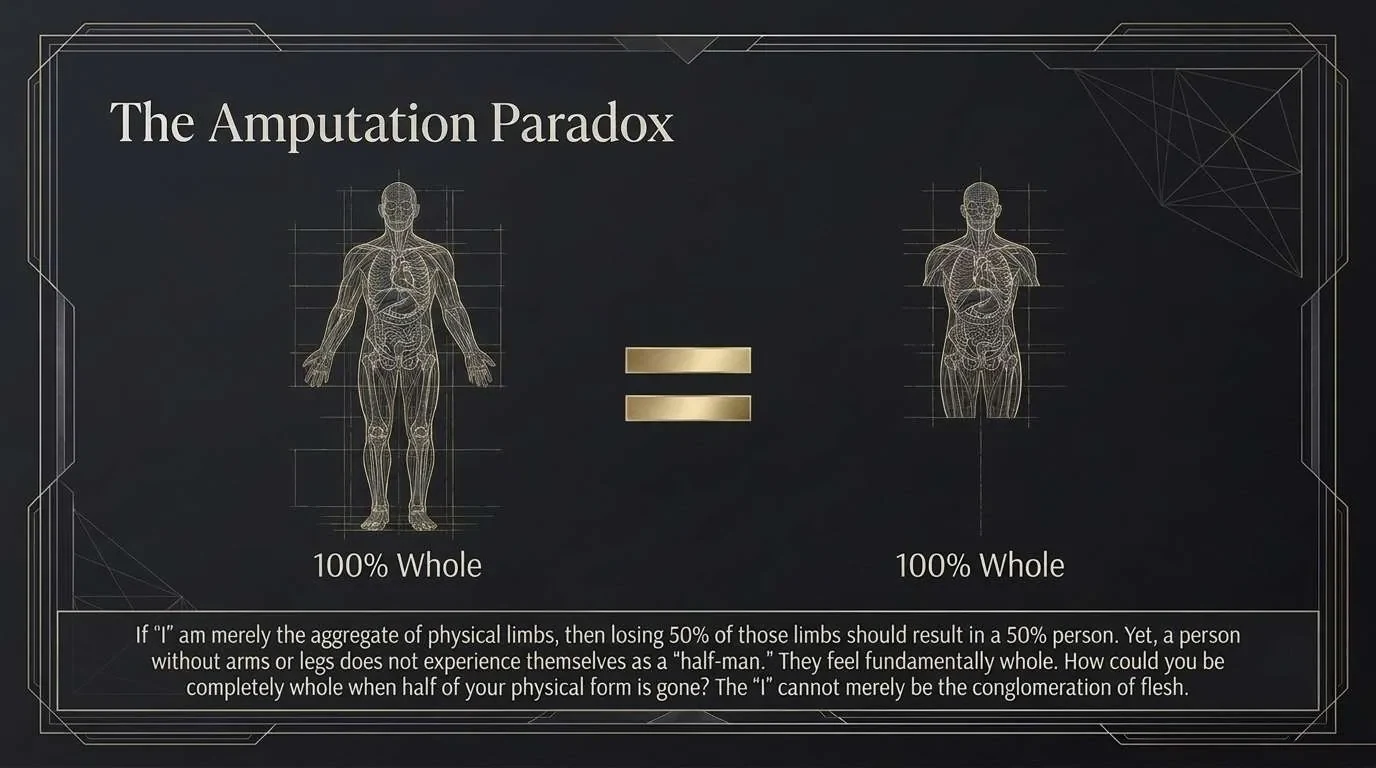
Run the arithmetic the picture runs. If “I” were the sum of limbs and organs, losing half of them would leave half a person. But someone who has lost arms or legs does not feel like a half-person, and the two figures carry the same label: 100% whole. The felt “I” is not measured in flesh. That is the Annamaya test above, run on a case anyone can check against the people they know.
Honest limit: this shows the sense of being whole is not proportional to body mass. It does not show what the “I” is. Psychology would add memory, narrative and the brain’s body map to the account.
Pranamaya+The "breath/vital-energy sheath" — one layer in from the physical body: the layer of life-force, circulation, and breath that animates it.
The Vital-Energy Layer
I am not this vital energy or the doer. I am the silent consciousness that illumines it. Neti, Neti.
Manomaya+The "mind sheath" — the layer of thought, emotion, and sensory processing; where most people spend nearly all their time without noticing it's a layer at all.
The Mental Layer
I am not this mind, thoughts, or emotions. I am the changeless screen on which they play. Neti, Neti.
Vijnanamaya+The "wisdom/intellect sheath" — the layer of discernment and insight, one step subtler than ordinary thought.
The Intellect Layer
I am not this intellect or ego. I am the pure consciousness whose light makes it appear conscious. Neti, Neti.
Anandamaya+The "bliss sheath" — the innermost and subtlest of the five, closer to the Self than to the intellect. Not a mood you generate, but what's left when nothing else is being generated.
The Bliss Layer
I am not this state of peace. I am the witness of this peace. Neti, Neti.
Five negations, one remainder. What's left when every object, every composite, every changing and insentient thing has been cut away isn't a sixth, subtler object — it's the un-objectifiable Subject the whole procedure was run to isolate. Not a new sheath found. The search for one, ending.
What Exactly Is Left Over
Sakshin+The Witness — the non-intentional, formless awareness that illuminates every mental state without ever itself becoming an object of knowledge. — The Witness
Worth being precise about what this word actually names, since “witness” has already appeared quietly, five times, in the checklist above. It doesn't mean the reflective habit of noticing your own thoughts — that habit is real, useful, and still just Buddhi, the intellect, watching Manas, the mind. Two parts of the same instrument, both already ruled out above. The Sakshin is something else: not a better observer, but the light every observer, including that reflective one, borrows to see anything at all.
Psychology notices, correctly, that self-observation changes over a lifetime — a child's isn't an adult's isn't a therapist's. It's filtered through identity-protection and old belief, and whoever's doing the noticing can't fully step outside the very consciousness being examined. That observer looks constructed, biased, and regressive: who, after all, is watching the watcher?
Every word of it is true of the reflective mind, which is exactly why it was already negated above. The Sakshin was never a more careful version of that observer. It doesn't perform an act of observing at all — it's simply what makes any observing, careful or careless, lit up in the first place.
This is also where the regress the objection worries about actually stops. Three competing answers exist for how any cognition gets known at all:
Every cognition needs a higher-order one to know it happened. Regresses infinitely — nothing could ever be known, since the chain of witnesses never terminates.
A cognition reveals itself and its object at once. Elides the witness entirely — but asks a knife to cut itself, subject and object in one same stroke.
The Witness doesn't know objects the way Buddhi does — it isn't an act at all. It simply reveals, the way a lit room needs no second lamp to confirm the first one is on. No regress, because nothing here is a cognition needing a further cognition to certify it.
The developmental observer really does change with age, training, and bias — the objection is sound, as far as it goes. It just goes exactly as far as the mind. What it can't touch is the one thing that was never a stage of anything: the light every stage, including the most reflective one yet, was already borrowing to see by.
Why “Witness” Is A Role
Why call the Self a witness at all? Because of the Upadhi+A limiting adjunct — something that appears to divide or qualify a substance without actually changing what that substance is. The pot doesn't add anything to space; it only appears to enclose some of it. it is being looked at through. Go back to the pot and the space. Space is only called “the space inside the pot” while the pot is there. The name belongs to the pot, not to space. Sakshin works the same way: consciousness gets this name only in relation to Buddhi, whose movements it lights up.
Looked at through Buddhi, consciousness is called Sakshin: the one that lights up every thought, feeling and perception.
No separate object is left to be lit up, so there is no one “lighting it up”. The role was always defined by the pair.
Pure consciousness, never made of subject or object. Nothing is added to it and nothing is lost. The role was a way of pointing at it, never a part of it.
Sakshin and Atman are not two things. Sakshin is Atman named by its role; Atman is Sakshin named by what it is.
Role And Nature
“Witness” is a relational name. It points to the Self as seen from inside the subject–object split — one consciousness, called by the role it appears to play while there is a seen.
When observer and observed resolve into one, the witness is not lost or left behind. The role dissolves back into Atman, which is pure consciousness and was never defined by subject or object to begin with. It needed no object to be itself.
Not what is left after the witness — what the witness was always pointing at.
And the sheaths, once this is seen? See The Burnt Cloth.
The Same Split, As Two Birds
The Mundaka draws the witness as a picture. Two birds on one tree. One eats the fruit, sweet and bitter, and carries the grief that comes with it. The other doesn’t eat. It looks on, untouched.
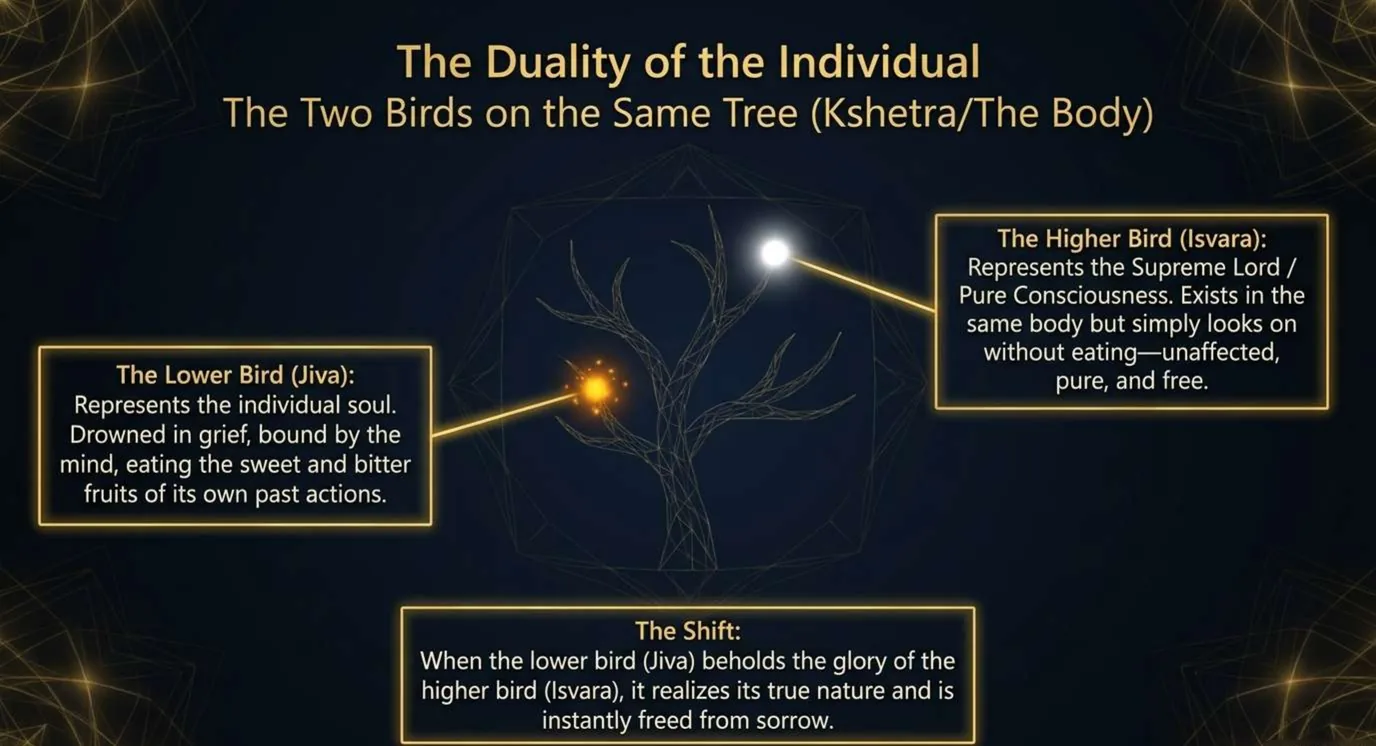
In the verse, the eating bird grieves until it sees the other and sees how great it is. Then the grief drops. It isn’t told to become the watcher. It sees that the watcher was never somewhere else. The short version is in Parables.
Which bird is reading this sentence?
Source: Mundaka Upanishad 3.1.1–2
Where The Feeling Of “Me” Actually Comes From
Chidābhāsa+“Reflection of consciousness” — the borrowed appearance of awareness in the intellect, mistaken for consciousness itself, the way sunlight caught in water is mistaken for a second sun. — The Reflection Mechanism
The Fourfold Mind named Ahamkara as the part that stamps “me” onto experience, without explaining the mechanics of how. This is the mechanics. Sunlight falling on still water throws a second, wavering image of the sun onto the wall — not a second sun, just the one sun's light, caught and bent by a reflective surface. The Sakshin does the same thing to Buddhi, the sattva-lucid, mirror-like part of the intellect. The reflection is called Chidabhasa, and the entire felt sense of being a located, limited someone is that reflection, mistaken for the light behind it.
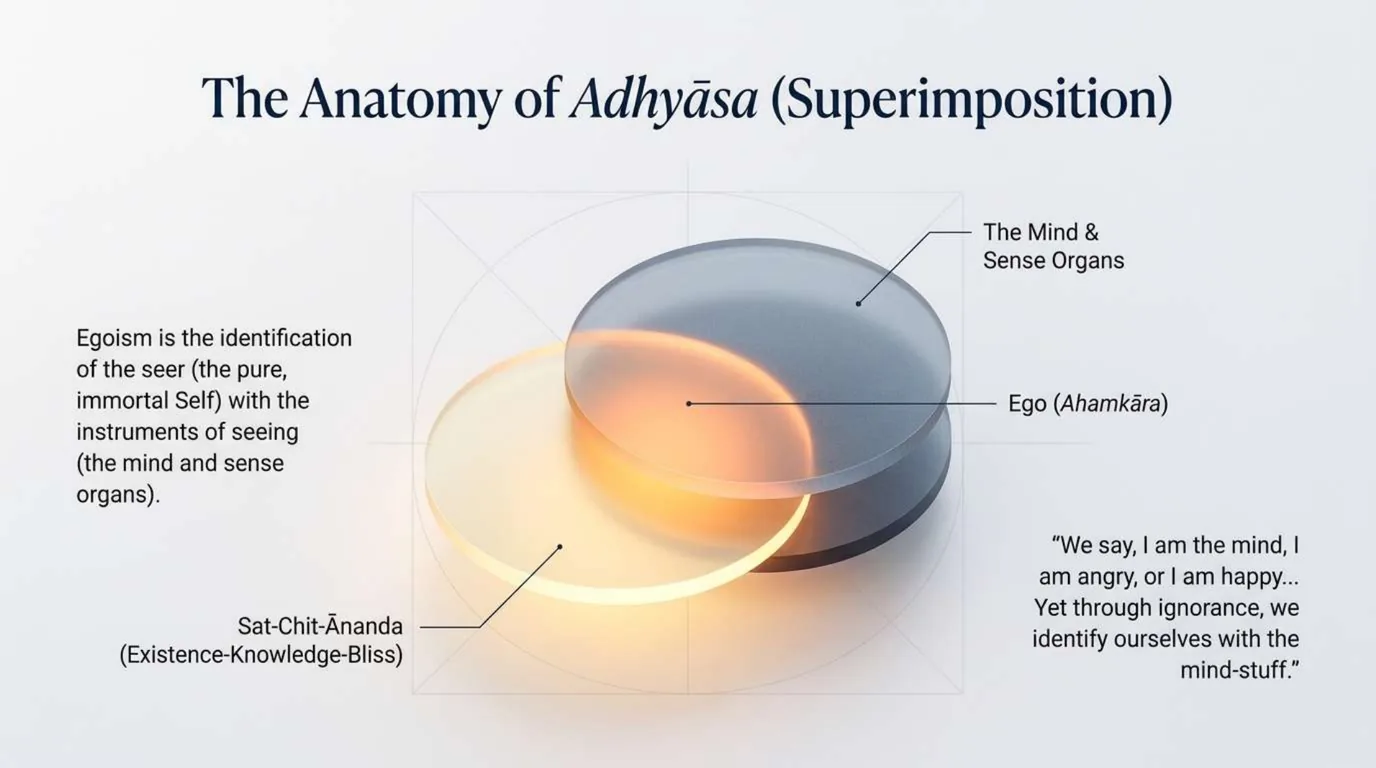
Sakshin: all-pervasive, non-intentional, like ambient light.
Buddhi: lucid, reflective, made of subtle sattva.
Chidabhasa: the borrowed glow, appearing as a located center.
The reflection is taken for the sun. “I am aware” becomes “I, this body-mind, am aware.”
Which is also why the mistake is so easy to make and so hard to shake by force of will alone: the reflection isn't fake light. It's real sunlight, genuinely present in the water. The only error is where the boundary of “the sun” gets drawn.
The Error Runs Both Ways
Light goes out. “My mind is sharp.” “My body is alive.” The sheaths borrow awareness and call it their own.
Weight comes back. “I am hungry.” “I am sad.” “I am getting old.” The sheaths’ states get posted onto what they never touched.
One loan out, one debt back. Which direction did you catch today?
The claim that “I am aware” and “I, this body-mind, am aware” are two different things, one borrowed from the other, has a clinical echo. What feels like one seamless sense of “mine” is at least three separable signals: that I am doing this, that I own this, that this is happening inside me. In anarchic hand syndrome, ownership and location survive while the sense of authoring the movement drops out — the hand acts, and the patient reports it as theirs but not as something they're doing. In thought insertion, a symptom of schizophrenia, even ownership can go, leaving only the sense that the thought is occurring somewhere inside — not from them, not theirs, but still there.
Stated plainly: this shows the ordinary sense of “I” is built from separable parts, which is what Chidabhasa says. It doesn't show that a Sakshin lies underneath the parts — that's this page's claim, not the clinic's.
When The Mirror Is Clean
A reflection depends on the surface. Muddy water throws back a smear of the sun. Still, clear water throws back nearly all of it. The Mundaka puts the Self inside a golden sheath, partless and stainless, the light of lights. The commentary reads the sheath as the intellect.
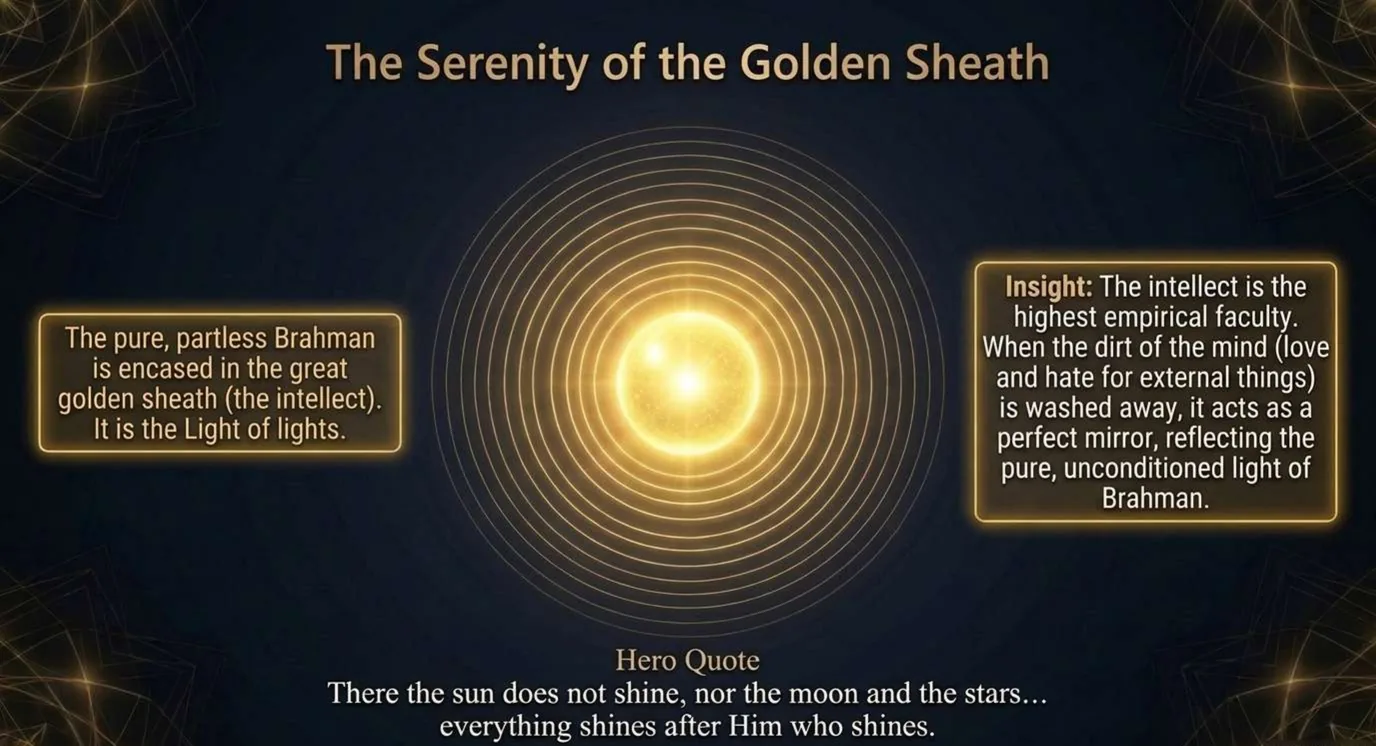
What clouds the glass is pull toward things and push away from them. Wash those out and the intellect stops colouring what it reflects. The verse then turns the picture over: no sun, moon, star or flame lights that. They shine because it does.
Honest limit: the Yoga Sutras go one step past this. Even the clean glass is let go at the end. See Even the Clean Glass.
What is stirring the water right now?
Source: Mundaka Upanishad 2.2.9–10
Zooming Out
Karana+Sanskrit for “causal” — the innermost, seed-state body, corresponding to the Anandamaya kosha., Sukshma+Sanskrit for “subtle” — the middle body of thought, feeling, and energy, spanning the Vijnanamaya, Manomaya, and Pranamaya koshas., Sthula+Sanskrit for “gross” — the outermost, physical body, corresponding to the Annamaya kosha. — the Three Bodies
The five koshas above aren't five separate things stacked in a row. They cluster into three bodies.
The innermost. The seed-state everything else grows from.
The middle. Where thought, feeling, and energy move.
The outermost. What can be touched, weighed, seen in a mirror.
In this framework, disturbance is said to move from the inside out — a thought or a knot of feeling in the subtle body, long before anything reaches the gross body at all. By the time the body is signaling that something's wrong, the traditional view holds that the disturbance has usually been circulating for a while.
One More Image
The Upanishads draw the same map as a wheel: worlds, senses, minds, every self, all fixed in the Self like spokes in the hub of a chariot wheel. A spoke can be replaced and the wheel still turns. Without the hub there is no wheel to speak of.
Which of the things you call “me” is a spoke?
Source: Brihadaranyaka Upanishad
Where Does “Out There” Begin?
To say a tree stands outside you, something in you has to reach the tree. If knowing stayed locked behind the skin, “out there” could never be said at all. Vedanta reads perception that way: not a camera recording a room, but consciousness meeting consciousness.
At King Janaka’s court, Yajnavalkya is asked about the inner controller, the Antaryami+Sanskrit for “inner controller” — the Self dwelling within every thing, unknown to it, whose body each thing is (Brihadaranyaka 3.7).. He walks through earth, water, fire, breath, eye, mind, naming in each the one who dwells within it and is unknown to it. Every round closes the same way: this is your Self, the inner controller, the immortal. Inside and outside, on this reading, are positions the mind takes, not two places.
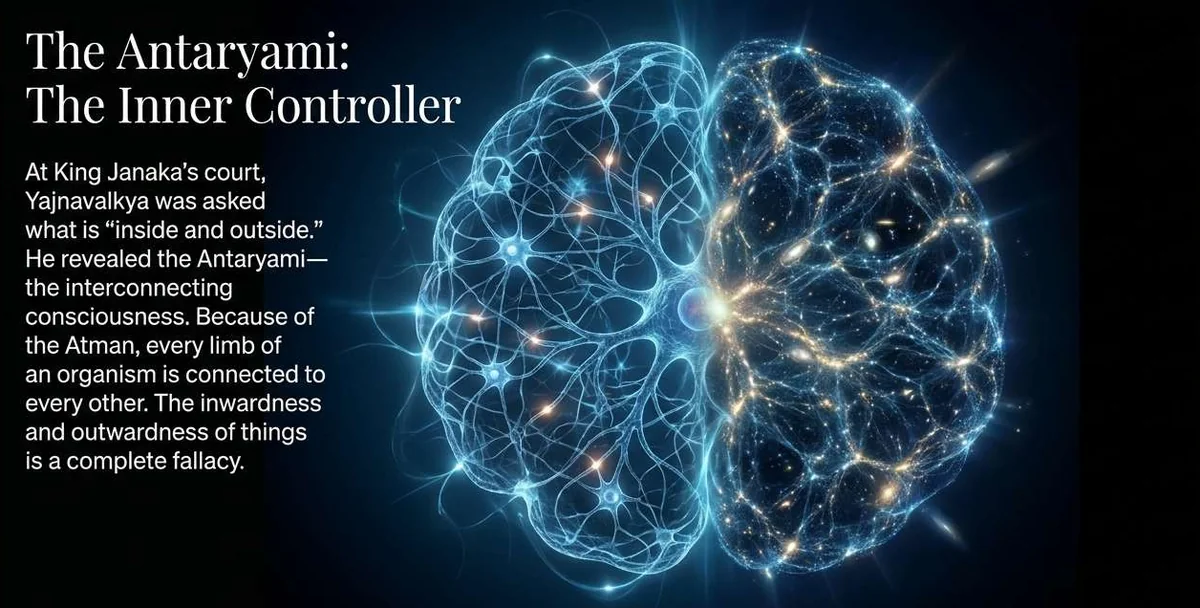
Where, in the seeing, does “inside” stop?
Source: Brihadaranyaka Upanishad 3.7
The longer version of this question, with pictures, is in Where Does “Out There” Begin? under Before the Ego, the Field.
The Equation of Instruction
At some point a teacher in this tradition says a sentence that sounds absurd on its face: “Tat Tvam Asi+Sanskrit for “That thou art” — one of the four traditional Mahavakyas, or “great sentences,” equating the individual with the absolute. Resolved not by literal reading but by the method of implied meaning. — That thou art.” Told to a king, “you are a beggar” would just be false. This isn't that kind of sentence.
Word by word: Tat — “That” + Tvam — “You,” or in the older phrasing “Thou” + Asi — “Are,” or “Art” — in plain English: “You Are That”, same sentence as the older “Thou Art That.”
‘That’ — Ishvara+Brahman viewed through the cosmic Upadhi — omniscient, omnipotent, the inferred cause, sustainer, and dissolver of the universe.
Omniscient. Omnipotent. Cause of the cosmos. Spoken of at a distance.
‘Thou’ — Jiva+Brahman viewed through an individual Upadhi — the limited, embodied sense of self that experiences itself as doer and enjoyer.
Knows little. Powerless. An effect within the cosmos. Immediate — the one reading this sentence.
Same move as the pot and the space inside it, above. Set aside what conflicts — creatorship on one side, limitation on the other — and what's left on both sides is identical.
set aside creatorship · set aside limitation · what remains is one, on both sides
One of Four
Tat Tvam Asi has three companions, one from each Veda. Four sentences, one recognition, said from four positions.
“Consciousness is Brahman.” Aitareya Upanishad, Rig Veda.
“I am Brahman.” Brihadaranyaka Upanishad, Yajur Veda.
“That thou art.” Chandogya Upanishad, Sama Veda.
“This Self is Brahman.” Mandukya Upanishad, Atharva Veda.
None of the four asks to be believed. Each is a sentence to test against whatever is reading it.
The sentence was never asking you to become something you aren't. Four syllables, pointing at what's left once both containers are set down — the same recognition the Framework’s Aham Brahmasmi arrives at from the individual's side.
Same Fire, Different Sparks
The Mundaka puts the equation as a picture. From a blazing fire, sparks of the same kind fly out in thousands. From the Imperishable, beings of every kind arise, and go back into it.
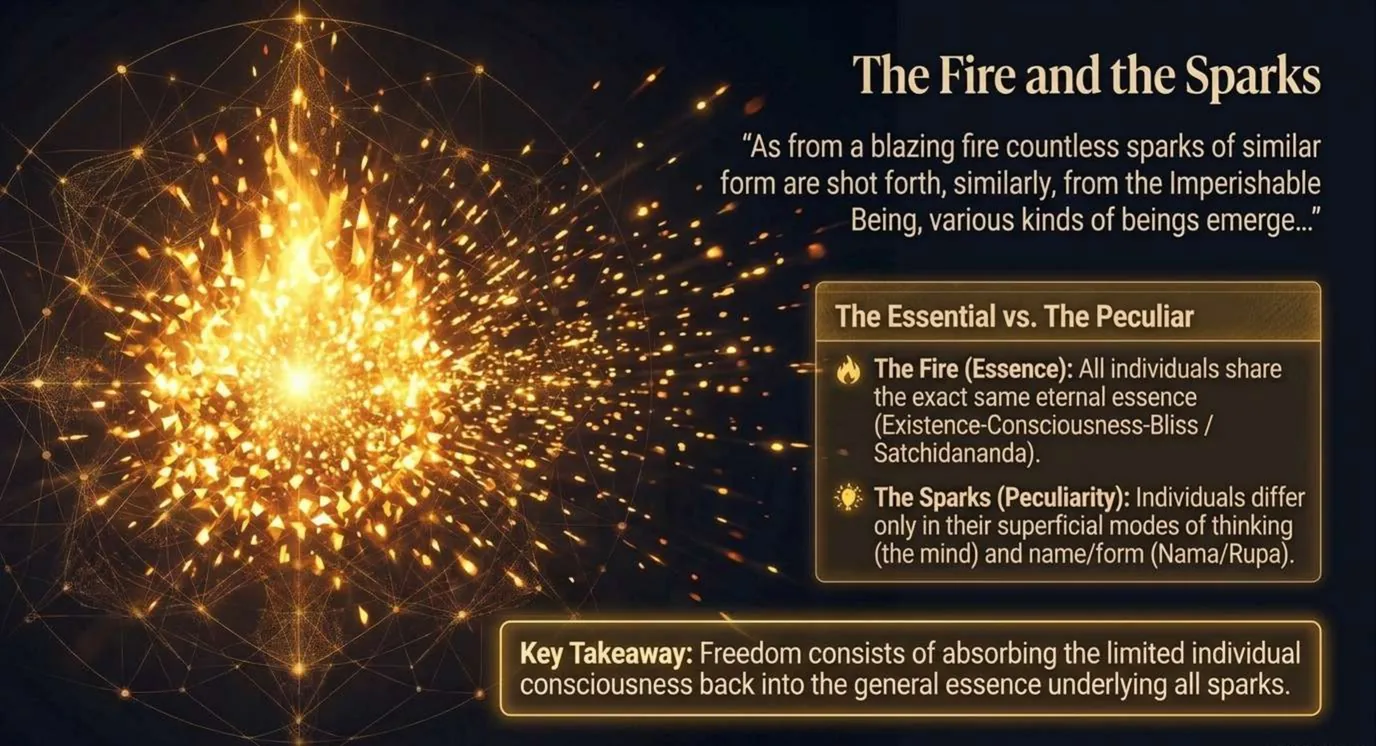
Look at what differs between sparks: size, path, how long each one glows. Look at what doesn’t: it is the same fire. Individuals differ in how their minds move and in name and form. What is underneath is the same in all of them.
Take away the path and the glow. What is left of the spark that isn’t fire?
Source: Mundaka Upanishad 2.1.1
Vedanta · The Measure and the Veil
Maya
The most translated word on this page, and the least understood.
Tat Tvam Asi, above, ends on a recognition: set aside creatorship and limitation, and what is left is one. That leaves the obvious question of why it ever looked like two. The rope and the snake in Beneath the Screen gave the picture, and the three-answers card gave the theory. Maya is the tradition’s word for the working part, and this is where the page keeps everything it says about it.
“Illusion” is the one-word answer everyone has heard. The cards below take the word apart in the order a question would: why a complete reality allows it, how it works, what it produces in a running life, what the word itself measures, how different schools use it, and what it can and cannot be called. Then the trap it sets in an ordinary day, and the places elsewhere on the page where it turns up.
The Question Vivartavada Doesn't Answer
Vivartavada, above, explains how the one appears as many without ever changing. It doesn't explain why a complete, lacking-nothing ground would bother appearing as anything at all. If God is already whole, the question isn't rhetorical — it deserves an actual answer.
The traditional answer: not lack, but generosity. A complete being doesn't create souls to fill a gap in itself — it creates them to share a bliss it already has in full, the way a parent doesn't have a child out of loneliness. And that bliss can only ever be shared, never installed, because it's inseparable from love, and love is mechanically impossible without a real choice behind it. A being incapable of choosing otherwise isn't loving — it's executing.
If God is complete, why create a world where souls suffer, forget, and grope around in the dark?
A real alternative to God has to feel genuinely attractive, or turning it down proves nothing. Maya is that alternative — convincing enough to make refusing it an actual act of love, not a formality.
Not cruelty, and not a mistake. The friction is what makes the return a real return — a story with no possible other ending isn't a story a soul can actually choose its way into.
Which is also the answer to why this page keeps saying “invitation,” never “requirement.” A requirement doesn't need Maya to test it. An invitation does — otherwise there was never anything to accept.
The Mechanism Necessity Doesn't Name
The Necessity of Maya, above, explains why a complete reality would allow something like this to operate at all. It doesn't explain how one undivided ground manages to look like a separate, crowded world — for everyone, at every single moment, without a seam showing. The tradition names two operations doing that work, always paired, never one running without the other.
Hides the ground itself. Not a distortion of what's there — a plain absence of seeing it, the way darkness doesn't disfigure a rope, it just keeps it from being seen at all.
Fills the space Avarana clears. Once the rope can't be seen as a rope, something still has to be seen — Vikshepa is what supplies the snake.
Same mechanism the rope-and-snake illustration already used without naming its two halves. Avarana is the failure to see the rope. Vikshepa is the snake that gets seen in its place. Neither runs alone — a veil with nothing projected onto it would just be blankness, and a projection with nothing veiled underneath would have nothing to disguise.
Vikshepa, Running
Vikshepa doesn't project on its own. It needs Rajas+One of the three Gunas — the quality of energy, passion, and ceaseless movement. In balance: motivation, creativity, sustained effort. Out of balance: restlessness, anxiety, and desire-driven action. The indispensable bridge between Tamas and Sattva — without Rajas, nothing moves. to power it — the guna of motion supplying the engine, Vikshepa supplying the direction. Once running, the tradition doesn't describe the output as one generic "world." It names specific pulls the projection keeps generating: wanting, aversion, acquisitiveness, self-inflation, resentment, the sense of being a separate doer, and envy of what that doer lacks. None of these are separate malfunctions to fix one by one — they're the same engine's exhaust, read seven different ways.
Bondage, in this account, isn't a sentence handed down. It's what a running engine produces by default, for as long as nothing questions who's driving it.
What the Word Measures
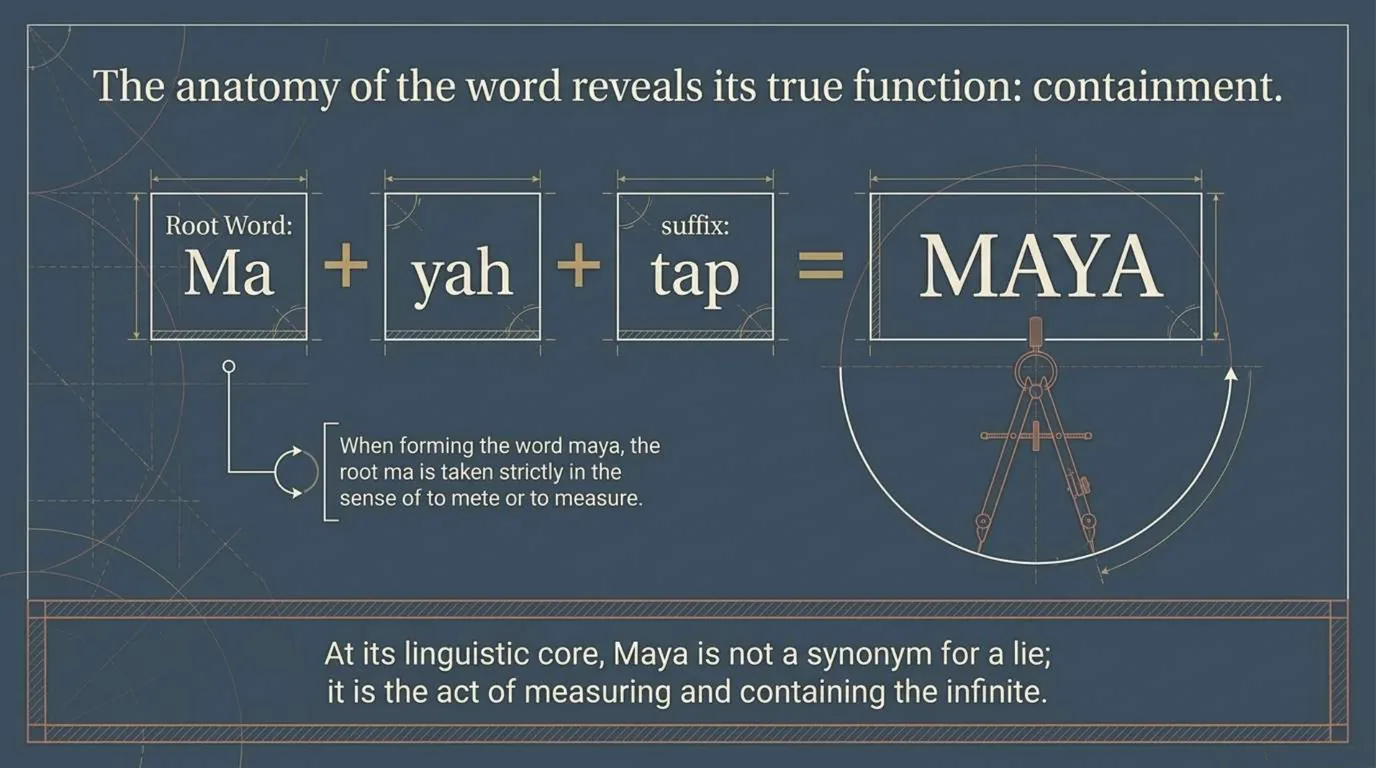
“Illusion” is the translation that stuck. The root under Maya is ma: to measure, to mete out. Read that way, Maya is less a lie than a ruler laid across something with no edges.
To measure is to draw edges. Edges give a thing a size, a shape, a name. None of that is added to the thing itself. It is laid across it.
What is the last thing you measured yourself by, and who was holding the ruler?
Honest limit: ma carries other senses in Sanskrit too, including binding and negation, and Advaita does read Maya as ignorance. This is where the word starts, not all the tradition does with it.
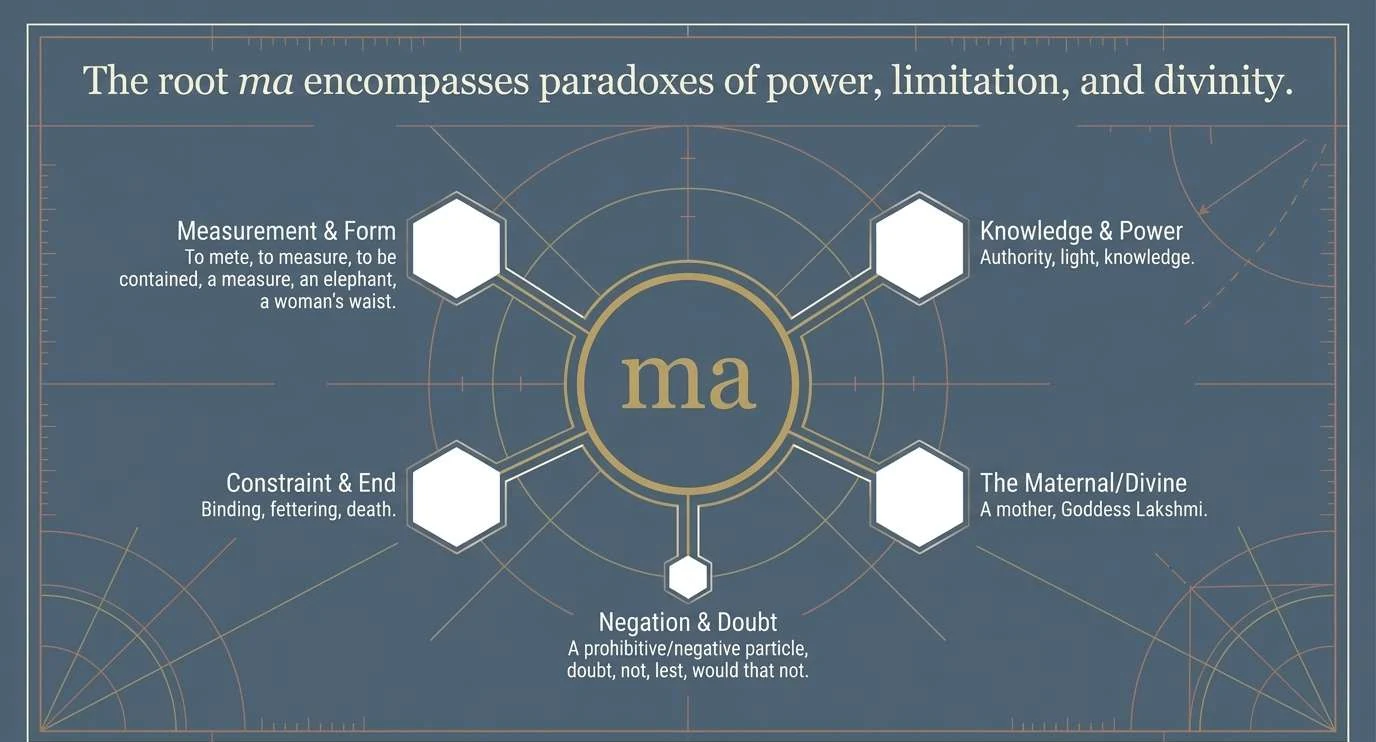
Traditional Source
Advaita Vedanta on Maya.
One Word, Three Different Jobs
“Maya” doesn't mean the same thing in every school that uses it. The word is shared; the metaphysics underneath it isn't. Everything on this page follows Advaita's account — the other two are here for contrast, not as equally-weighted alternatives.
| School | What Maya Is | Nature of the World & God |
|---|---|---|
| Advaita Vedanta | Beginningless ignorance, operating through Avarana and Vikshepa above. | Makes Brahman appear as the world. The world is real at the transactional level, not ultimately real. |
| Vishishtadvaita | The real power of Ishvara — not ignorance, a capacity. | God uses Maya to create and sustain. The universe is a real, actual manifestation, not a veil over one. |
| Dvaita | The material cause of the universe. | Created and controlled by God, but eternally distinct from God. World and souls stay separate, even at liberation. |
The dividing line running through all three: whether Maya conceals a oneness that was always the whole truth, or actually produces the manyness in the first place. Advaita alone takes the first position — which is why nothing else on this page treats the world as ultimately, rather than transactionally, real.
One more reading worth naming, outside this table because it isn't answering the same question: the Shakta tradition doesn't treat Maya as a problem to dissolve at all. It worships the same power as Mahamaya+Literally “the great Maya” — the Shakta tradition's name for Maya worshipped as the Divine Mother's living power, rather than approached as ignorance to be dissolved., the Divine Mother — the exact force that binds a soul to the material world held to be, in the same gesture, the force that liberates it. A different Shakti already has a full table on this page in the Four Powers of the Mother; Mahamaya is that same worship pointed specifically at the veiling power itself, rather than at what it goes on to build.
Maya as a Lamp
The schools above ask what Maya is. Saiva Siddhanta+A school of Shaivism, strongest in the Tamil tradition, that holds God, souls and the bonds on them to be eternally distinct. Only God is free, and grace is what releases the soul. asks what it is for. It names three bonds on the soul. Anava+In Saiva Siddhanta, the darkness of ignorance that grips the soul and keeps it returning to birth. It is the root of the soul’s bondage, and only grace removes it. is the darkness of ignorance that keeps the soul returning to birth. Karma carries it from life to life. Maya is the third, and the only one of the three that works on the soul’s side.
Its picture is a lamp in a dark house. Maya supplies the body and the world the soul needs to work its karma out, and gives just enough light to see by until grace dawns like the sun. When grace arrives, anava’s darkness goes entirely, and the lamp has done its work.
So the fault is not in Maya. The school calls it a good relation. What keeps a person clinging to the world as if it would last is the three Eshana+A craving or drive. The tradition names three, for family, wealth and standing in the world, that make a passing world feel permanent.s, and that is anava’s work, not Maya’s. Maya is meant to be put down once it is seen to be passing. The grip is the problem, not the lamp.
What has been lighting your way that you are now afraid to put down?
Honest limit: this is one school’s own account, and a pluralist one. God, soul and bonds stay eternally distinct, and only God is free, which Advaita does not accept. It sits beside the table above, not inside the Advaita account this page follows.
Traditional Source
Saiva Siddhanta on Maya.
Neither Real Nor Unreal
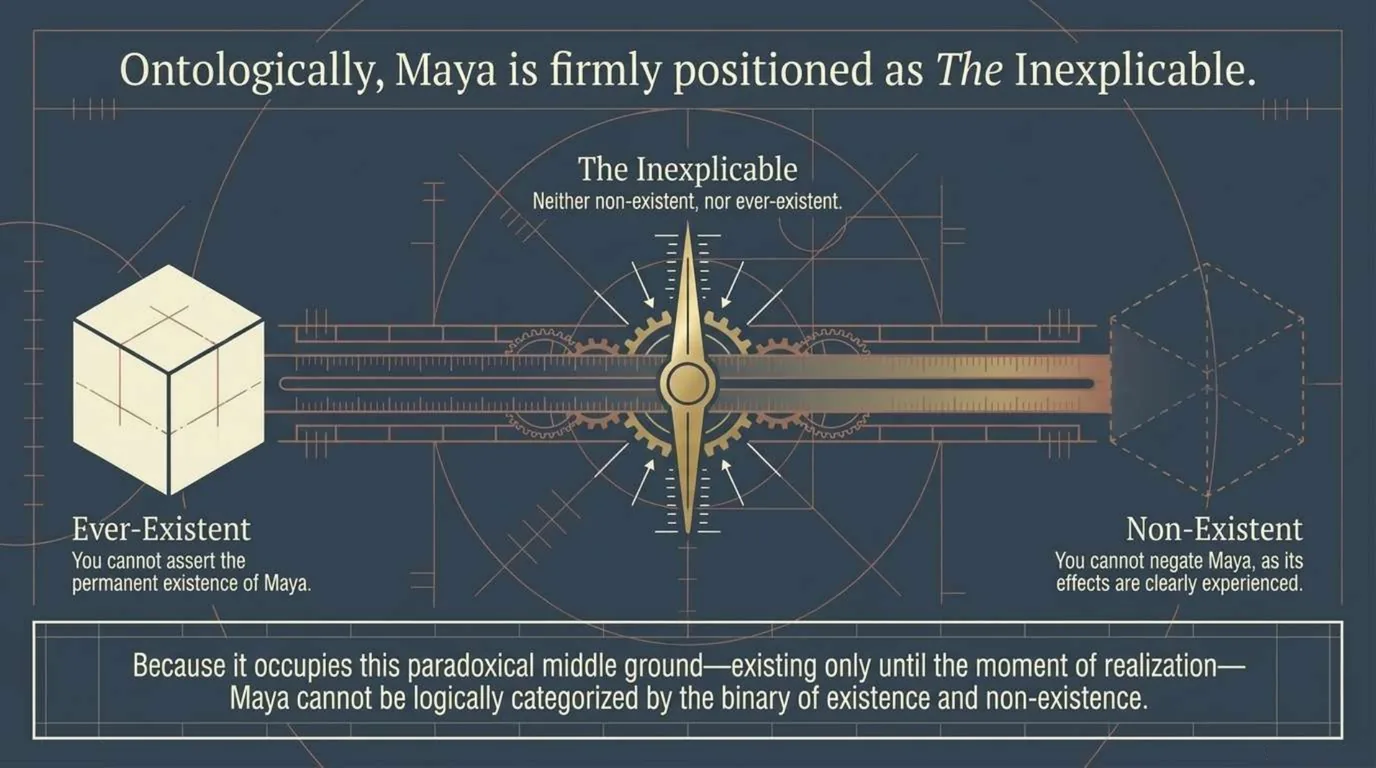
Advaita will not call Maya ever-existent, because it ends the moment the Self is known. It will not call it non-existent either, because the world is plainly being experienced right now.
The tradition’s word for what falls between is anirvachaniya: that which cannot be pinned down as either. It is not a hole in the argument. It is the honest label for something that fits neither box.
Try calling this room real, then try calling it nothing. Where does each answer stall?
Honest limit: the “neither” is Advaita’s own classification. Other schools reject it and call the world plainly real (see the table above). It is a way to hold the problem, not proof that it is solved.
Traditional Source
Advaita Vedanta on Maya as anirvachaniya.
Who Is Asserting What
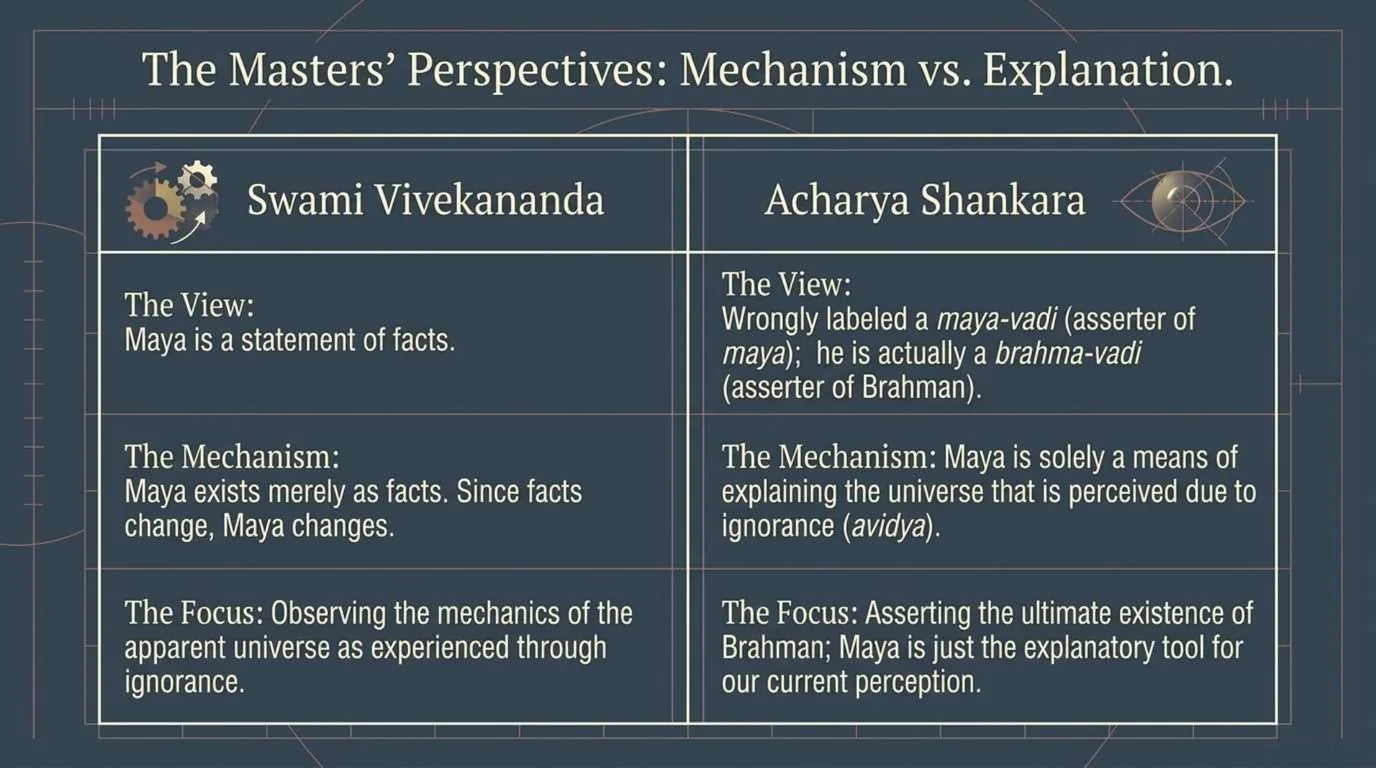
Vivekananda called Maya a statement of facts: the world as it appears, which changes because the facts change. Shankara, on the Advaitin’s own account, is no teacher of Maya at all. He asserts Brahman, and uses Maya only to explain why anything else seems to be there.
The label maya-vadi, asserter of Maya, was pinned on Advaita by rival schools. Advaitins have long refused it. One looks at the mechanics. The other keeps pointing at what the mechanics sit on.
When you say “it’s all Maya,” are you describing the facts, or pointing at what they sit on?
Honest limit: Vivekananda and Shankara are not rivals here. The table compares emphasis, not disagreement.
Traditional Source
Swami Vivekananda; Adi Shankaracharya.
The Trap of Maya
Everything above is the machinery. Vikshepa, Running listed the pulls the projection keeps generating, self-inflation among them. One ordinary place that engine gets fed is what other people think of you.
Human opinions form, shift, and vanish like bubbles on water.
A reputation built on them is a castle built on the same water.
“Lack of discrimination is like deep sleep.” A life spent tracking what others think is a life spent watching bubbles — each one convincing while it lasts, gone without a trace by the time the next one forms. Recognizing the bubble as a bubble, rather than the ground, is what the sutra calls the dawn of discrimination.
A castle in the air is still a castle in the air, however many people are looking up at it.
Whose opinion of you did you adjust something for today, and where is that opinion now?
Honest limit: the Shiva Sutras belong to Kashmir Shaivism, which has its own account of Maya apart from the Advaita one this page follows. The line is used here for one narrow point: failing to tell what passes from what holds.
Traditional Source
Shiva Sutras, Aviveko maya sausuptam.
Where Maya Turns Up Next
That is the whole account in one place. Maya names the problem; the rest of the page is about seeing it and what to do about it. Three sections pick up directly from here, and four others touch Maya from a different angle.
The procedure for finding what is left once every sheath of the self has been set aside.
What exactly is left over when the projection is seen as a projection.
Turning attention back toward the one looking, with the Pancaratra picture of the binding and the Inner Controller’s grace inside it.
Moha in a seeker’s own virtues: infatuation as the feeling of being too sure to check.
Calls the world Consciousness-Force in total self-forgetting, rather than an appearance cast by ignorance.
A second Shiva Sutra: attend to where the energy sits, and the story on top of it loses its grip.
The same lens in a single card, dissolved when you recognize you are the screen, not the projection.
One rival account still has to be answered before this section closes: a cosmos that needs no conscious ground at all. It is next, in The Rival Cosmology, Ruled Out.
The Rival Cosmology, Ruled Out
Samkhya offers a real alternative to everything above: the universe evolves from Pradhana+Primordial nature — a state of perfect equilibrium of the three gunas (Sattva, Rajas, Tamas) before creation, held by Samkhya to be the insentient first cause of the universe., blind and insentient matter that simply contains the potential for everything that later evolves out of it. No consciousness required, anywhere in the chain — just latent potential, unfolding on its own.
Vedanta's reply doesn't dismiss the claim — it goes straight to the Upanishad's own wording. Before creation, the text has the First Cause declare: “Ikshata+To see, visualize, or plan — in Vedanta, the conscious act attributed to Brahman immediately before creation, used to argue the First Cause cannot be insentient matter. — it saw. I shall become many.” Seeing, in any ordinary sense of the word, is not something blind matter does. A cause capable of visualizing a plan and then executing it has already conceded the one property Samkhya's Pradhana was built to do without: consciousness.
The cosmos evolves from insentient Pradhana — potential without a planner.
The scripture's own verb is "it saw" — and seeing, planning, and designing are not things that happen without someone home to do them.
Not a leap of faith against a rival theory. A close reading of what the rival's own preferred texts actually say the First Cause did.
The same cascade turns up inside a theistic account. The Pancaratra story of creation has three movements: the projection of Brahma, an evolution out of Pradhana, and a “pure creation” by the Supreme Person. The middle one runs Pradhana to Buddhi to Ahamkara, then splits into the organs of knowledge and mind, the organs of action, and the five subtle and five gross elements. It is the sequence behind the 24 tattvas, told as one part of a larger story.
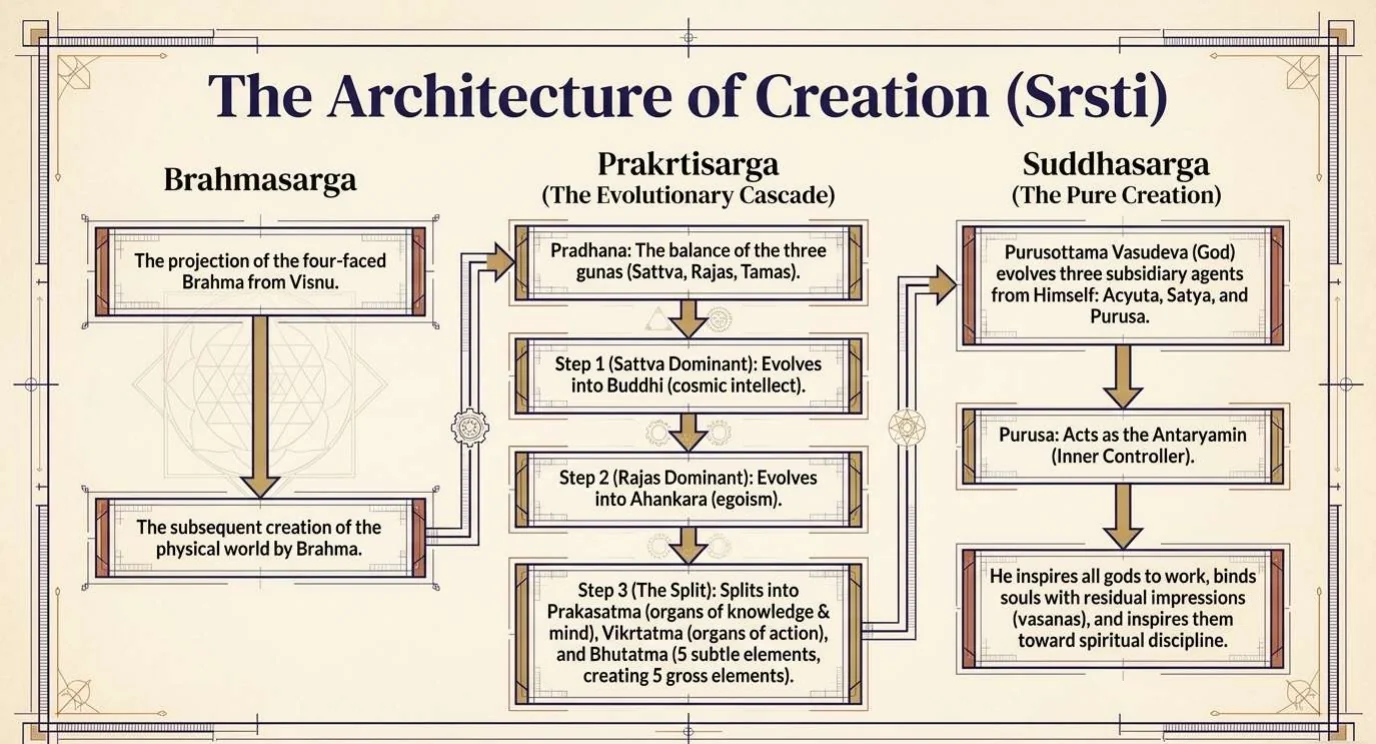
Honest limit: a summary of one school’s account. The individual Samhitas differ in detail, and the page above is arguing about what the first cause must be, not about the order of the evolutes.
If the ground of everything has no face, why does the tradition keep so many gods?
The answer on offer is not that the One became many. It is that a heart needs something it can meet — and the faces are how the formless gets met.
Everything on the page above works at the level of Brahman and Ishvara. This section steps down one rung, to the deities themselves: why the One shows up as many, how the three great acts fit together, and three figures who carry the teaching — one of a forgotten power, one of two kinds of perfection, and one whose feared face is the protective one.
Tap to expand — six cards: why the One shows up as many, five ways the One is met, one Being in three acts, a forgotten strength, two kinds of perfection, and a feared face that protects
The Prism
Traditional Source · Why a non-dual path still has gods
Everything above points at Brahman, and Brahman has no face. The tradition’s own question is what a human heart does with something that vast. It cannot love an abstraction, thank it, fear it or argue with it. Ishvara, and the Bhagavan+The Lord — the personal face of the Absolute, the aspect of God a devotee can address, love and serve. a devotee addresses by name, is the answer: the same Absolute, shown in a form a person can actually relate to. The Epics and the Purana+One of the great story-scriptures of India — tales of gods, cosmic cycles and descents that carry the abstract teaching of the Upanishads into forms the heart can follow.s do the translating.
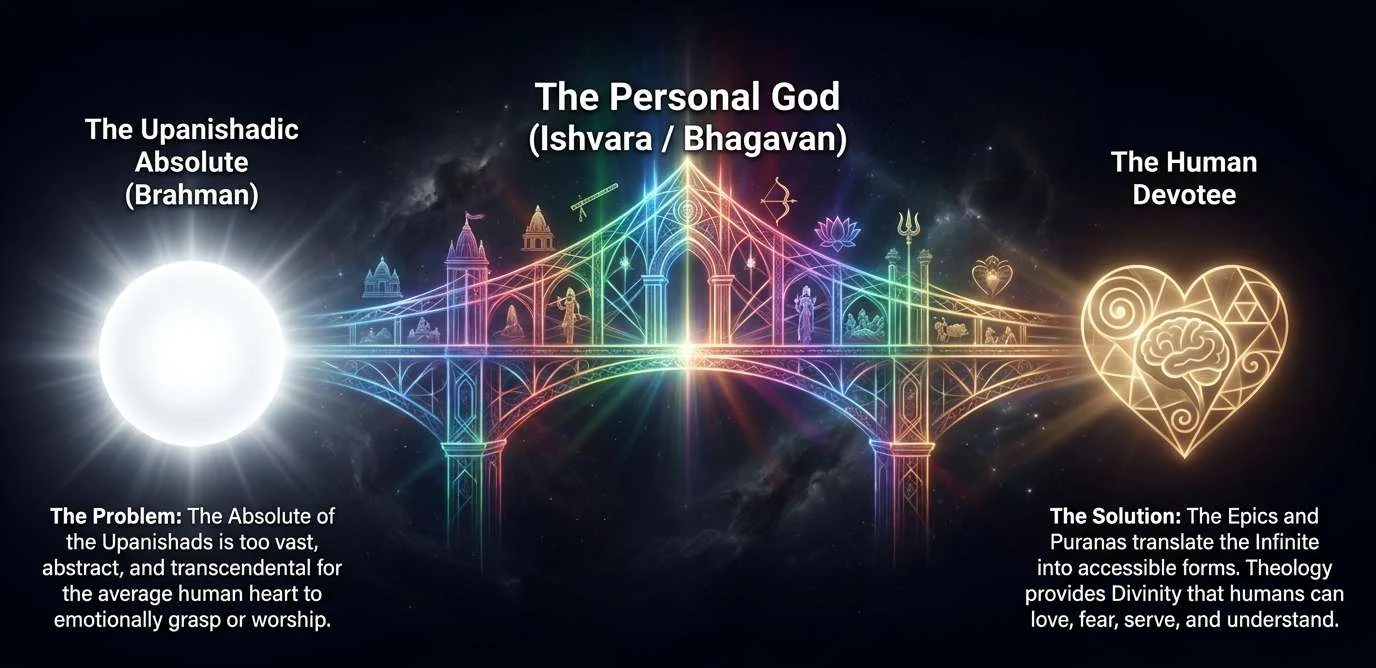
The Absolute of the Upanishads is formless and beyond every quality. Most hearts cannot worship a principle.
The personal God is a form that can be loved, feared, served and understood — the same One, made reachable.
Loving the many colours gently guides the mind back to the single light they came from. That is Moksha, not a detour from it.
The gods do not split the One into many. They are the faces of it a person can actually meet.
Honest limit: this is one tradition’s own account of why the gods exist. Advaita ranks Ishvara beneath Brahman, as the page above does. Theistic schools make the personal God the highest reality, and many devotees worship the deities as real beings in their own right, not as aids.
Five Ways the One Is Met
Traditional Source · Pancaratra, the Vaishnava Agamas
Pancaratra+A Vaishnava tradition of the Agamas — texts on cosmology, yoga and temple worship. The name is usually read as “five nights”: the teaching is said to have been given over five nights. gives a graded answer to the question this section opens with. The one Supreme Person is described in five aspects, from the most remote to the most reachable. The list runs from what no one can approach to a form anyone can stand in front of.
The Supreme as it is in itself, beyond the qualities of matter.
The Supreme delegating its blessed qualities across four emanations, so that creation can be made and governed.
The descents into the world. Rama and Krishna, below, are the best known.
The Inner Controller dwelling in every being, the same figure Yajnavalkya names to Janaka in Beneath the Screen.
The image in a temple or a home shrine: the form a person can actually approach.
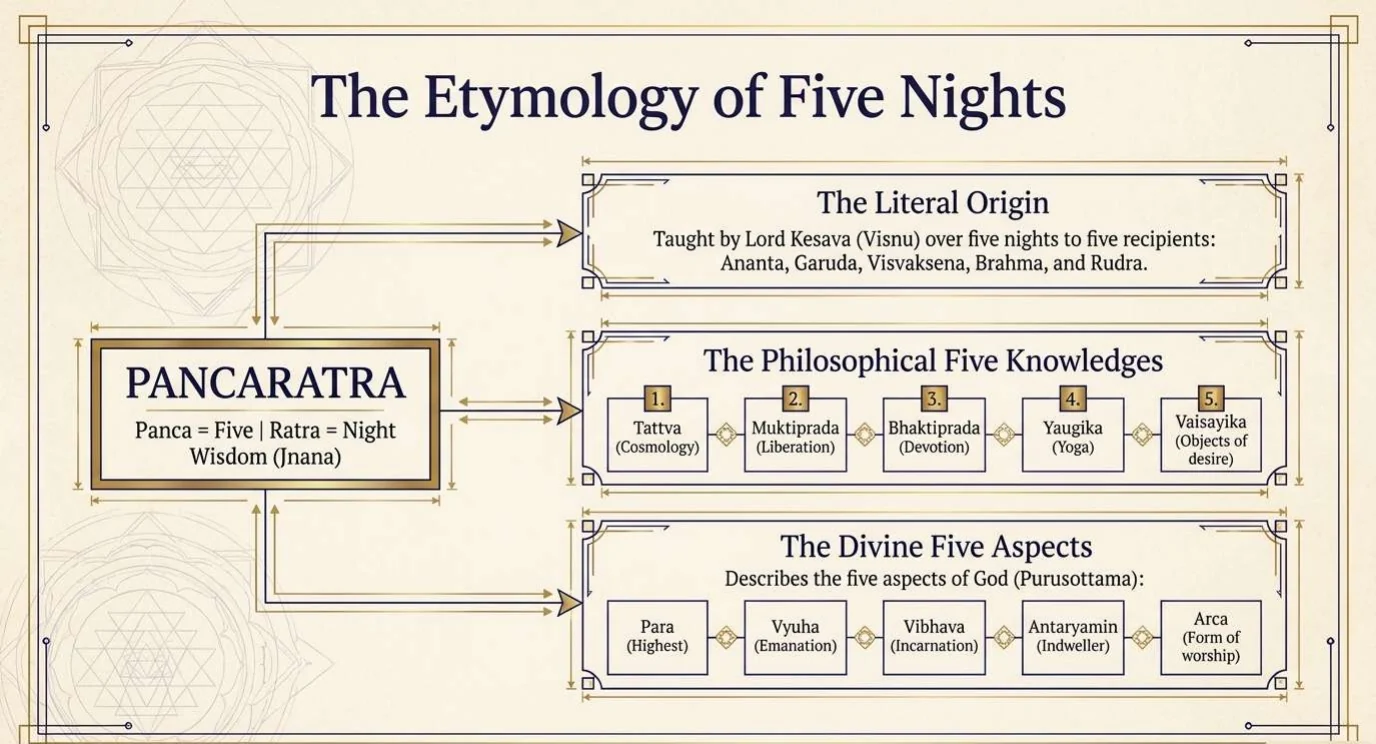
Five aspects, one Being. The last two are the nearest: the one within, and the one in front of you.
Honest limit: this is one school’s own scheme. Pancaratra is a theistic tradition that holds the personal Supreme as highest, while Advaita, as this page does, ranks Ishvara beneath Brahman. Its place inside the Vedic fold is argued from within the tradition and is not accepted by every school.
One Being, Acting in Time
Traditional Source · Creation, preservation and dissolution as one act in three phases
The Trimurti+The three-faced form of God — Brahma, Vishnu and Shiva as creation, preservation and dissolution; one Supreme Being seen at work in time. is not three gods sharing a job. It is one Supreme Being seen at three moments of the same act: begin, hold, end. Brahma+The creator god — the cosmic intellect that projects the universe. Not to be confused with Brahman, the formless Absolute. (not Brahman) is the cosmic intellect that projects the universe out of creative will. Vishnu+The sustaining power — keeper of cosmic order, equilibrium and law, also called Narayana. The one who descends as the avatars. sustains it, keeping order, balance and law. Shiva+The transformer — the force of dissolution that draws all manifestation back into its unmanifest source, and also the ascetic, Lord of Yoga. Also called Rudra. draws everything back into the unmanifest, so that dissolution is a return and not a loss.
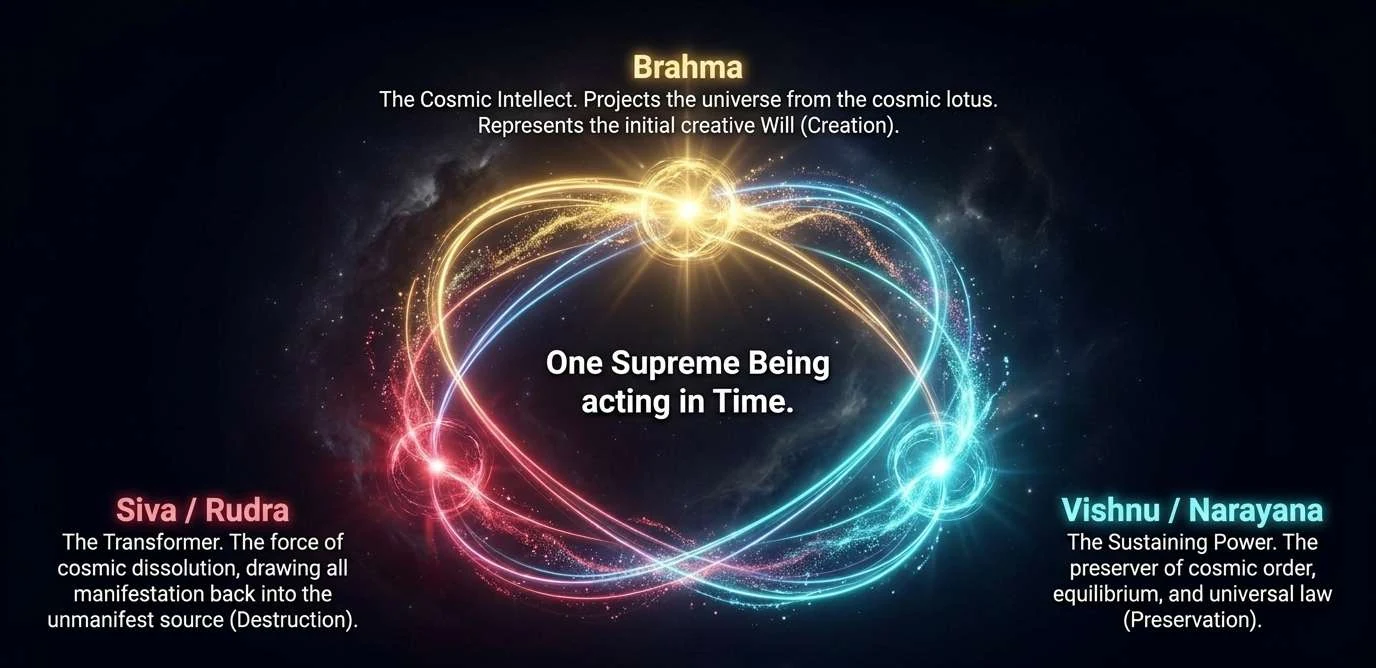
The cosmic intellect projecting the universe from the lotus.
The sustaining power, keeping order, equilibrium and law.
The transformer, drawing manifestation back into the source.
The same three names turn up in the body. The Granthis in the Pranayama section are the Brahma knot at the root, the Vishnu knot at the heart and the Rudra knot at the brow. The cosmic story and the inner map were written in the same vocabulary.
Honest limit: the Trimurti is one popular synthesis. Many traditions hold Vishnu, Shiva or the Goddess as the one Supreme and the other two as aspects. Brahma, though central in the cosmic story, has far fewer devotees than either.
Hanuman, the Forgotten Strength
Traditional Source · The soul that forgot its own power
Hanuman+The devoted monkey-hero of the Ramayana — master of wisdom, son of the wind god, and the model of surrender through service to Rama. holds three things at once: a master’s command of the Vedas and grammar, the power of the wind and a blessing of deathlessness from Brahma, and total surrender in service to Rama. The tradition adds the part that matters for this site. He is cursed to forget his own strength, and it returns only when he is reminded of it, at the moment the search for Sita needs him.
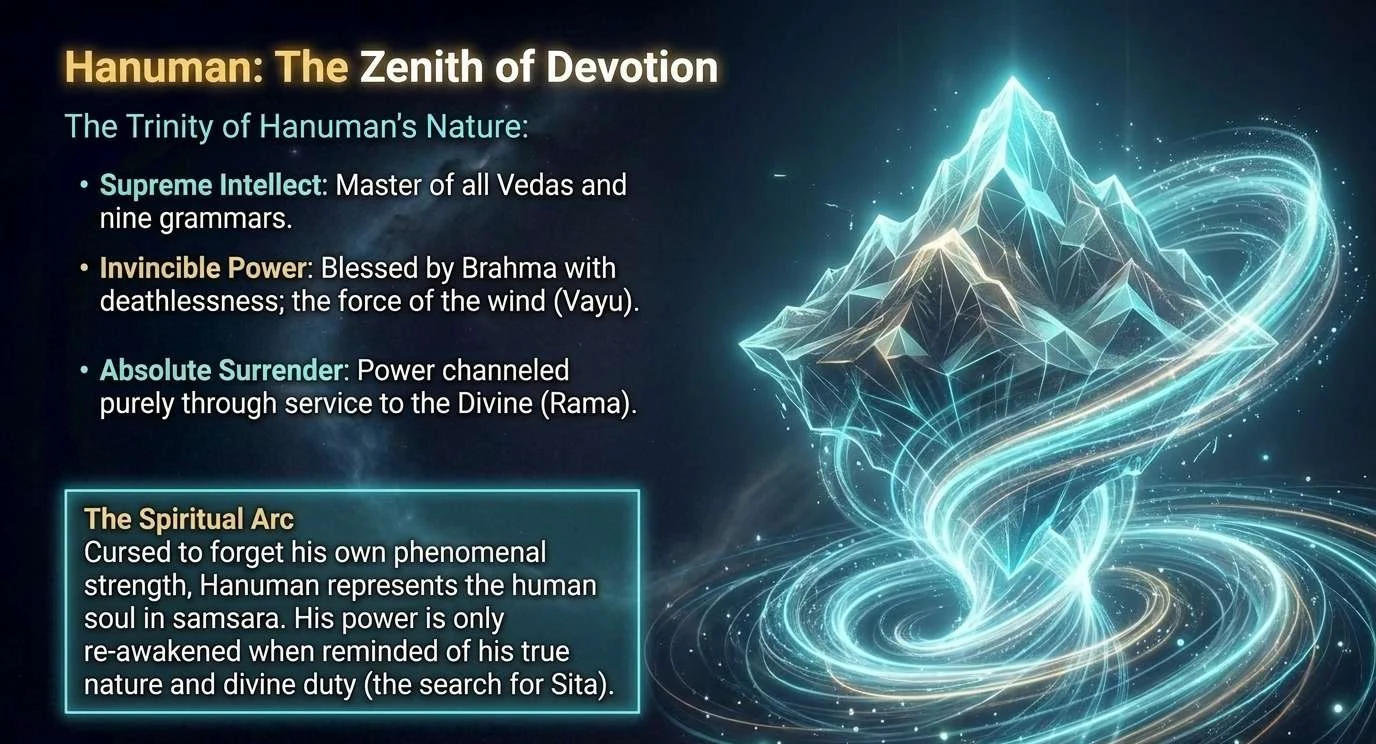
Command of the Vedas and the nine grammars.
Blessed by Brahma; the force of Vayu, the wind.
All of it channelled into service of the Divine, not into himself.
Nothing was missing. It was only forgotten, and it came back when someone reminded him.
Honest limit: the curse of forgetting belongs to the later layers of the Ramayana tradition, not to its oldest core, so treat it as the tradition’s reading rather than a plain-text fact. The parallel with self-enquiry is the site’s reading too, not the tradition’s.
The tradition also reads the whole Ramayana as an inner map. In one such reading, Rama is the Self, Sita the mind carried off and exiled by desire, Ravana the ten senses rushing toward the objects of the world, and Hanuman the guide whose insight wakes the soul.
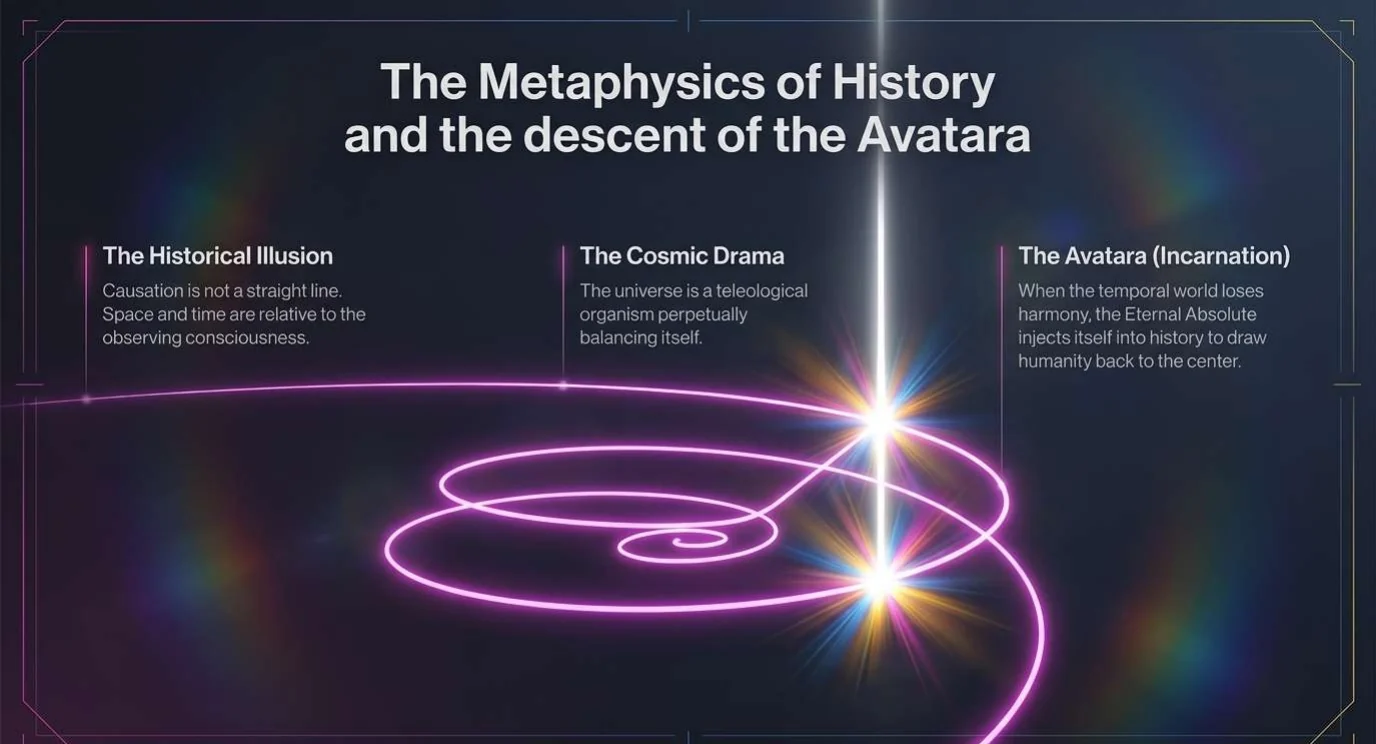
Honest limit: this is one allegorical reading laid over the story, not its plain sense. It also casts Hanuman as the guide, where the card above casts him as the soul that forgot its strength. A story that carries two readings is not contradicting itself, but neither reading is the text’s own claim.
Rama and Krishna
Traditional Source · Two ways of being perfect
Both are Avatara+A descent — the Supreme taking form in the world, traditionally whenever righteousness declines. Rama and Krishna are the best known.s of Vishnu, and the Gita has Krishna say that he takes birth whenever righteousness declines. They answer different questions. Rama is the Purushottama+The Supreme Person — the highest among beings. Rama is called Maryada-Purushottama (the Supreme Person of right limits), Krishna Lila-Purushottama (of divine play). of right limits, the person who keeps within the law even when it costs him everything. Krishna is the Purushottama of divine play, who acts from above ordinary logic. One shows how to live well inside the rules. The other shows what the rules are for.
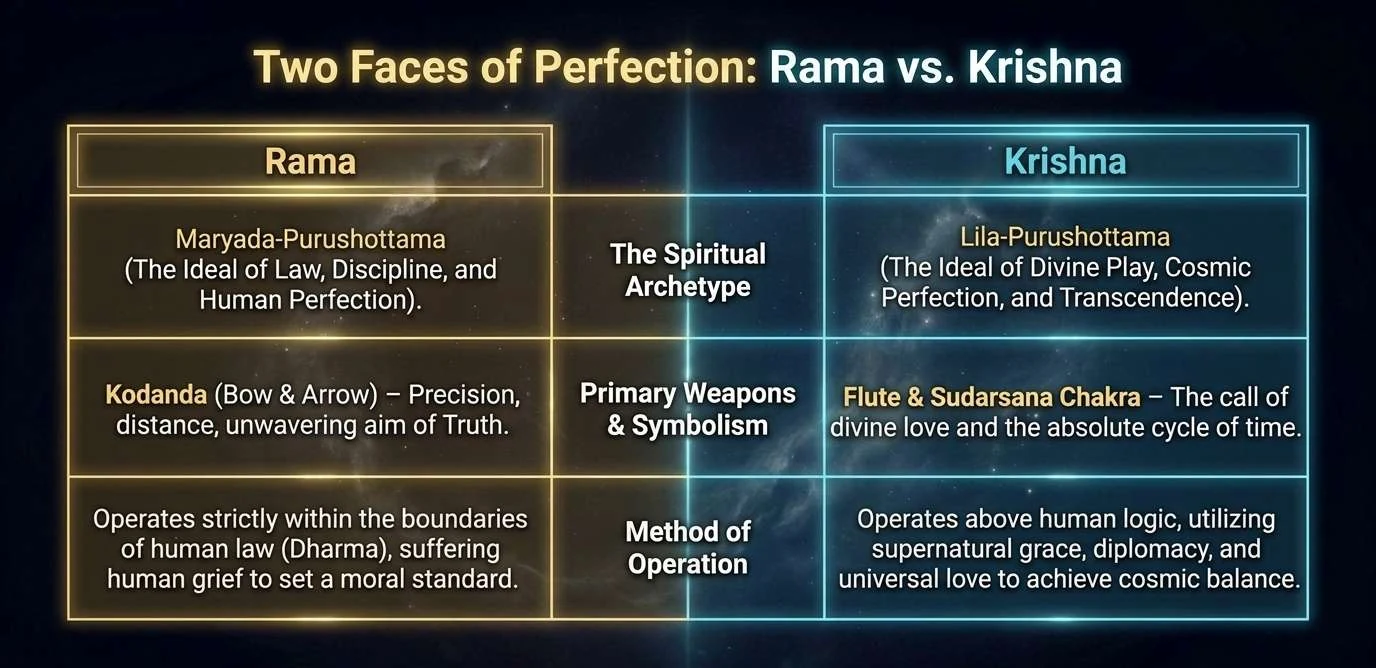
The man who keeps the law, and the one who plays above it, are the same Being.
Honest limit: the contrast is a teaching shorthand. Rama also acts beyond ordinary reckoning, and Krishna also defends dharma. Each shows both sides, in different proportions.
Kalaratri, the Feared Face
Traditional Source · Where the terrible form turns out to protect
Kalaratri is the seventh of the Navadurga+The nine forms of the Goddess Durga, each worshipped on one of the nine nights of Navaratri. The Devi Kavacha names them in order: Shailaputri, Brahmacharini, Chandraghanta, Kushmanda, Skandamata, Katyayani, Kalaratri, Mahagauri, Siddhidatri., the nine forms of the Goddess. The list is fixed in the Devi Kavacha, a protective hymn recited with the Chandi Path, the liturgical reading of the Devi Mahatmya. The verse that names them is among the best known in Shakta devotion:
Prathamam Shailaputri cha, Dwitiyam Brahmacharini.
Tritiyam Chandraghanteti, Kushmandeti Chaturthakam.
Panchamam Skandamateti, Shashtham Katyayaniti cha.
Saptamam Kalaratriti, Mahagauriti chashtamam.
Navamam Siddhidatri cha, Navadurgah prakirtitah.
In plain terms, the verse lists Shailaputri, Brahmacharini, Chandraghanta, Kushmanda, Skandamata, Katyayani, Kalaratri, Mahagauri and Siddhidatri, in that order, and calls them the Navadurga.
Her name and form say one thing, and her title says the opposite. Kalaratri+The seventh of the Navadurga — Durga in a dark, fearsome form, worshipped against destructive forces. The name is usually read as the dark night, since kala can mean both black and time. is read as the dark night. Her other name, Shubhankari+Literally the one who brings what is auspicious — an epithet of Kalaratri that names the protective, well-being side of her fearsome form., is the one who brings what is auspicious. The tradition holds both at once: she is met in the darkest nights, against what destroys, and what looks like the threat is the protection. It is what the Maya blocks say about names and forms, given a face.
Durga is almost always shown on a lion or a tiger. Kalaratri’s vahana+The animal or vehicle a deity is shown riding or accompanied by. Each carries a traditional meaning, and readings of a given mount differ. is a donkey. The iconography is traditional; the meaning people draw from it varies, and the reading below is one of them.
One common reading takes the donkey as the animal that carries the load nobody applauds. Set beside the lion, the pair becomes a question to put to your own effort: does the work have to be seen in order to feel real? Most people are already living in one column or the other.
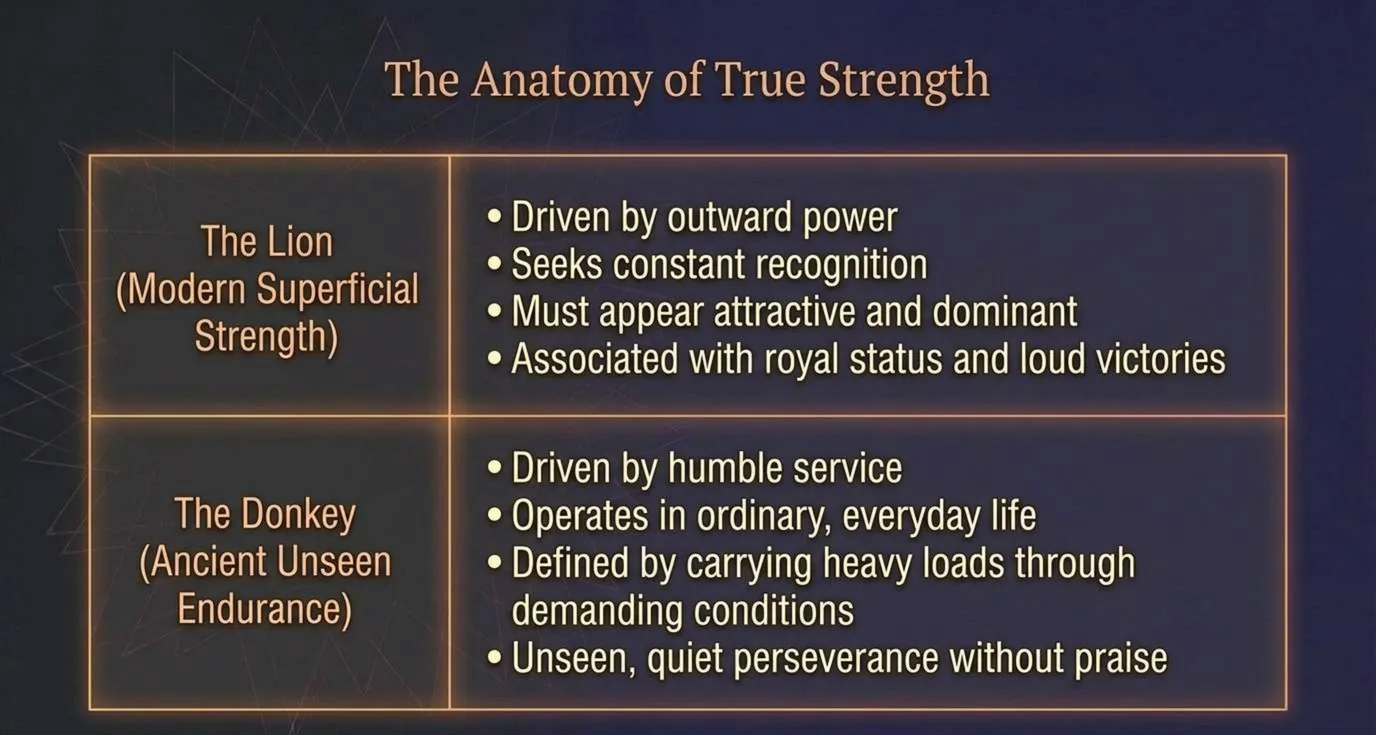
This is Karm Yog seen from outside: duty kept, outcome released, and nobody clapping. The Gita lines that go with it sit in three places on this page — 2.47 beside Karm Yog, 2.70 in Sublimation and 2.14 in Interrupting the Reaction.
The feared face and the protecting face are one.
Honest limit: the Devi Kavacha gives her place in the list. Her fearsome form, the double meaning of her name and the donkey are traditional iconography. Reading the donkey as unseen endurance, set against the lion’s display, is a teaching reading (42SELF Interpretation), not something the verse says. Other readings take the donkey as the heavy, dull force she has tamed, not as a virtue.
The doing tells you nothing. The reason tells you everything.
Two people write the same check to the same cause. One is closing a reputational gap. One doesn't remember doing it by evening. Vedanta calls the underlying fuel the guṇas+The three modes of material nature — the qualities that color every thought and action, whether or not the person acting is aware of them. — four rungs, base to apex.
Tap to expand — the four rungs, base to apex
Tāmasic+Of the mode of ignorance — one of the three modes of material nature.
Self-gratification at someone else's expense — the base of the ladder
Driven by self-gratification, at the expense of someone else. Corner-cutting that lands on another person, dressed up as ordinary business. Nothing subtle here — just the willingness to let someone else absorb the cost.
Rājasic+Of the mode of passion — one of the three modes of material nature.
Legal, fair, and still for the ego — the second rung
Legal. Fair. Correctly executed. Nothing wrong on paper. The motive is prestige, ego, or accumulation — not harm to anyone, just nothing given away either. Most of what gets called "success" lives here.
Sāttvic+Of the mode of goodness — one of the three modes of material nature.
Done for someone else — the third rung
Compassion, generosity, contribution as the actual motive — not the marketing around it. The action serves someone other than the one performing it, and means it.
Guṇātīt+Transcendental to the three modes of material nature.
Beyond the need to be seen as good — the apex
The action offered without a claim on the result. Not "beyond good" — beyond the need to be recognized as good. The rarest rung, and the only one with no audience built in.
You already know which rung a given action sits on — that's what the ease or discomfort around it is telling you. Take one thing you did today that you'd call good. Check it against all four rungs. Where does it actually land?
Not every “should” is the same voice. One was absorbed — from parents, culture, everyone’s expectations. Another arrives before any argument, fits one person in one situation, and no rulebook could have predicted it. Which one is asking right now?After Viktor Frankl’s account of conscience
Describing It, Or Doing It
Marcus’s note to himself is one instruction: stop talking about the kind of person a good one ought to be, and be one. Sort anything you did this week by two questions — who saw it, and did it actually happen? Quoting Seneca at dinner and quietly repaying $40 sit in different corners.
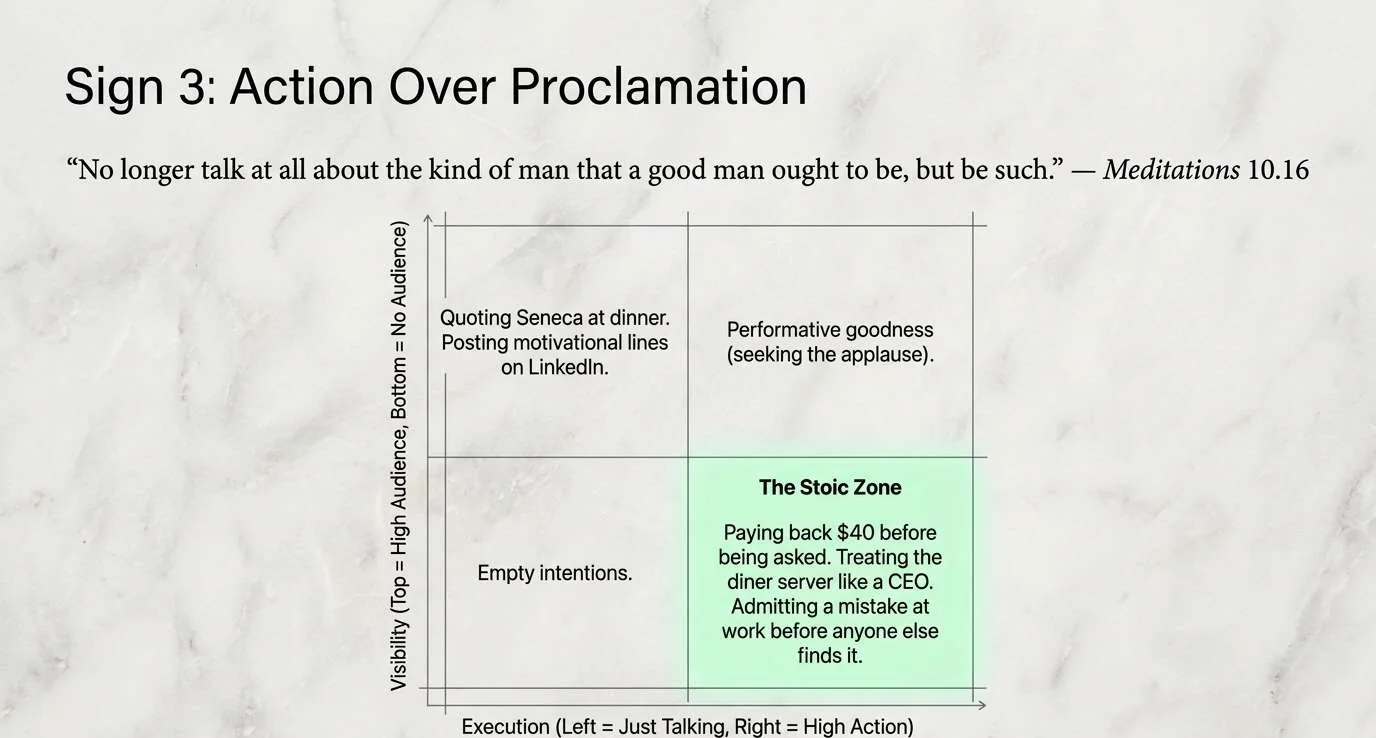
“No longer talk at all about the kind of man that a good man ought to be, but be such.” — Marcus Aurelius, Meditations 10.16
Which corner did today’s good deed land in? The bottom-right corner is the ground of the fourth rung above: no audience built in.
Honest limit: visible good is still good, and speaking is sometimes the action — a warning, an apology, a refusal. The grid sorts where the doing comes from, not whether it helped.
Source: Marcus Aurelius, Meditations 10.16 (George Long translation).
If the gunas are running the show, doesn't that make the whole idea of karma pointless?
Fair objection. If everything were predetermined, there'd be no one left to hold responsible for anything — the Law of Karma would collapse into nonsense the moment it was stated. The resolution rests on a distinction the fatalist reading collapses into one thing: the hand you're dealt, and how you play it.
The body, the family, the raw circumstances a life opens with. Fixed — the result of past actions already in motion, no longer subject to a vote. Not a life sentence. A starting hand.
Entirely in your control, in the present moment, regardless of the hand. A skilled player wins with a weak hand. A careless one loses a strong one. Today's effort is also tomorrow's Prarabdha — the deck currently being reshuffled.
Tap to expand — the three karmas Prarabdha is only one third of
Prarabdha, above, is only one third of the full ledger. The deck metaphor holds for all three — it's just that most of the deck is sitting somewhere other than the hand currently being played.
Every card ever earned, across every hand ever played before this one. The total accumulated stock — almost all of it still sitting in the box, unripened.
Already covered above: the specific cards drawn from that deck for exactly this life. Fixed for the round — fixed, not sourceless.
Every card played right now, present tense, going straight back into the deck for some future hand. This is the “today's effort is tomorrow's Prarabdha” line above, named in full.
Only one of the three karmas is ever actually being written. The other two are either already filed, or not yet due — which is exactly why the present moment carries more weight than either the past or the future ever will.
When the Dreamer Wakes
Classical Advaita adds one claim about these three, and it changes how the ledger reads. Knowing who you are, it says, does not treat all three alike.
Actions in a dream are not paid off on waking. They simply have no one left to belong to. The vast stock goes the same way — not worked through, seen through.
The hand already dealt still gets played, until the body ends. The difference: it is played without a player who believes the cards are his.
Nothing clings to space. Action still happens through the knower, and it leaves no residue on him.
A tradition's claim, not a promise — and not a license. It describes seeing through the doer, not skipping the work of seeing. The same standing is named under Jivanmukti. For now, one question is enough: how much of what you carry today is weight for a doer you have never actually located?
Karma was never a claim that the future is written. It's a claim that the pen never leaves your hand — only the paper you were handed to write on was already chosen before you sat down.
Seven layers. Seven stages of a single life. One universal pattern.
Nature, consciousness, and human life all move through the same sequence — from the density of raw survival to the clarity of pure being.
“As above, so below.”
—The Hermetic Principle of CorrespondenceTap a stage to jump to its full breakdown
Collapsed by default — expand to see all seven stages, Red to Violet
Survival — “I Exist”
Grounding in the body
Consciousness fully embedded in matter. You do not operate reality; reality operates on you. Dense, chaotic, and entirely focused on reacting to physical constraints just to maintain baseline existence.
Alchemy: Lead (Base Matter) · Brainwave: Delta
Life Stage: Womb & Infancy
The Vertical Leap — Somatic Grounding: anchor completely in the physical form without resisting limits or survival demands.
Emotion — “I Feel”
Meeting emotion with breath
Raw physical experience is no longer just endured — it generates an internal, subjective, volatile charge. These emotional spikes create the very first echoes of a subjective self, distinct from the world pushing against it.
Alchemy: Copper (Purification) · Brainwave: Theta
Life Stage: Childhood — First Cry / Play
The Vertical Leap — Breath Mastery: use the breath as a conscious regulator to wash away reactionary emotional spikes.
Thought — “I Think”
Watching the thoughts, not being them
To survive the chaos of raw emotion, the mind begins to categorize and predict. Reactions calcify into predictable, automated patterns — a rigid architecture built around the initial spark of consciousness to keep it safe.
Alchemy: Iron (Strength) · Brainwave: Alpha
Life Stage: Early Youth — Sensory / School
The Vertical Leap — Mindful Observation: step back from the mental chatter; shift from being the thoughts to watching them.
Love — “I Connect”
The heart as bridge
Identity is not who you truly are — it is the refined construct built from every layer of prior conditioning. It acts as a filter and a fulcrum, bridging the mechanical responses of your past with the expansive awareness of your future. The heart is the bridge from density to divinity.
Alchemy: Silver (Refinement) · Brainwave: Mu
Life Stage: Late Youth — Curiosity / Higher Learning
The Vertical Leap — Intellectual Surrender: recognize the limits of dry logic and let concepts dissolve into intuitive knowing.
Wisdom — “I Understand”
Alchemical gold: self-awareness
Consciousness dis-identifies from its own patterns. You realize you are not your thoughts, emotions, or history — you are the silent entity observing identity itself. This separation is the true alchemical gold: the dawn of objective self-awareness.
Alchemy: Gold (Illumination) · Brainwave: Beta
Life Stage: Young Adulthood — First Impressions / Career
The Vertical Leap — Alchemical Refinement: strip away the personal stories attached to your past; hold your history as educational data.
Bliss — “I Transcend”
Where observer and observed merge
As awareness heightens, the dualistic gap between the observer and reality collapses. The psychological friction of separation ceases, distilling consciousness into pure integration and unmediated bliss.
Alchemy: Quintessence (Spirit/Essence) · Brainwave: Gamma
Life Stage: Mature Adulthood — Ambition / Leadership
The Vertical Leap — Dissolving the Observer: merge the gap between watcher and watched; step out of individual self-importance.
Oneness — “I Am”
The unshakeable “I Am”
Beyond patterns, beyond identity, beyond even the observer. You are no longer experiencing reality — you realize you are the ultimate reality experiencing itself. Complete ontological transmutation. The absolute “I am” phase.
Alchemy: Philosopher’s Stone (Completion) · Brainwave: Lambda
Life Stage: Elderhood & Beyond — Manifestation / Realization
The Vertical Leap — Final Realization: rest permanently in the unshakeable “I Am,” free from the illusions of time, change, and decay.
Different expressions. One enduring pattern. From physical survival to final realization, there is one map — and you are the one moving through it.
Explore deeper: the Path of Subtilization walks these seven layers as a lived journey — the Master Matrix holds the full reference for each.
If you are depressed, you are living in the past.
If you are anxious, you are living in the future.
If you are at peace, you are living in the present.
Stillness is not somewhere else. It is already here, in plain sight.
Four doorways into the Now that need no crisis and no technique to fix anything — just attention, redirected.
The Gap
This is not the RRRR gap — that one interrupts a reaction after something has already triggered it. This gap is always there, whether or not anything just happened. Pay attention to it, and the formless dimension underneath ordinary thinking briefly surfaces.
The brief, silent space between one word and the next in conversation.
The space between the notes of a piano, where the music actually lives.
The gap between the in-breath and the out-breath.
The Inner Body
Feel the energy of the body from within — not what it looks like, but the aliveness underneath fluctuating emotion and thought. The moment attention moves there, mental noise slows down, sometimes stops. Every cell is alive in that presence, underneath whatever the mind happens to be narrating.
Listening Inward
Sound can be a doorway too — not the sound, the listening. Nada+Sanskrit for “sound” — in Nada Yoga, the inner sound that attention can follow, from coarse to subtle, until the listening itself is what remains. Yoga describes a rough ladder of what the inward ear finds when it stays long enough: the loud and coarse first, then finer and finer, until nothing is left to hold.
Thunder, ocean roar, the great kettle-drum. The loud ones arrive first.
Drum, horn, bells. The edges begin to soften.
Flute, vina, the hum of a bee. Barely sound.
The mind blends into the sound as milk into water, until the sound itself is gone. Listening remains, with nothing to listen to.
Not a technique to master. A question to sit with: in the quiet, what is the faintest sound — and who is hearing it?
The Artist’s Eye
Habit and intellectual efficiency exist to smother raw impression — the mind labels a tree “tree” and stops looking. Art’s whole function is to strip away the knowledge that imposes a pattern, holding attention on the ordinary until it stops resembling anything familiar at all.
Hold gaze on an ordinary object until the label falls away and only the raw shape, color, and texture remain.
Describe something familiar as if encountering it for the first time, with no prior word for what it is.
This is not decoration. It is attention deliberately doing what a child’s attention does by default.
None of these four is a technique to master. They are doors that were never locked — only unnoticed.
How to Pay Full Attention
Five concrete daily disciplines — where the doorways above ask for nothing but noticing, these ask for a little repetition.
Under all five is the same three-part motion: notice where it went, return it without penalty, hold it a little past comfortable.
Do one thing at a time. When eating, just eat. When working, just work.
Observe your thoughts instead of becoming them. Not “I am angry” but “anger is arising in me.”
Slow, even breath — inhale and exhale each lasting five to six seconds, repeated for two to five minutes. The physiology behind the number is in Pranayama, below.
Pause and ask: what am I doing right now? Why am I doing it? Is this aligned with my dharma+Right action or duty — the personal-scale expression of Rita, cosmic order, at the level of a single life.?
The RRRR Protocol in miniature: observe before speaking or reacting — replacing an automatic reaction with a conscious response.
The Fruits of Awareness
Your karma becomes better.
Your decisions become clearer.
Your relationships become better.
Your life becomes peaceful.
Interrupting the Reaction
Same gap between trigger and response, worked from two different doors. Neither is the advanced one — they're just entry points, and which one is open depends on the moment.
For when the behaviour is about to happen — revenge trading, the angry reply, reaching for the drink. Body first, understanding later.
RRRR · V1 — Stop the Impulse
Recognize → Resist → Return → Release. Full protocol →
The 3-Step Circuit Breaker
Box Breathing → Witness and Label → Detached Action. Full steps →
For when the impulse has already passed and what's left is understanding it — a difficult relationship, a pattern that keeps repeating.
RRRR · V2 — Process the Emotion
Recognize → Reflect → Reframe → Respond. Full protocol →
The Anatomy of Redirection
Trigger → Attention → The Choice → Redirection. Full walkthrough →
The Mechanics of Mantra
Replacing the loop that repeats on its own with one chosen on purpose. Full section →
The doors above are for when it is already happening, or just did. If you can see the difficult person coming — a tense meeting, a family dinner, an inbox you are dreading — name them in advance, so the rudeness lands as ordinary instead of as news. Morning Armor →
Augustine noticed an odd asymmetry in the Confessions (Book 8): the mind tells the hand to move and the hand moves, but when the mind tells itself to do something it meets resistance. The lopsidedness is the clue. If one mind were giving and taking the order, there would be nothing to argue about. When the reaction is already rising, name the two voices (the one that wants and the one that says no) and notice who is hearing both. That listener is the gap the doors above are trying to reach. The parts doing the arguing are mapped in The Fourfold Mind.
Both doors work better once the feeling is classed correctly. Gita 2.14 describes what contact with the senses does: heat and cold, pleasure and pain arrive and then leave. Its instruction is Titiksha+Forbearance — the capacity to endure the unavoidable pairs of opposites (heat/cold, praise/blame) without agitation or complaint., endurance, which is a different thing from suppressing. The rising reaction is real, and it is weather: it has a shape and a duration, and it is not a verdict on you.
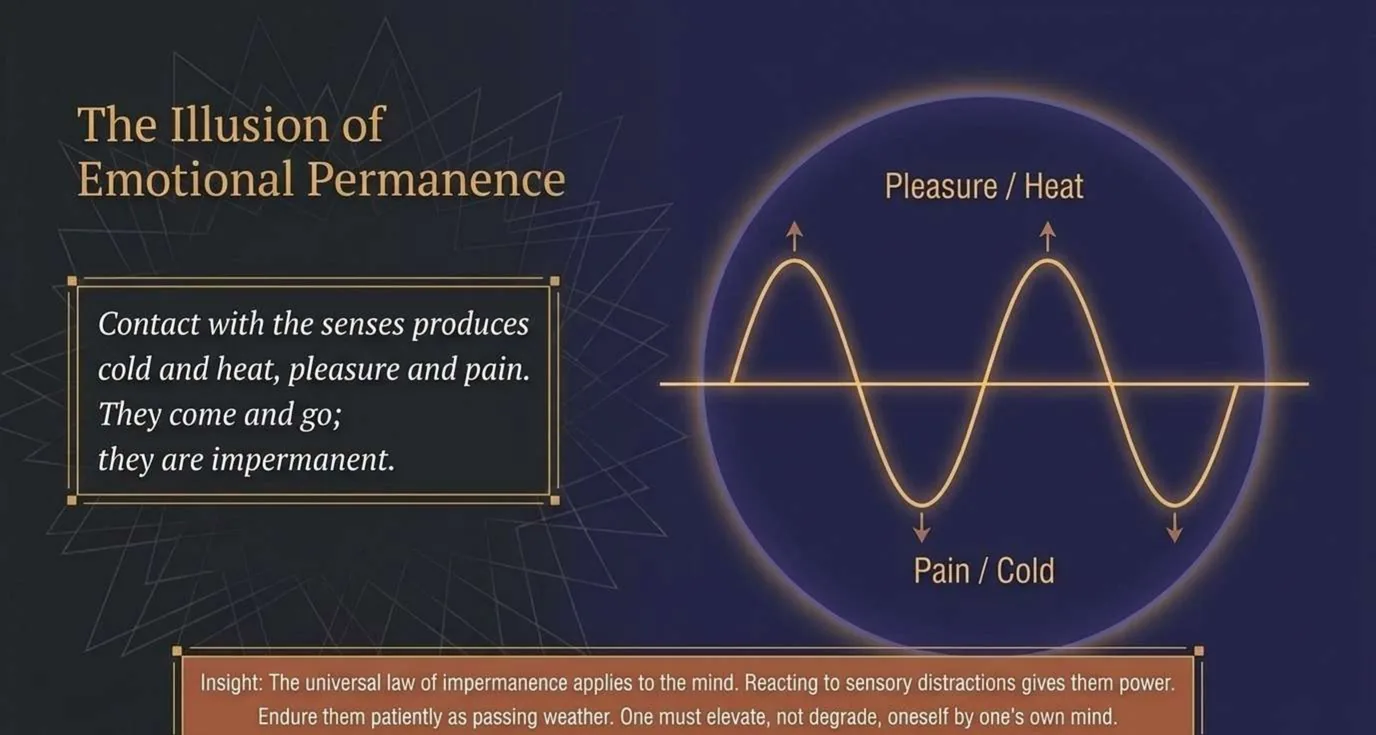
Honest limit: endure does not mean ignore. A feeling can carry real information about a situation. The verse’s claim is that intensity is not permanence.
The body stops the impulse. The mind processes what caused it. Use whichever door happens to be open.
Acute Overwhelm · The STOP Sequence
Neither of the two doors above quite fits when the flood is total — not one impulse, not one emotion to unpack, just every sense firing at once. This is the door for that: four steps, run in strict order, each aimed at one layer already mapped on this site — the koshas+Kosha means “sheath.” Yoga and Vedanta describe you as layered like an onion — body, breath, mind, and deeper still — with awareness itself at the center. Each layer is a sheath you can learn to notice, and work with, one at a time., worked from the outside in.
Target: Manomaya Kosha+The “mind sheath” — the layer of thoughts, feelings, and sensory processing. When you’re overwhelmed, this is the layer that’s flooded; most people live here without noticing it’s only one layer.. Drop your gaze or let your eyes unfocus for three full seconds. Nothing more — the point is just to stop feeding the mental sheath new input for a moment, which is enough to break the loop's momentum.
Target: Pranamaya Kosha+The “breath / vital-energy sheath” — the layer of breath and life-force that animates the body. It’s the easiest layer to influence directly, because you can change your breathing on purpose.. One belly breath, exhale twice as long as the inhale — the same 1:2 ratio behind the Anchor of Breath above. The long exhale is what tells the nervous system the danger has passed.
Target: Purusha+Pure awareness — the silent witness that watches thoughts, feelings, and sensations without becoming any of them. In this sequence, it’s the “you” that can step back and simply observe.. Silently re-label what's happening in the third person — not “I am angry,” but “anger is rising, the chest is tightening.” This is the Separation Technique from Full Attention, above, aimed at a moment of overload specifically.
Same chain used elsewhere on this site: Object → Senses → Mind (the projector) → Consciousness (the Screen). Whatever's flooding in right now is the film. The mind projecting it is not you. You're the screen it's playing on — unchanged by what's showing.
None of this is willpower. It's a sequence, run in the same order, every time — the mechanics do the work the effort can't.
Emotional Self-Management (ESM)
A tapping-and-breathing sequence you can run on one specific stuck feeling at a time.
There's nothing to lose by trying it once. Rate the feeling before you start, run the sequence, rate it again. If it moved, you have your answer. If it didn’t, you also have your answer — and that's a fine outcome too.
Tap to expand — the full six-step sequence, plus the tradition's own explanation for why it's built this way
Step 1 — Rate It
Bring the specific thing to mind. On a scale of 0 (nothing there) to 10 (as bad as it gets), how strong is it right now? Hold that number — you'll compare against it at the end.
Step 2 — Balanced Breathing (~2 min)
Sitting with a straight back, cross your left ankle over your right.
Extend both arms out, cross right over left at the wrist, interlock fingers, and rotate your hands inward and up to rest on your chest.
Inhale through the nose, tongue on the roof of the mouth. Exhale through the mouth, tongue on the floor. Hold the word “balance” in mind. Continue for about two minutes.
Order can be reversed (right ankle, left wrist) — what matters is that opposite sides cross.
Step 3 — Say It
Rub the sore spot on your chest — below, roughly three inches off-center above the heart; press around gently until you find a tender point — while saying, out loud, three times: “Even though [the problem], I deeply and completely accept myself.” Then tap under the nose a few times, and under the lip a few times, saying the same line once more at each. This pass isn't about the problem yet — it's clearing the reflex to reject yourself for having it, so the next step has room to work.
Chest (the sore spot) — about three inches off-center above the heart. Rub firmly in a tight circular motion, outward and downward, roughly once a second.
Under the nose — center point between nose and upper lip. Tap firmly with one or two fingers, three to four taps a second.
Under the lip — center of the chin, just below the lower lip. Tap firmly with one or two fingers, three to four taps a second.
Back of the hand — the dip between the knuckles of the ring and pinky finger, an inch toward the wrist. Flat four-finger tap. Not used until Step 5, below — shown here for reference.
Either hand works for tapping; switch freely.
Step 4 — Name It & Tap It
Tap the same three points again — chest, under the nose, under the lip — but this time say one honest sentence about what's actually happening, not the acceptance line from Step 3. A few examples, or use your own words:
“I forgive them, because they didn’t know how to do differently.”
“I forgive myself — I couldn’t have done differently.”
“I am comfortable with myself and others. I release the past.”
The only rule: it names the real thing, not a vaguer stand-in for it. Say it three times, tapping through the three points once per repetition.
Step 5 — The Bridge
Find the back-of-hand point shown in the diagram above, and tap it continuously with your other hand through all of the following. Eyes open, then closed. Glance down-right, then down-left. Circle your eyes fully one way, then the other — head still, only the eyes moving. Hum a few notes. Count to five out loud. Hum again. Roughly thirty seconds total.
Step 6 — Repeat & Recheck
Tap through the three points once more, saying Step 4's sentence three times. Then check the number from Step 1 again. Moved down, stayed the same, or moved up — any of the three tells you something. If it's not at zero, you can simply repeat the cycle, or stop here for today.
Where the Method Comes From
Traditional Explanation
The tradition this comes from describes the body as running on an electrical polarity — top/bottom and left/right — and treats a stuck emotion as a local disruption to that polarity, with the tapping and crossed postures meant to restore it. That's the framework's own account of why it might work, not a claim this site is making. Nobody has established that literal electrical polarity is the mechanism; what's better supported is that any of several plainer things could be doing the work here — focused attention on the feeling, the rhythm of repeated touch, or simply pausing to name a feeling honestly out loud. The steps above are worth trying regardless of which explanation is right.
A Related Lens · The Open Cage of Repentance
Step 4's guilt line above — “I forgive myself, I couldn’t have done differently” — is doing more than it looks like. In Zen, repentance is pictured as a birdcage. Most people either leave the door shut, trapping the bird, or leave the cage empty, pretending nothing needs holding. The instruction is neither: paint a cage with an open door, and simply wait in it.
Not shutting yourself off from what you did. Not staying locked inside the guilt either. Just enough structure to hold the feeling honestly, with the door already open the entire time.
The forgiveness in Step 4 isn't a trick to make the feeling go away faster. It's the open door.
This is light fingertip tapping and slow breathing, not needles — there's no wrong way to do this that causes harm. The worst case is nothing changes, not that something goes wrong.
Not a treatment for trauma, phobias, or a clinical condition, and not a substitute for one — for those, see a professional. This is a self-run experiment you can try once and judge for yourself, not a claim about what it will do for you.
The 1% Method — Kaizen for the Nervous System
Not a new insight, but a way of actually keeping the ones above. A resolution usually doesn’t collapse from weak willpower — it collapses from a step sized wrong for the nervous system running it.
The amygdala hardware already covered on this site doesn’t only fire at threats — it fires at drastic change. Kaizen (改善, “good change”) is the practice of staying small enough, every time, that the alarm never trips at all.
Tap to expand — why drastic resolutions fail, and the three-step method that doesn’t
Applied Framework
Why Drastic Goals Fail
A sudden, large demand on behavior reads to the amygdala as a threat, and the fight-or-flight response it triggers crowds out the very willpower the goal needs. A step small enough to feel like it barely counts stays under that alarm threshold — and gets taken anyway.
| The Resolution Approach | The Kaizen Method | |
|---|---|---|
| Focus | The end goal, all at once | The process, one micro-step at a time |
| Timeline | Instant, or the 21-day myth | Continuous — real habit formation runs 18 to 254 days |
| Nervous system | Trips the amygdala’s alarm | Stays under the threshold entirely |
| Typical outcome | High burnout, often by mid-January | Cumulative, durable change |
The Method, In Three Steps
Rate your current satisfaction — Health, Work, Money, Home, Relationships — on a simple 1-to-10 scale, each. Pick exactly one area to start with, to avoid overwhelming the system.
Where am I now, really? Then, what would meaningfully better look like, long-term? Then, the only one that matters today — what is the smallest, least disruptive step I could take in the next 24 hours?
A grid where you colour in a box on any day the 1% step happened. Nothing else. The tracking itself — not the scale of the step — is what builds the evidence that you keep your own word.
A goal like “meditate daily” sized down to Kaizen scale might start as: sit for the exact length of one song, once, today. That is the whole target. Anything beyond it is a bonus, not a requirement.
Case in Point
In 2002, the British Cycling team had never won an Olympic gold. Rather than chase a medal directly, its coaching staff broke the entire system down — aerodynamics, diet, sleep, even how the team washed their hands — and aimed for a 1% improvement in each separate part. By the 2008 and 2012 Olympics, the same team won 7 of 10 possible gold medals. No single 1% was impressive. The aggregate was.
In Kaizen, this spreading is called Yokoten — copying what works in one area of life into the next. A 1% win in sleep tends to fund a 1% win in exercise, which tends to fund one in work. You don’t need a drastic resolution. You need your first 1%.
The 5 Pillars of Self-Enquiry
Answer honestly.
Tap to expand — the five pillar questions
Who am I?
Your gift, distilledDiscovering your passion, attributes, and legacy. If you had one gift of value for the world — what is it? Not your job title. Not your resume. The singular thing only you can bring.
Where am I from?
Your source & conditioningUnderstanding your spiritual source and your current baseline reality. What shaped the lens you see through? What do you carry that you didn’t choose? And what of it is actually you?
Why am I here?
Your purpose, namedDefining your innate purpose and the specific problems you are uniquely built to solve. Not what the world needs from everyone. What it needs from you specifically.
What can I do?
Your gifts, in actionActionable service. Developing the strategic route to deploy your gifts. The gap between knowing your purpose and actually serving it is practice — not revelation.
Where am I going?
Direction, not destinationDefining your ultimate destination and vision to empower your true potential. Self-realization is direction, not arrival. Are you pointed right? That is the only question that matters.
Write them down in the workbook, or return to them anytime in the Web Companion.
Looking for Ramana Maharshi’s method of tracing the “I”-thought to its source? That is Atma-Vichara.
Attention practice is not automatically safe just because it is popular.
Structured programs show genuine results in relapse prevention, stress reduction, and even changes in gray matter density.
Strip a contemplative practice of the ethical intention behind it and you risk depersonalization, surfacing old trauma, or the disorienting territory some call the Dark Night — already flagged elsewhere on this site.
Attention without the “why” behind it doesn’t become dangerous — it just shrinks. What was self-enquiry becomes a stress-reduction technique with the inquiry quietly removed. If a practice here ever surfaces something that feels bigger than technique can hold, that is the moment for a licensed professional, not a harder push through the exercise. See the disclaimer for where to go from there.
You don't have to leave the world.
Ancient seers mapped two routes to the same center — both walked while remaining an active participant in life.
Jnana
ज्ञान — KnowledgeRadical intellectual inquiry. Strip away everything that is false until only what is true remains. The relentless question: “Who is aware of this thought?” For the solitary, rigorous seeker who trusts the mind to outrun itself.
Bhakti
भक्ति — DevotionSurrender precedes knowledge. Devotion over doctrine. The practitioner in the marketplace, the parent, the trader — who finds the SELF not by withdrawing from life but by offering it.
A form to worship isn't in tension with a formless goal — see why, further down.
Both paths lead to the same *SELF.
The question is only which door you are walking through.
The Five Stages of Surrender
In the Sivananda Lahiri, Adi Shankaracharya maps the melting of the individual ego through five vivid metaphors — from strenuous individual effort to effortless, absolute wholeness.
Tap to expand — the five stages of surrender
The seeker must take the difficult first step. This represents conscious, individual effort toward the divine — the hardest stage, because it happens entirely by your own will.
The universe meets you halfway. The rigid ego begins to soften. Synchronicities appear. What felt like effort begins to feel like a current you are floating in.
A true partnership where individuality melts into a shared purpose. The material and the ultimate are no longer in conflict. This is the stage of the active participant in the world.
The seeker realizes they cannot exist independently of the universal support structure. Deep trust replaces anxiety.
The river pours into the ocean, permanently losing its individual name and form. The restlessness of the mind ceases completely. There are no longer choices — only flow.
You do not need a saviour to walk this path.
The path does not begin when someone rescues you. It begins the moment you stop waiting for rescue.
Across traditions, the instruction is similar: the inner voice has always known the way.
Buddha’s Final Teaching
“Be a lamp unto yourself, be a refuge to yourself. Take yourself to no external refuge”
These were the Buddha’s final words. Not a doctrine. Not a deity. A direction: look inward.
Jnana names the door above. Here is how one sage actually walked through it.
In 1902, a young seeker climbed Arunachala+The sacred hill in Tiruvannamalai, South India, where Ramana Maharshi lived from age sixteen until his death in 1950 — revered in the tradition as Shiva himself in the form of a mountain. to ask Ramana Maharshi+1879–1950. A South Indian sage who taught almost entirely through silence and through one recurring instruction — trace the “I”-thought back to its source. His recorded answers to a disciple's questions were later published as Nan Yār? (“Who am I?”). fourteen questions about the nature of the mind. The answers, later published as Nan Yār?, don't add a new philosophy to what's already on this site — they give the Jnana path above an actual set of hands and feet.
Tap to expand — six cards, from the geography of the “I”-thought to non-attachment and surrender
The Geography of Consciousness
Where the “I”-thought is born, and the two directions it can travel
Ramana located the rising point of the “I”-thought at the Heart+Not the physical organ, and not a chakra in the usual sense — Hridayam, the spiritual heart-center on the right side of the chest, described as the seat from which the “I”-thought first rises and to which it can be traced back. — not the brain. From there, consciousness runs in exactly one of two directions.
The “I”-thought runs out through the brain and sense organs and lands on gross names and forms. Result: the mind goes out, the world appears, the Self is obscured.
The same thought is restrained at its point of origin instead of chased outward. Result: names and forms disappear, the mind ends, and the Self is left standing as the residue.
The Six-Step Algorithm
What “asking Who am I?” actually consists of, step by step
Any thought at all. It makes no difference how many arise, or how urgent each one feels.
The thought is not argued with, elaborated, or acted on. It is simply not followed downstream.
Instead of following the thought's content, the question turns back onto the one experiencing it.
Every single thought, traced back, resolves to the same claimant. There is no thought without an “I” underneath it.
Not answered conceptually. Held as a question with nothing to elaborate and nowhere else to go.
The thought becomes quiescent. Repeated, this is the entire method — not one insight, but a return practiced every time a thought pulls outward.
“The thought ‘Who am I?’ destroys all other thoughts, and like the stick used for stirring a burning pyre, it will itself in the end get destroyed.”
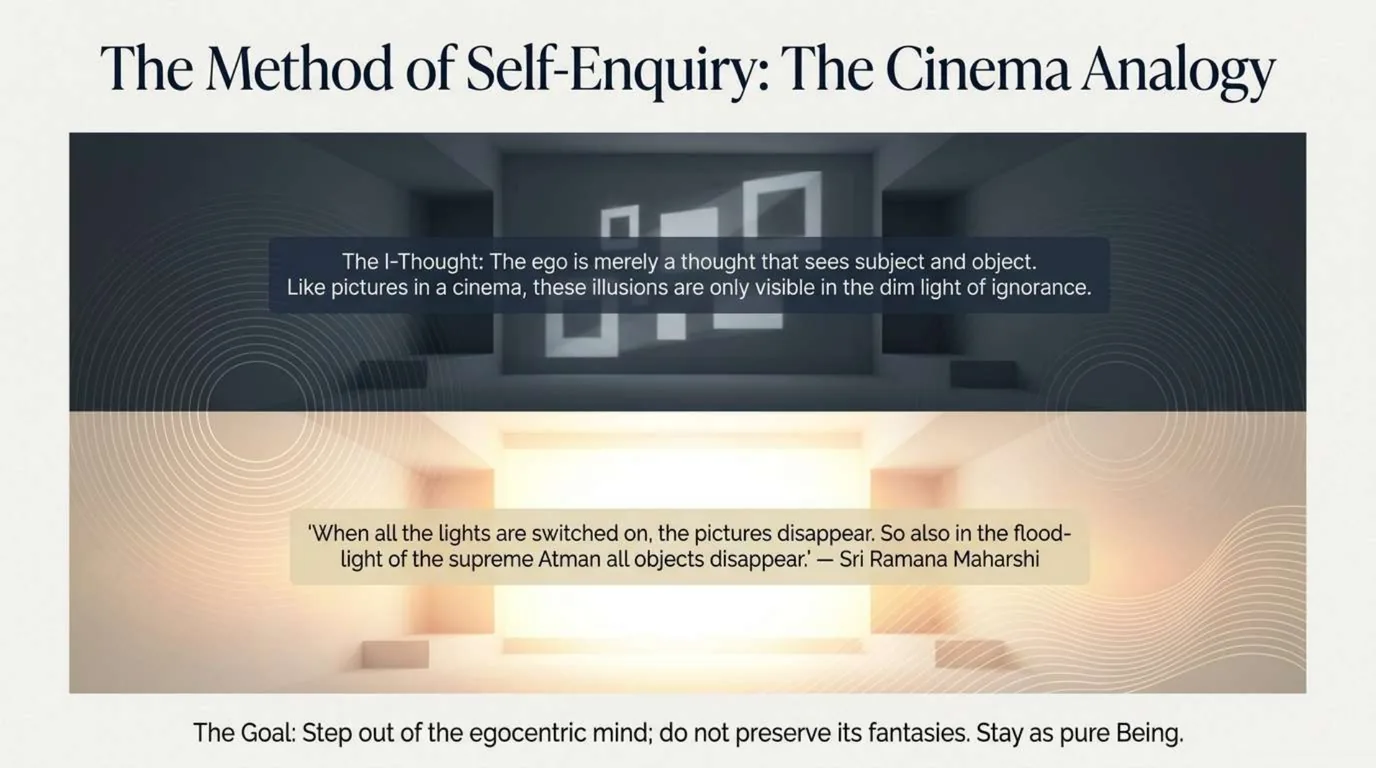
Two Ways to Quiet a Mind — Only One Is Permanent
Manonasa+Sanskrit for the destruction of the mind at its root — what Self-Enquiry aims at, as distinct from Manonigraha. vs. Manonigraha+Sanskrit for the temporary suppression or stilling of the mind — what breath-control, mantra, and other auxiliary aids achieve, without touching the root.
| Mechanism | Technical Result | Permanence | |
|---|---|---|---|
| Self-Enquiry | Cuts the root — the “I”-thought — from which all else originates. | Manonasa: destruction of the mind. | Permanent. The mind is destroyed at the source. |
| Auxiliary Aids | Breath-control, mantra, form meditation, restrictive diet — occupies the wandering mind with a single point. | Manonigraha: the mind rendered quiescent, temporarily. | Temporary. Once the aid stops, residual impressions send the mind wandering again. |
Effort and Grace
Two questions the method raises about who does the work
God and the Guru are not different — both show the way, but neither carries the seeker there. “Just as the prey which has fallen into the jaws of a tiger has no escape, so those who have come within the ambit of the Guru's gracious look will be saved — yet each one should by his own effort pursue the path.”
One can know oneself only with one's own eye of knowledge, not with somebody else's. “Does he who is Rama require the help of a mirror to know that he is Rama?” Books and textual analysis are ultimately futile — the Self is within the five sheaths; books are outside them.
The Pancaratra Agamas draw the same tension in one picture. The binding is beginningless, laid down by vasanas, and effort alone does not undo it. The release begins when the Antaryamin, the Inner Controller, turns the soul toward the truth.
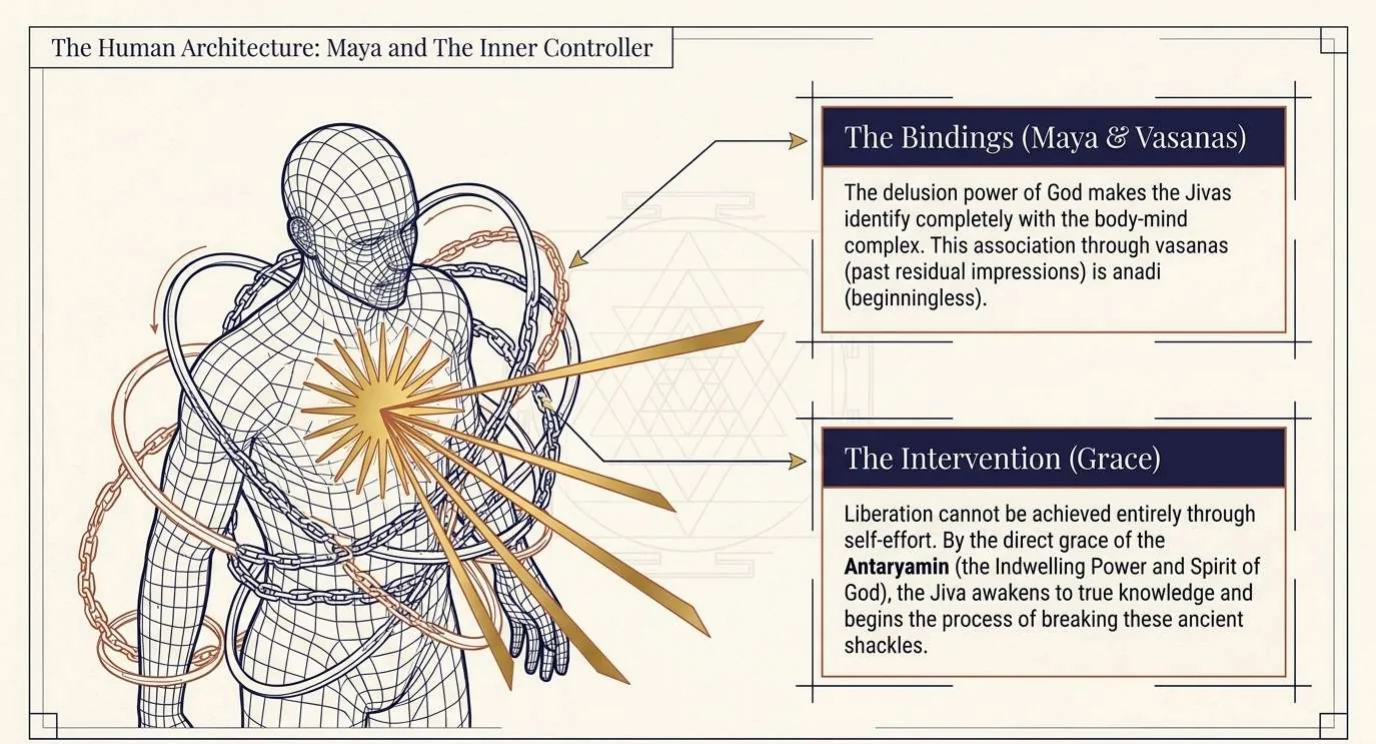
Honest limit: Pancaratra places grace in a personal God. The Advaita reading on this page puts the Guru’s look, and the Self’s own pull, in that place. The shape of the claim is shared: effort is necessary and not sufficient.
Who Gets Tired
Work and the sense of doing it are not the same thing
Two days. Same hours, same task list. One leaves you emptied. The other leaves you quiet. The workload did not change. Something else did.
Act as if all of it is yours to maintain. Full effort. No hiding behind “not my job.”
Hold that the doing is not only yours. Outcomes were never in your hands to carry.
Held apart, each one breaks. Responsibility alone becomes a weight. Surrender alone becomes an excuse. Held together, work has somewhere to rest.
Look at the last thing that drained you.
Was it the work? Or was it “I have to make this turn out right”?
Find the “I” in the sentence. Notice what it costs to carry.
Non-Attachment & Surrender
The two metaphors Ramana returned to most
Two images Ramana returned to again and again when asked what surrender actually feels like from the inside — one about carrying weight you no longer need to carry, the other about what it takes to reach something worth having.
“We know the train carries all loads. After getting on it, why should we carry our small luggage on our head to our discomfort, instead of putting it down? God's supreme power makes all things move. Surrender means remaining constantly in the Self without worrying about what should or should not be done. He bears the burdens.”
“Just as the pearl-diver ties a stone to his waist, sinks to the bottom of the sea, and takes the pearls, so each of us should be endowed with non-attachment, dive within, and obtain the Self-pearl.”
You are not your body. Even the ugliest form is filled with radiance.
Somewhere between the 8th and 14th centuries, an anonymous author took Shankaracharya's non-dualism and stripped it of every remaining trace of doctrine, deity, and gradual path. The result, the Ashtavakra Gita+A dialogue between the sage Ashtavakra and King Janaka, of uncertain date (roughly 8th–14th century C.E.), considered one of the most radical statements of Advaita — it offers no ritual, no deity, and no gradual path, only direct pointing., doesn't argue for non-dualism the way the Brahma-Sutra-Bhasya does above. It simply talks as though the reader is already free, and waits to see what that does.
Tap to expand — four cards, from the myth of Ashtavakra to the clear space the five renunciations lead to
The Myth of Ashtavakra
“Crooked in eight ways” — why the teacher who erased the self was born deformed
While still in the womb, Ashtavakra corrected his father Kahoda's recitation of the Vedas. Cursed by his insulted father, he was born with deformed limbs — “eight twists.” At age twelve, he traveled to King Janaka's court, defeated the scholar Bandin in debate, and proved the absolute oneness of God.
“The body is nothing, the Self is everything. Even the ugliest form is filled with God's radiance.”
The physical vessel is the illusion the text spends its length dismantling. A visibly broken teacher, delivering a gospel of absolute self-effacement, is the point — not an irony to explain away.
The Paradox of Practice
Why striving for God and striving to look spiritual are not the same striving
“Striving is the root of sorrow.” The fool presumed to be a seeker practices strenuous indolence — running around puffing himself up looking for God, busily making excuses for not finding himself. Bound by the habit of meditation.
“Who is lazier? He has trouble even blinking!” A child, a fool, a man asleep, a leaf tumbling in the wind. He sleeps soundly without sleeping. He is busy but does nothing. Unsmudged by right or wrong.
We are already perfect. But dealing with our ignorance requires Sadhana+Spiritual practice, or effort — here, not the building of a new self, but the systematic abandonment of strenuous self-estrangement. — not to build a new self, but to systematically abandon our strenuous self-estrangement.
The Dissolution Arc — Five Renunciations
The text's own path, ending by renouncing the path itself
The starting renunciation, and the easiest one to state without yet meaning it.
Not sensory deprivation — refusing to let the senses' pull count as evidence of who you are.
The mind keeps changing its verdict. Ceasing to treat its latest verdict as you is the third renunciation.
Even the discipline that got you this far becomes something to release — a raft, not a residence.
The final turn: non-attachment itself, held as an achievement or identity, is one more thing to be free of. Nothing left to renounce, because there's no longer anyone renouncing.
“Let yourself dissolve. You are pure.”
Cidākāśa+Sanskrit for “the space of consciousness” — awareness described as a clear, unbounded space rather than a state to attain or a thought to think. — The Clear Space
What's left once all five renunciations are actually complete
Not a state reached after the fifth renunciation, but what was already the case underneath all five — described here in the text's own words rather than explained around.
It is easy.
You are the clear space of awareness,
pure and still,
in whom there is no birth,
no striving,
no “I.”
The Text's Own Final Gesture
“Who is the seeker? What has he found? Who is the disciple, and who the master? For I have no bounds. I am Shiva. Nothing arises in me. In whom nothing is single, nothing is double. Nothing is, nothing is not. What more is there to say?”
With its last gesture of self-erasure, the anonymous master dissolves even the voice of spiritual inquiry that carried the whole text this far — including, by the end, itself.
Traditional Source — Patanjali’s Yoga Sutras, Book IV, and the Kaivalya Upanishad.
When the seer is free, what becomes of the field?
The Dual Purpose lays out the arc: experience first, liberation second. It stops at the door. Patanjali doesn’t. His last chapter is named for what comes after: Kaivalya+Literally “aloneness” — in the Yoga Sutras, the state in which consciousness stands in its own nature and the field no longer has work to do for it. Not loneliness: nothing is missing, so nothing is sought from another..
Tap to expand — four cards: how the ripening ends, what remains once the seer is free, why “alone” is not lonely, and the two ways liberation lands
The Ripening — Sutras IV.29 to IV.32
How the last chapter gets from effort to rest, in six movements
Sutra IV.34, below, says the Gunas fold back into their source. These earlier sutras say why they can. The order here follows the commentarial reading of the chapter as one arc; the sutras themselves are terse and do not number their own steps.
Virtue stops being something done and becomes the only thing present. The commentary’s image is goodness raining down like nectar, because divinity shows itself in full. The negative is not fought off; it is absorbed into the positive.
The five afflictions+The five Klesas — ignorance, ego, attachment, aversion and fear of death. The root pattern that keeps karma running. and the karma they drive end at the same moment, not one after the other. Karma is how the Gunas bind an individual, so when it goes, the binding goes with it. The image: the sun appearing in a clear sky after a heavy downpour.
Tamas obstructs with torpor and sleep. Rajas is subtler and keeps the mind oscillating. Sattva is last: a golden chain, a clean pane of glass that reflects Truth perfectly and is still a barrier to union. A layer can be fine and still be a layer.
Two things lift. The veil is Avidya, the ignorance covering consciousness. The dirt+Mala — the specific impurities of desire, anger and greed, as distinct from the veil of ignorance that covers consciousness. is desire, anger and greed. Once the heavy obstructions are cleared, the last movement is so fast that the stages cannot be tracked as they pass.
Ordinary knowledge is informative: a knower here, an object there, and the bigger the object, the less room is left in the knower. Intuitive knowledge enters the object instead of looking at it. When knowledge is infinite the knowable becomes little — not because the world vanishes, but because there is no room outside the knower for an extra object to stand in.
The succession of change ends. The Gunas existed to give experience, a training ground for the spirit. Once the spirit is trained, the nucleus of desire is gone and matter stops gravitating toward form. They are Kritartha+Literally “one whose purpose is done” — said of the Gunas once they have finished giving the spirit its training in experience (Sutra IV.32). — purpose fulfilled. Pull out every brick and the building ceases to be: nothing is attacked, the parts simply disperse.
Samapatti+Sutra I.41 — the mutual commingling of knower, knowing and known, so that the three no longer stand apart. (I.41) describes the same collapse from an earlier rung: knower, knowing and known commingle until knowledge is the only reality left. Here at the end the three have nothing left to stand apart in.
“Liberation is not acquiring new territory. It is dissipated energies coming home.”
The commentary’s metaphor for why this feels like return, not gain: facing outward at sense objects is a war that bankrupts the spiritual economy, restlessness is the energetic immune system fighting off attachment like a fever, and liberation is the prodigal energies going back to the source.
Honest limit: this is one commentary’s reading of the sutras as a sequence. The text does not promise anyone will feel it in this order.
Source: Patanjali, Yoga Sutras I.41, IV.29–IV.32.
What Remains — Sutras IV.34 and II.22
The Gunas fold back, and the world carries on for everyone else
Sutra IV.34. The Gunas, with no purpose left to serve for the seer, fold back into their source. Consciousness abides in its own nature. Nothing is destroyed. The field is no longer being asked to work. The mirror has served its purpose. Sutra I.3 says the same from the other side: then the seer rests in its own nature.
Sutra II.22. For the one whose purpose is fulfilled, the world has ceased. For everyone else it has not, because it is shared. Liberation is not the deletion of the universe. It is one seer no longer needing it.
Stated plainly: two sutras, one point. The world’s work for this seer is done. Neither sutra says the world is unreal, and neither adds anything further to reach.
Not a claim to accept. A place to look. What is the world still being asked to do for you?
Source: Patanjali, Yoga Sutras I.3, II.22, IV.34.
Alone, Not Lonely
What kevala does and doesn’t mean
The word Kevala+“Alone, sole, unmixed” — the root of Kaivalya. It means wholeness with nothing added, not isolation with something missing. is easy to hear as isolation. Set the two side by side and they come apart.
Physical isolation, and the felt gap where an “other” should be. Rooted in lack, limitation and the ego. It is aloneness with something missing.
Utterly solitary, yet completely whole. No trace of a need for another to fulfil you. Individual consciousness expands to contain the whole cosmos, so there is no outside left to be cut off from.
Hold it against the Origin of Desire card in The Great Forest of Being: the Original Being, alone, felt no joy and made itself two. That is aloneness with a lack in it. Kaivalya is the same word with nothing missing.
One care is needed. Patanjali’s Yoga is dualist: Kaivalya there is the seer standing apart from the field. The Kaivalya Upanishad is non-dual: the Self with no second. The two schools do not mean quite the same thing by “alone”. What they share is the relief at the end of it, nothing further needed from outside.
Source: Kaivalya Upanishad (Krishna Yajurveda); Patanjali, Yoga Sutras IV.34.
Two Ways It Lands
Within a life, and after it
The Upanishad counts Kaivalya the highest form of Moksha because it covers both standings.
Freedom in this life, in a living body. This is what IV. Phala means by liberation lived out, not merely believed.
Freedom that remains once there is no body left to live it in. Nothing is lost at that point, because nothing was being held.
The Upanishad’s own voice for the standing: smaller than the smallest and larger than the largest, with everything arising from, resting in and dissolving into the Self. Enjoyer, enjoyed and enjoyment collapse into a witness that is already complete.
Source: Kaivalya Upanishad (Krishna Yajurveda).
The Burnt Cloth
A burnt cloth keeps its shape. It holds nothing.
The tradition says the five sheaths may still appear to one who has seen through them. They keep their perceptibility and lose their substantiality. They are still seen, but there is nothing in them to be taken as the Self. The appearance stays and the substance doesn’t.
Why nothing is left in them: the sheaths were never what the Self was. Taking them as the Self was Adhyasa+Superimposition — mistaking the attributes of one thing for those of another, the way dim light lets a rope be mistaken for a snake. Here, the attributes of a limited body-mind get superimposed onto the limitless Self., and seeing through it is the burning. What is burnt is the claim, not the cloth.
The Knot Cut
The Mundaka names what happens when the seeing lands, in four clauses. The knot of the heart is cut. Every doubt is cleared. The store of action runs out. One who knows Brahman becomes Brahman.
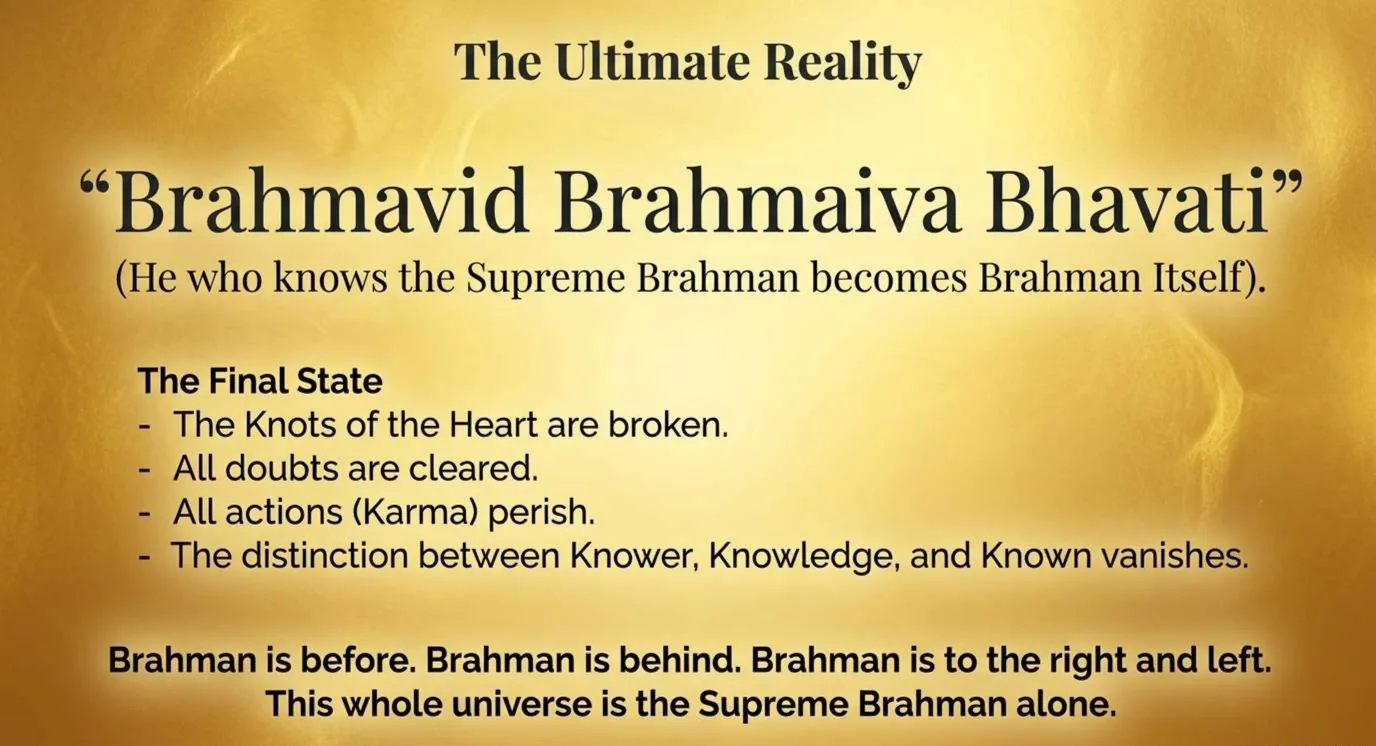
Notice what the list leaves out. No new place, no new state. The knot is the claim that there is a separate someone to protect, and the doubts are the questions that claim kept producing. The same Upanishad gives the image: rivers running into the sea give up name and form there. Nothing travels. It stops being called a river.
Whether that is read as here and now or as what the fall of the body completes is the split laid out in Two Ways It Lands.
Honest limit: “becomes Brahman” sounds like a promotion when read fast. In Advaita it is a recognition of what was already so.
Which doubt still needs a someone to hold it?
Source: Mundaka Upanishad 2.2.8–9, 3.2.8–9
One says home is a place you have never been. The other says you are already standing in it.
Vedic cosmology and Zen mindfulness both begin by naming the same ache — birth, aging, and death as friction no one asked for. They part ways completely on where the exit is.
Tap to expand — three cards, the cosmic journey compared with the internal journey, the present moment, and patience
The Cosmic Journey vs. The Internal Journey
The comparison table and the two-directions summary
| The Cosmic Journey (Vedic) | The Internal Journey (Zen) | |
|---|---|---|
| The Core Problem | The biological cycle of birth, aging, disease, and death. | Mindless wandering, anxiety, and disconnection from reality. |
| Nature of Reality | A temporary, destructive material world set against an eternal spiritual sky. | The singular, encompassing reality of the Present Moment. |
| Ultimate Destination | Vaikuntha — a transcendental location beyond the material sky. | “Here” — an immanent state of being, not a place at all. |
| Role of the Body | A temporary overcoat, ultimately discarded. | The essential anchor required to touch the present. |
| Primary Vehicle | Bhakti-yoga — devotional focus of the mind. | Mindfulness — breath and conscious awareness. |
⟳ Tip: turn your phone to landscape for a wider view of this table
One path travels outward — across dimensions, toward a sky beyond birth and death.
The other travels inward — zero distance, toward the exact coordinates of here.
Opposite directions. Same instrument.
Not breath. Not distance. Not ritual. Concentrated awareness — aimed far, or aimed close. The rocket is useless either way. The mind was always the ship.
What “The Present Moment” Actually Means
Zen's own account of the Internal Journey row above — not a mood, a specific claim about time
The ordinary picture of time is a single heavy line, the past pushing into the future through a thin seam called “now.” Dainin Katagiri+A 20th-century Zen teacher who brought Soto Zen practice to the American Midwest, known for grounding abstract teaching in the texture of ordinary daily life., working from older Zen sources, describes something else: a single moment already contains 65 ksanas+Sanskrit/Pali for “instant” — the shortest conceivable unit of time in classical Buddhist thought, used here to argue that a moment isn't a slice of a line but a complete, self-contained event. — instants, each one complete in itself, each one already finished before the next arises. Not a bridge between what came before and what comes after. A sealed bubble, with nothing to hold onto and nothing that needs to be let go of.
Read this instant as evidence for a story about yesterday, or a rehearsal for tomorrow.
This instant was never carrying that weight. It arose, complete, and is already gone.
A cheap plastic bowl never breaks — and no one cherishes it. A fragile china bowl gets held carefully, admired, kept for years, precisely because it exists in a dangerous situation, always fading. Life and death are the same — “just going, just coming.” Nothing here escapes that danger. The instruction isn't to escape it either: it's to take the best possible care of what's fragile, right in the middle of its fading, and let it bloom anyway.
“And what is it, the heart? It is the sound of the pine breeze there in the sumi painting.” — Ikkyū Zenji
Mind is not a frantic machine chasing the next instant. It's the rhythm underneath this one — already complete, the way a breeze is already whole inside a painting that isn't moving at all.
Why Patience Isn’t Passive
Nothing here is new. Everything is coming back around
Impermanence says things end. Recycling says something more useful: they return in another form. The water in your glass has been rain, river, cloud, and ocean. The situation you are impatient with has been many situations. It will be more.
Patience. Accept this moment fully. Nothing in it is final or new.
Dynamism. Your time in this form is short. Move as if it is.
Patience without dynamism is sleep. Dynamism without patience is panic. The pair is the point.
What are you hurrying that will come around again anyway?And what are you postponing that will not?
42SELF Interpretation — our own synthesis of Western psychotherapy and Eastern practice, not a claim either field makes on its own.
Neither East nor West alone. Together, they become whole.
Western psychotherapy and Eastern wisdom traditions are not opposites. They are complements. But to integrate them, you must first understand what each got right — and what each missed.
Tap to expand — East meets West, in four steps
Step 1 — The Two Hemispheres
The Western Paradigm
The Head
Extroverted and materially developed. Gives us vocabulary to name our suffering, understand our patterns, and build cognitive insight. Maps the cause.
Strength: Psychology · Clarity
Gap: Ignores the Spirit
The Eastern Paradigm
The Heart
Introverted and spiritually developed. Holds the mind as an ecology, not a mechanism. Suffering is a vital message. Completely absorbed in inner depths — often failing to develop external potential.
Strength: Spirituality · Spaciousness
Gap: Fails external development
Two isolated pillars cannot merge at the base — they must be joined by a roof that spans the divide.
Step 2 — The Western Conflation, Resolved
Biological and physical. Governed by laws of time, space, and causation. Like a pot — a fixed container that stays largely the same. The outer crust.
The inner instrument (antahkarana+Literally “the inner instrument” — the collective term in Vedanta for mind, intellect, memory-store, and ego-sense together: the machinery through which consciousness processes experience.). A finer body, constantly changing. Like water in the pot — it changes shape, absorbs new properties, and dictates what the vessel actually holds.
The Atman+The individual self, in Advaita Vedanta — held as identical to, not separate from, universal consciousness. — the True Self. Ever free, infinite, eternal, and unchanging. The Sun, not the Moon. The Mind has no light of its own; it shines only with the borrowed radiance of Consciousness.
The West confuses the pot with what is put into it. Until the absolute distinction between Brain, Mind, and Consciousness is clear — no true integration is possible.
Step 3 — The Trinity Synthesis
East and West cannot simply meet in the middle. The gap cannot be crossed on the level of mind alone.
The vessel, the external environment.
The reflector, inner reflectiveness.
Only when body and mind are in balance can a relationship with the Soul be forged. The meeting point is not in the middle ground — it is formed above it.
The Trinity above is the map. Here is what it looks like the moment a wave of feeling actually rises.
The wave rises and is immediately read as a story — what it means, who caused it, what it says about you. The story keeps the wave in circulation. It returns later, unchanged.
The wave rises and is met as sensation, before the story forms. Nothing needs to be fixed or explained. It moves through, and finishes.
The difference isn’t which side is stronger, mind or soul. It’s whether the wave is met by something steady enough to hold it while it moves. Two things tend to make that possible: a ritual — the same small form, repeated, so feeling has somewhere expected to go — and enough time away from the clock’s pace for it to actually finish.
Symptoms are often a healthy response to an unhealthy environment.
"It is never about resolution. It is more about spaciousness. How expansive can I become? Become immense."
— James Hillman
The Foundation
The universe doesn’t contain Consciousness.
Consciousness contains the universe.
*SELF is the practice of knowing that from the inside.
Each tag also asks for its own kind of test. Traditional Source: does it hold when practised? Modern Research: does it replicate? 42SELF Interpretation: does it cohere with the rest? Applied Framework: is it useful? These pairings are ours, not the traditions’ or the researchers’.
Nothing here asks to be believed. Check it against what you find when you look.
“We have exchanged a cosmology of connection for an ideology of separation. We have demarcated ourselves from the world. The human and the sacred has been forgotten.”
— Francis WellerHow the universe reaches you
The chain through which all experience arrives — and the single shift that changes everything.
Realization is the process of recognizing that you are the Screen — not the movie being projected upon it.
The world, your thoughts, and your emotions are the film. The screen remains unchanged by whatever plays upon it. You are that unchanging screen.
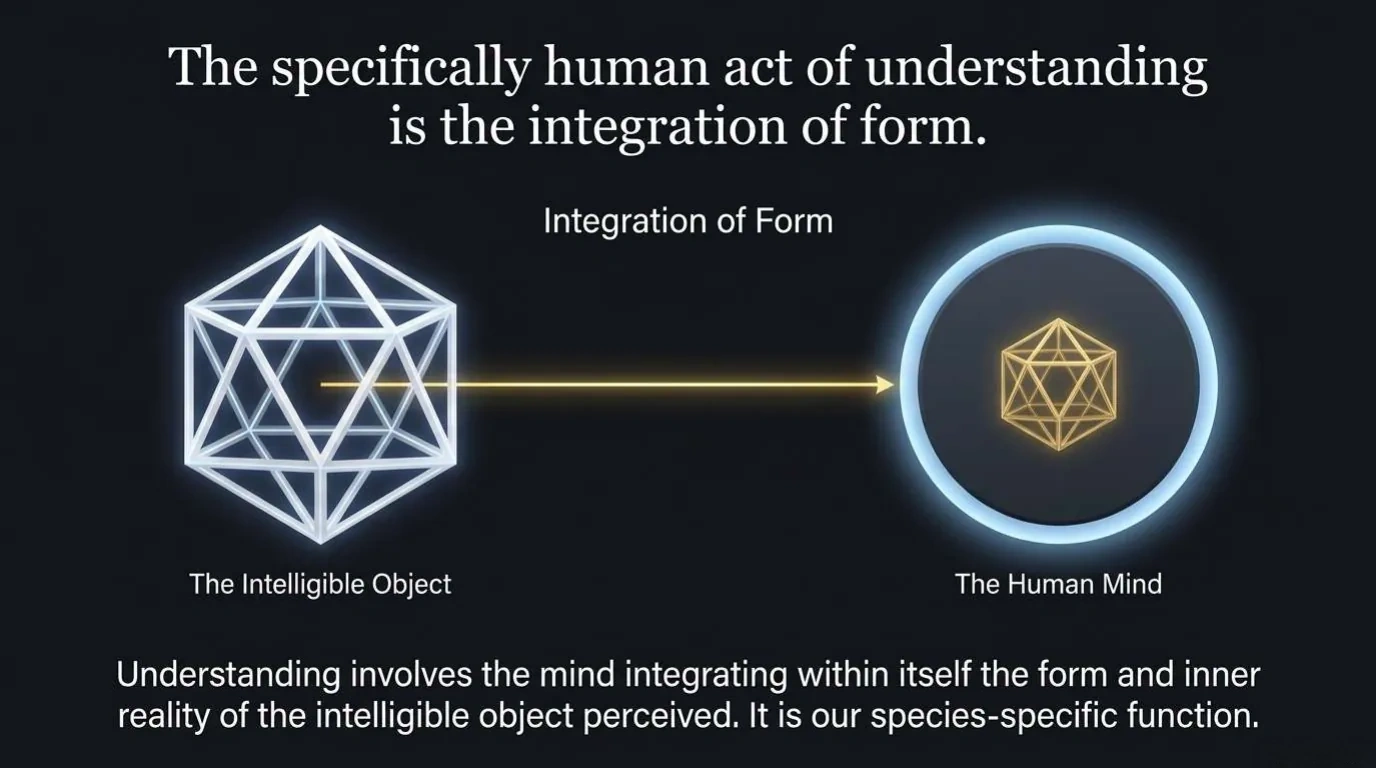
Between Object and Consciousness, the mind does one thing: it takes the shape of what it meets. The tradition calls that shaped mind a Vritti+A fluctuation or wave of the mind-stuff (Chitta) — stirred up by the senses, rippling across an otherwise still lake of awareness.. Aristotle described understanding almost the same way, as the mind taking in the form of the thing known. While the mind is shaped like the cup, the cup is all that shows. The one who knows the shape is not in the shape.
Right now, what shape is the mind wearing? And who is noticing?
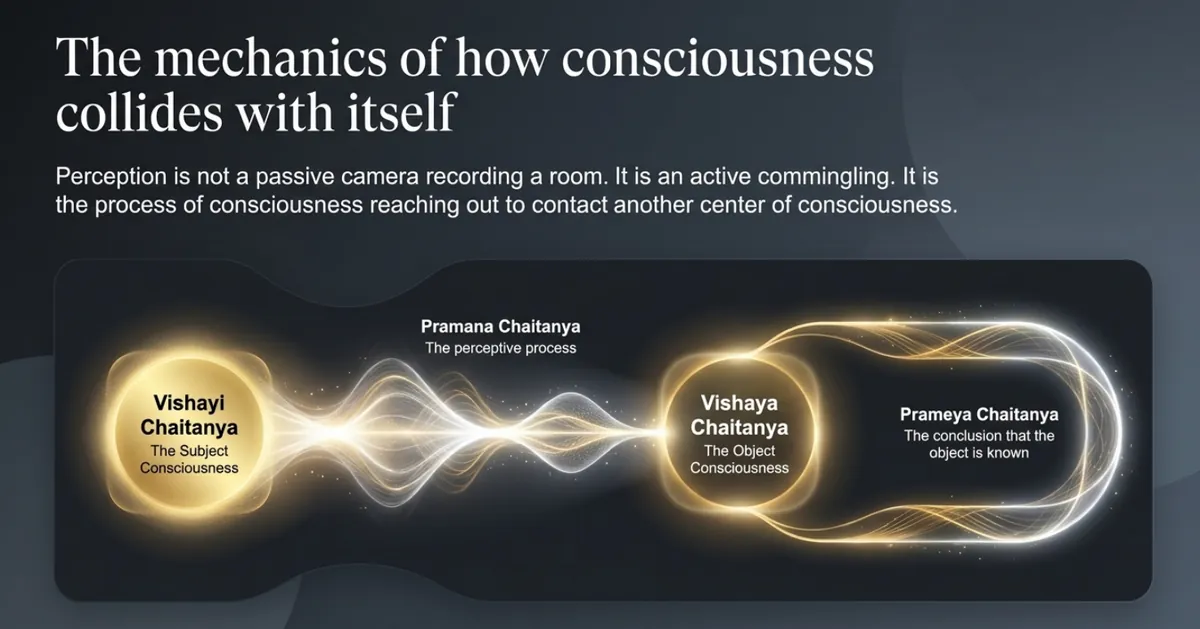
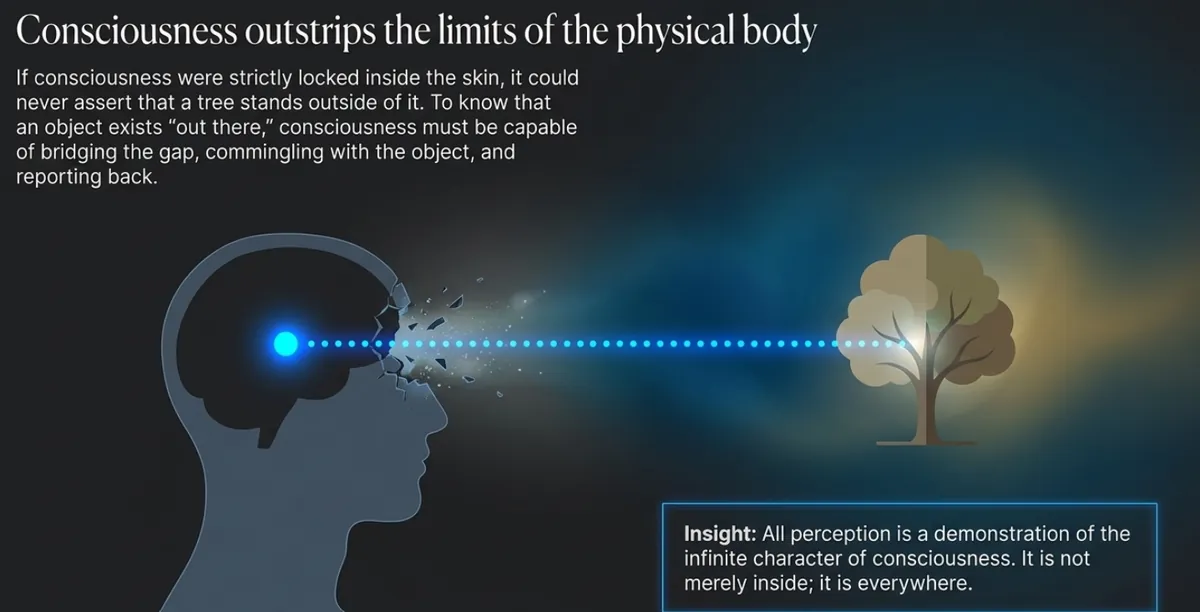
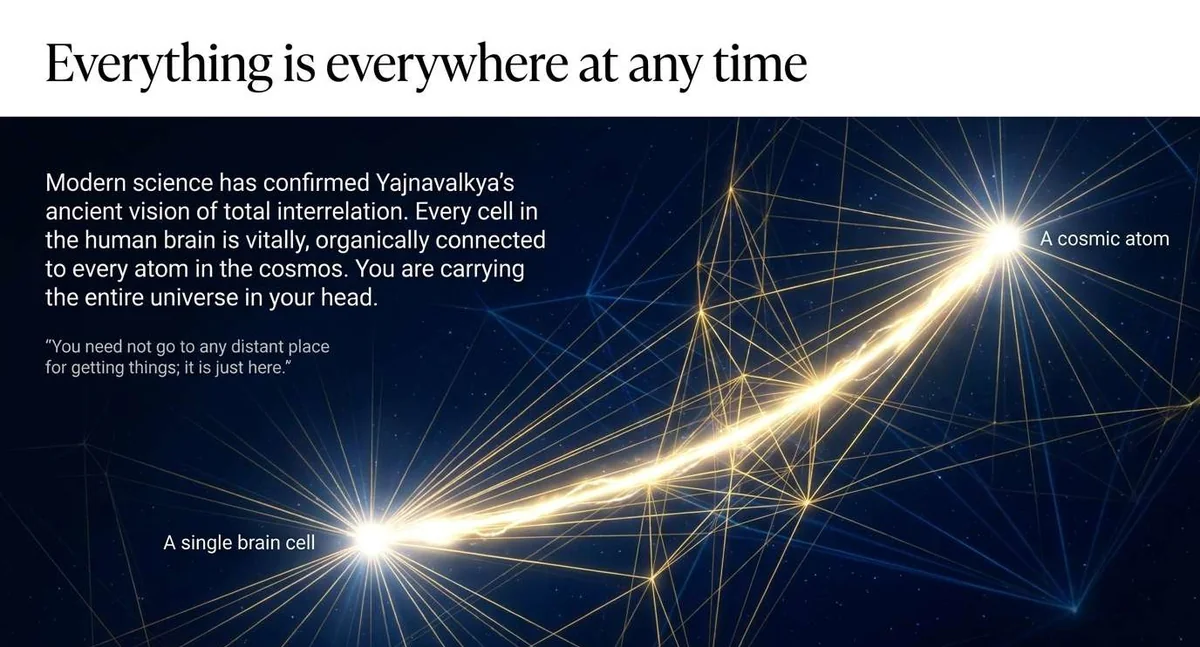
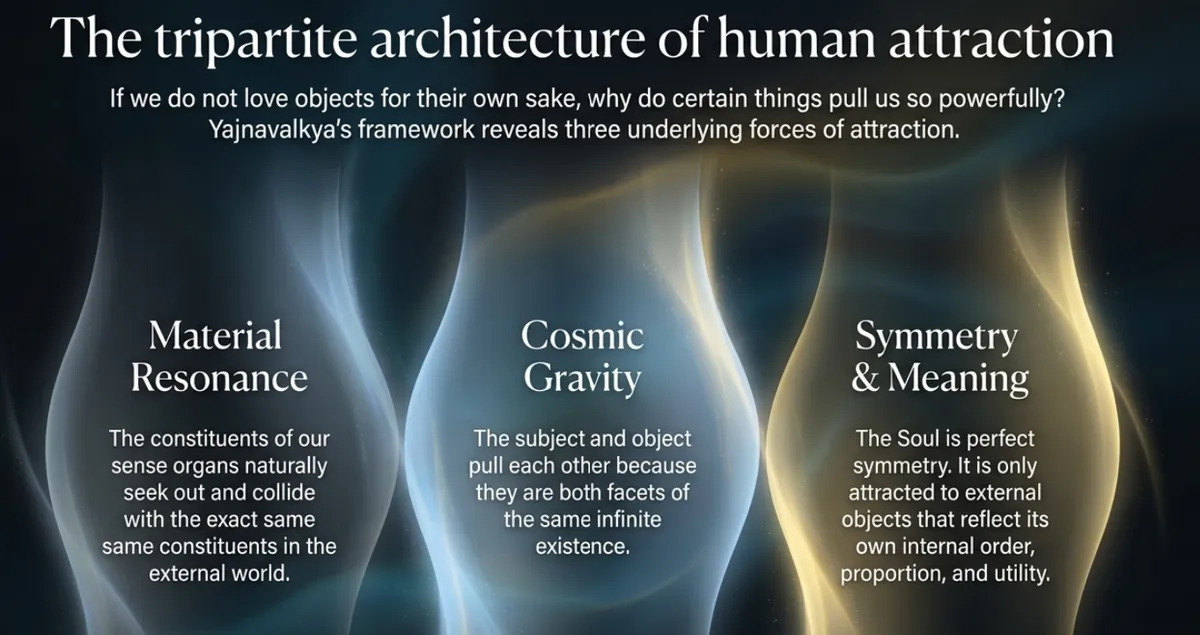
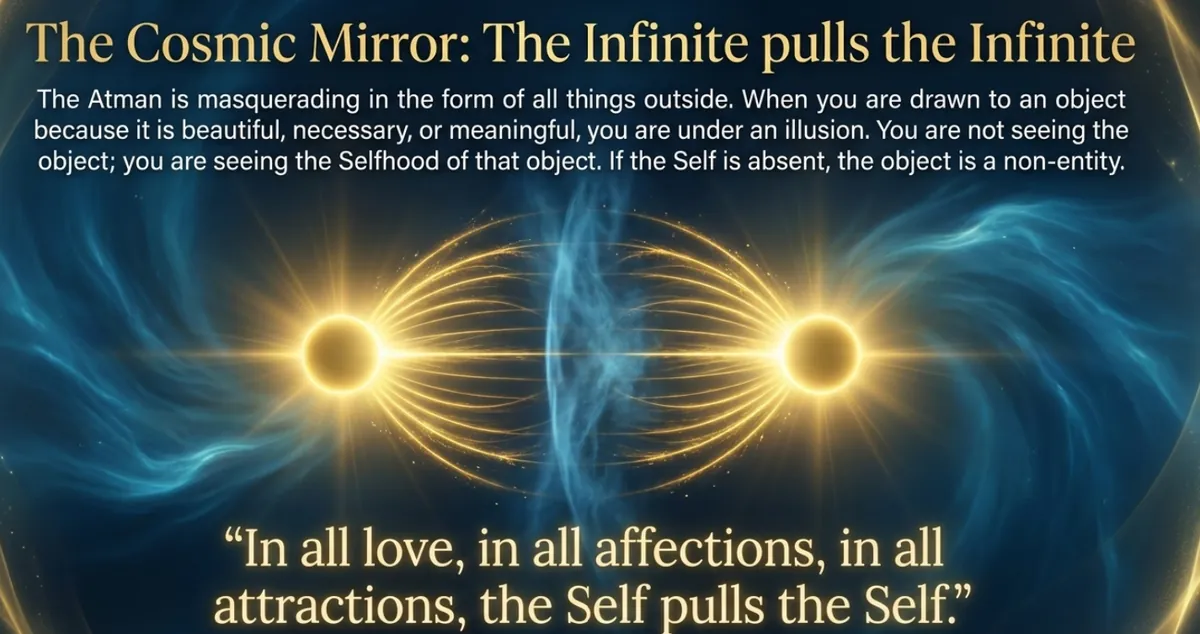
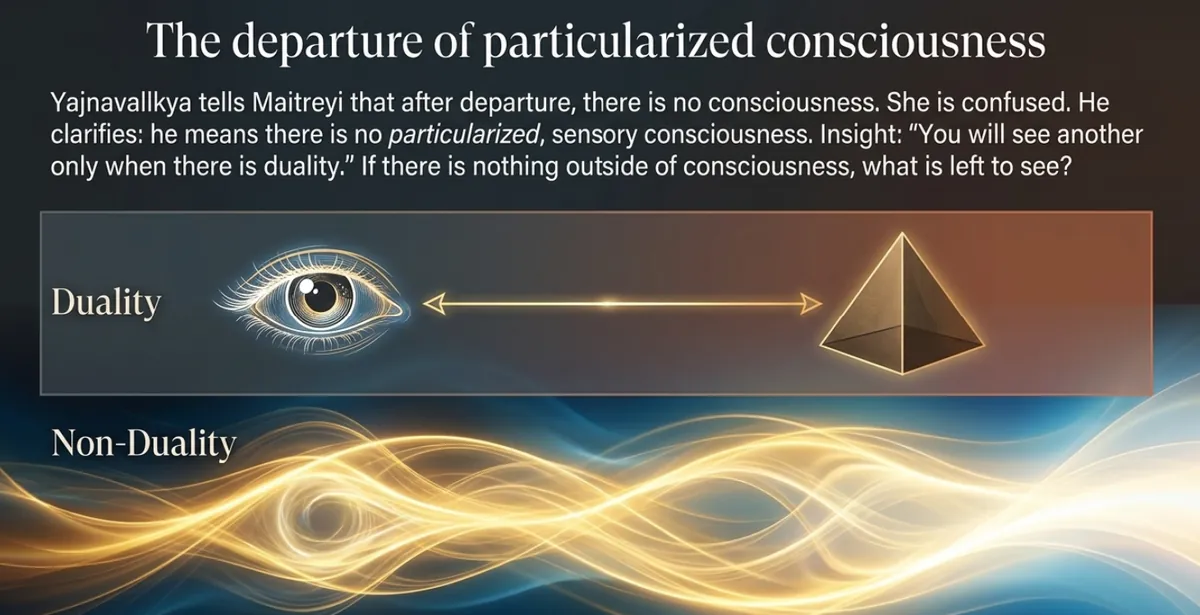
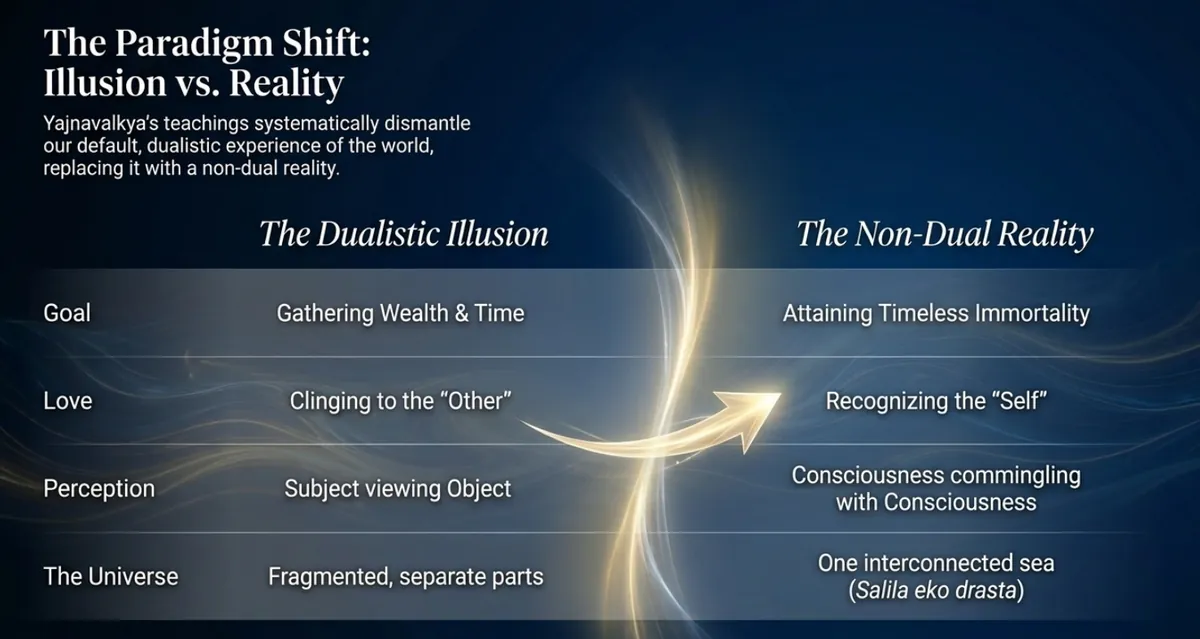
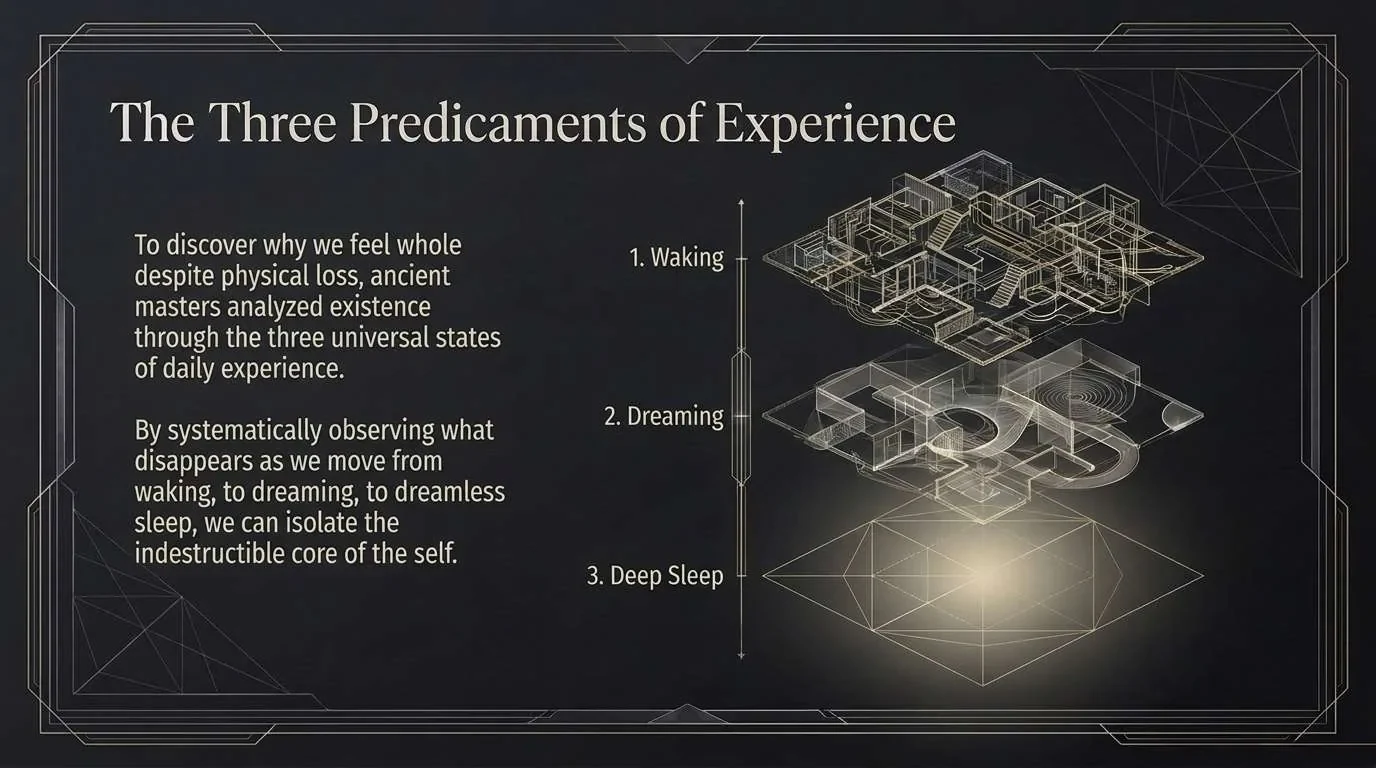
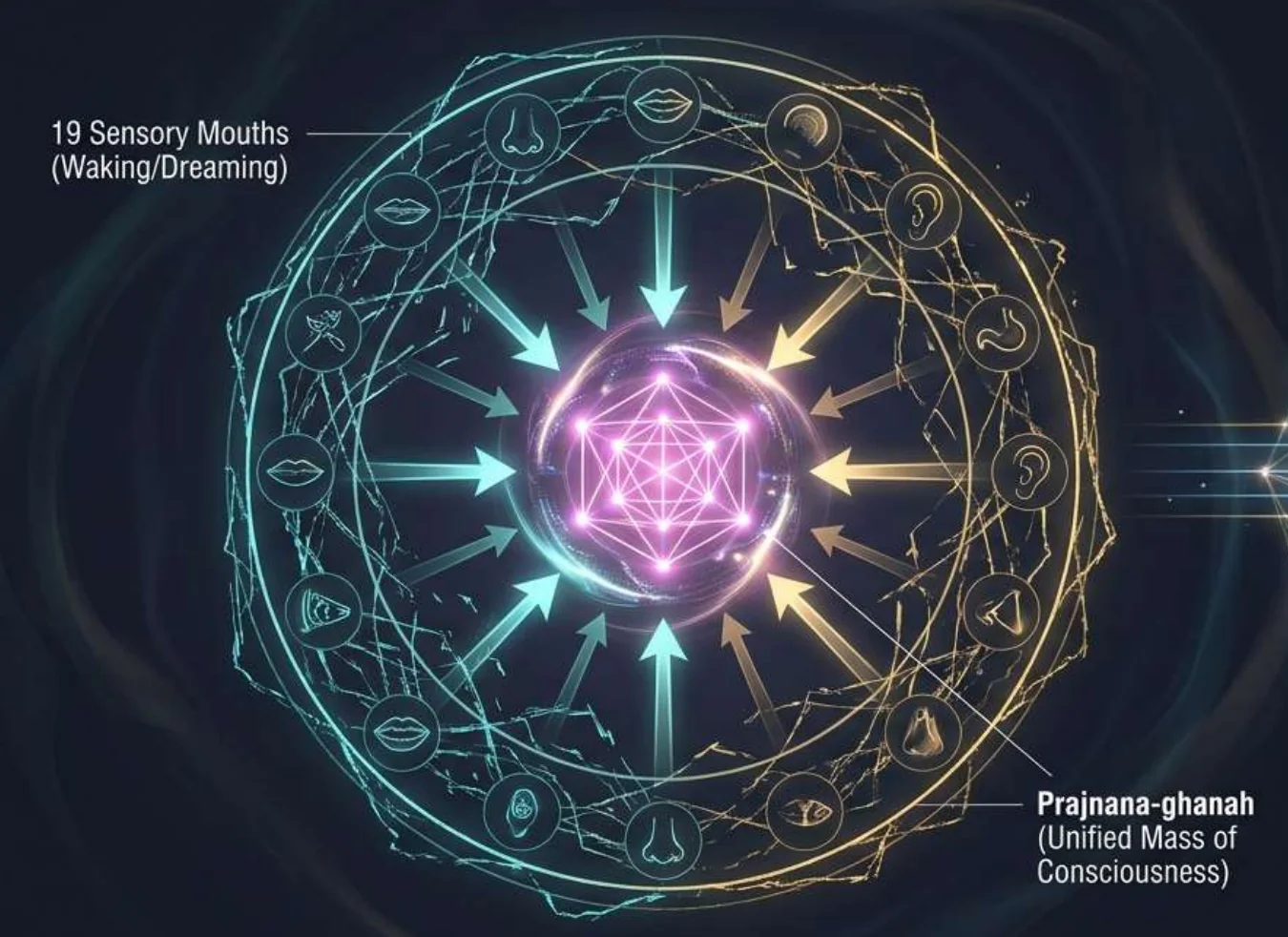
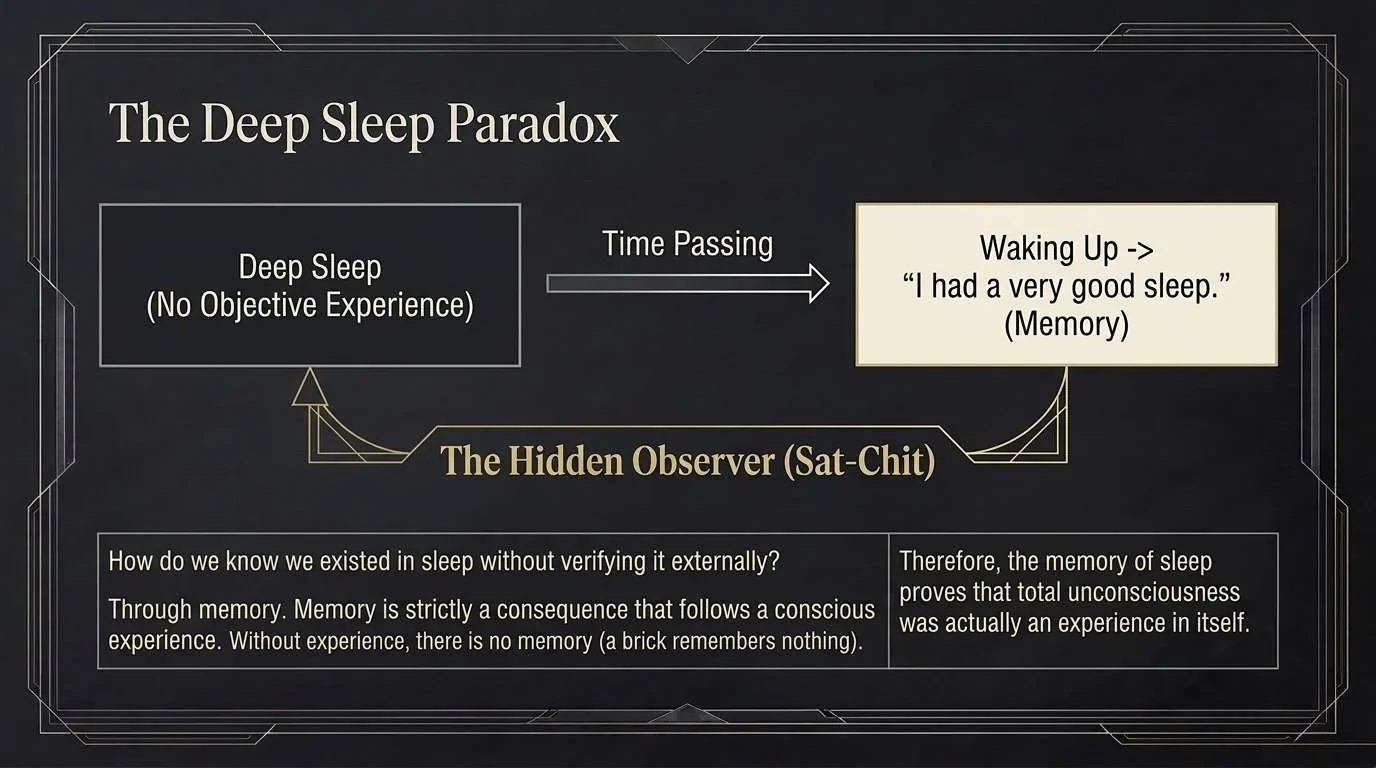
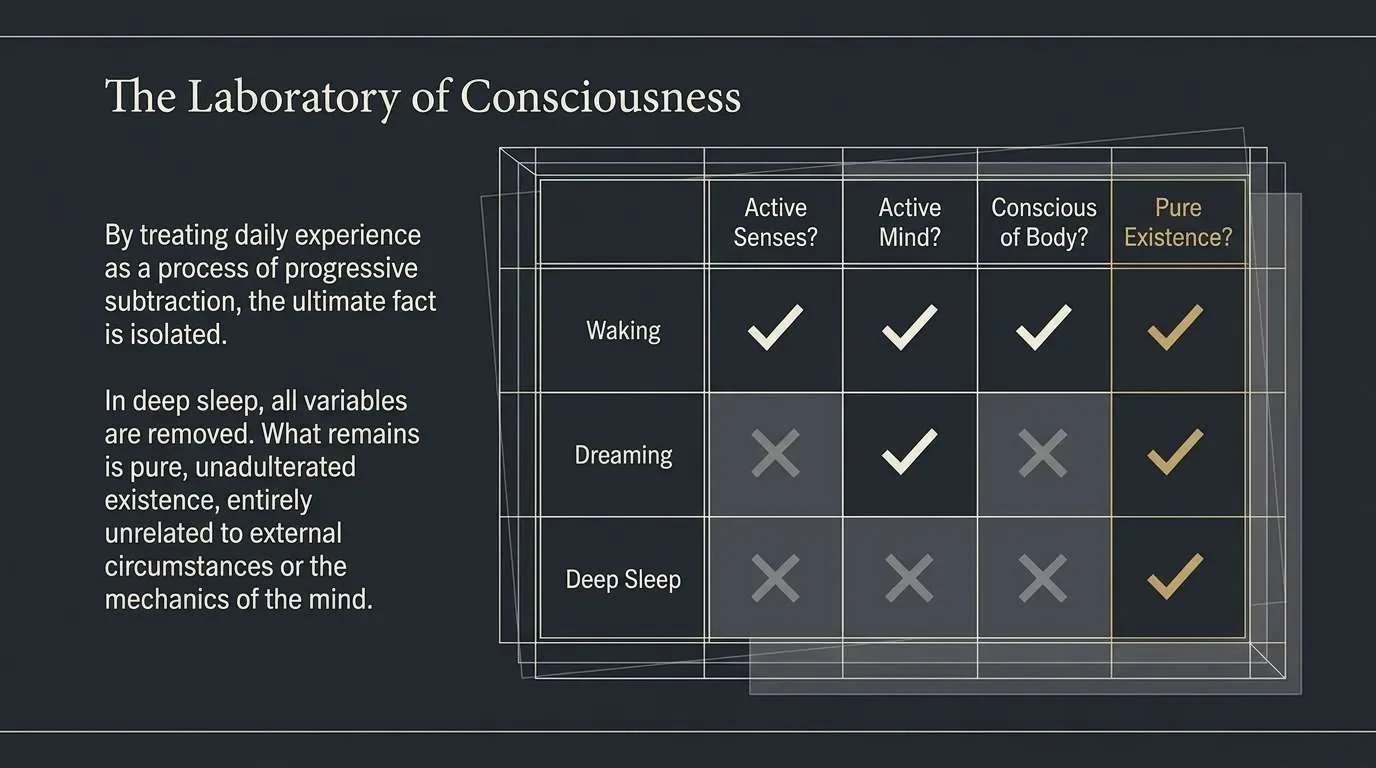
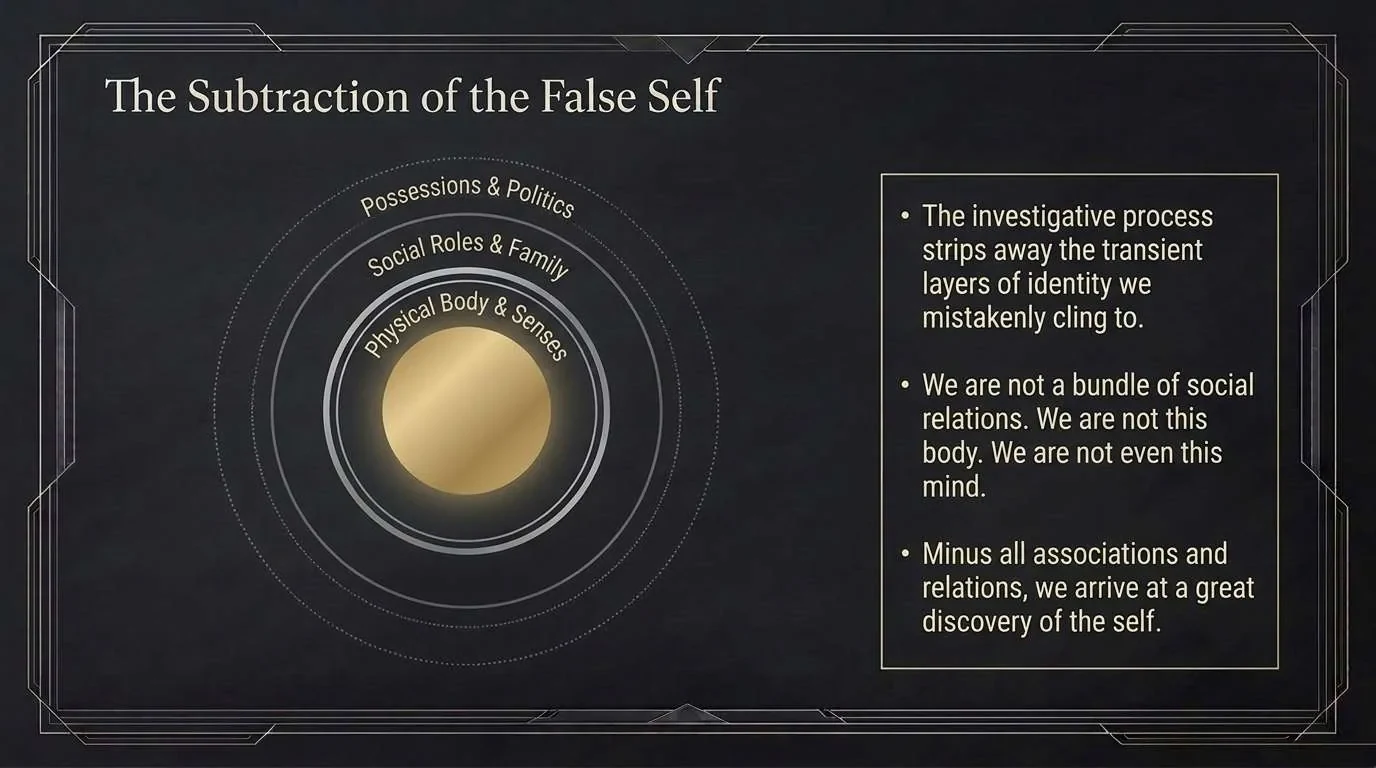
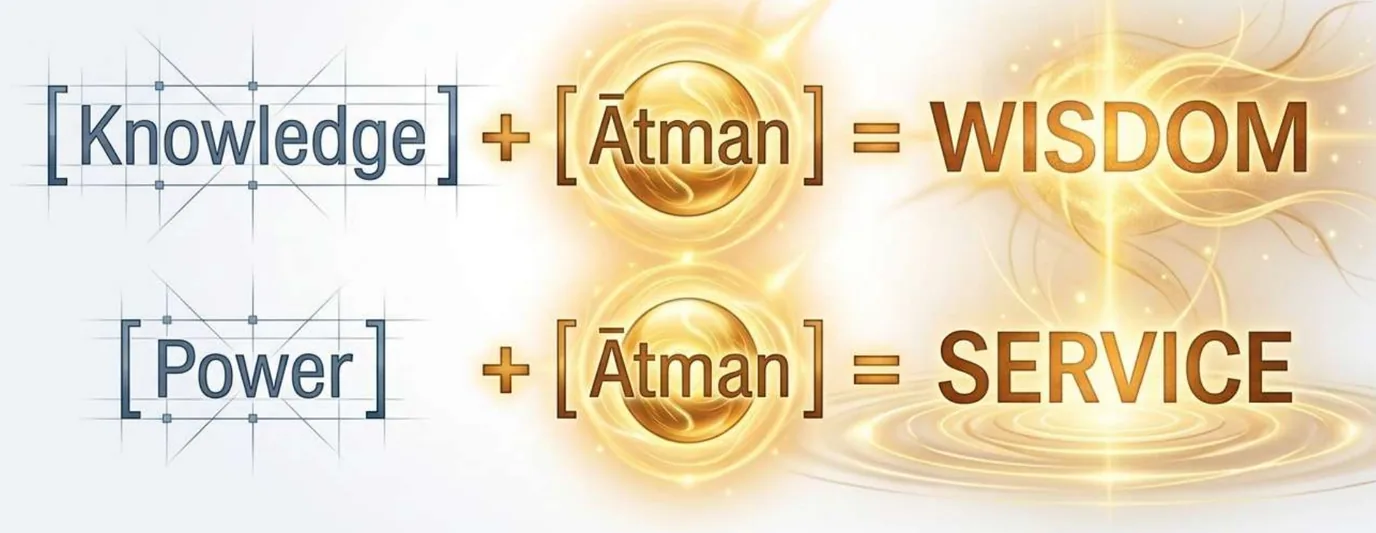
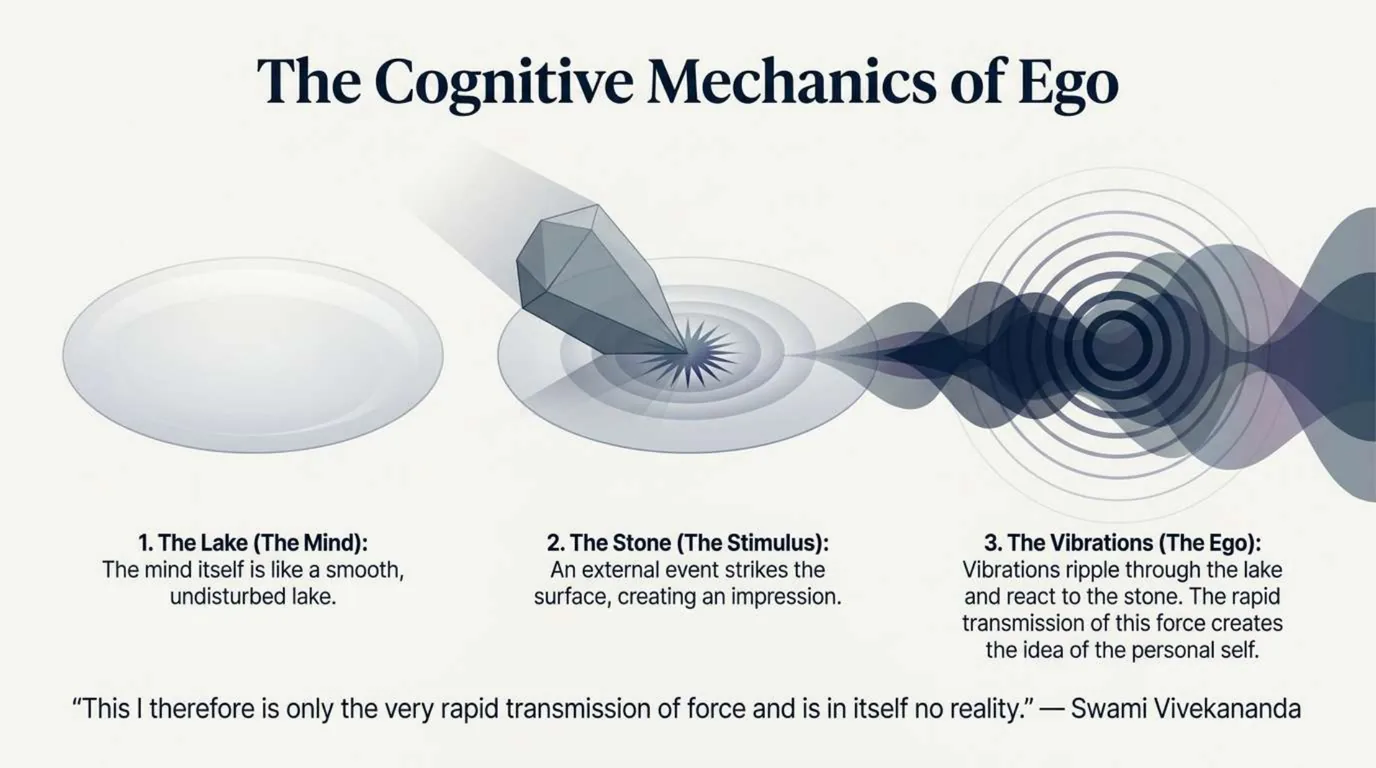
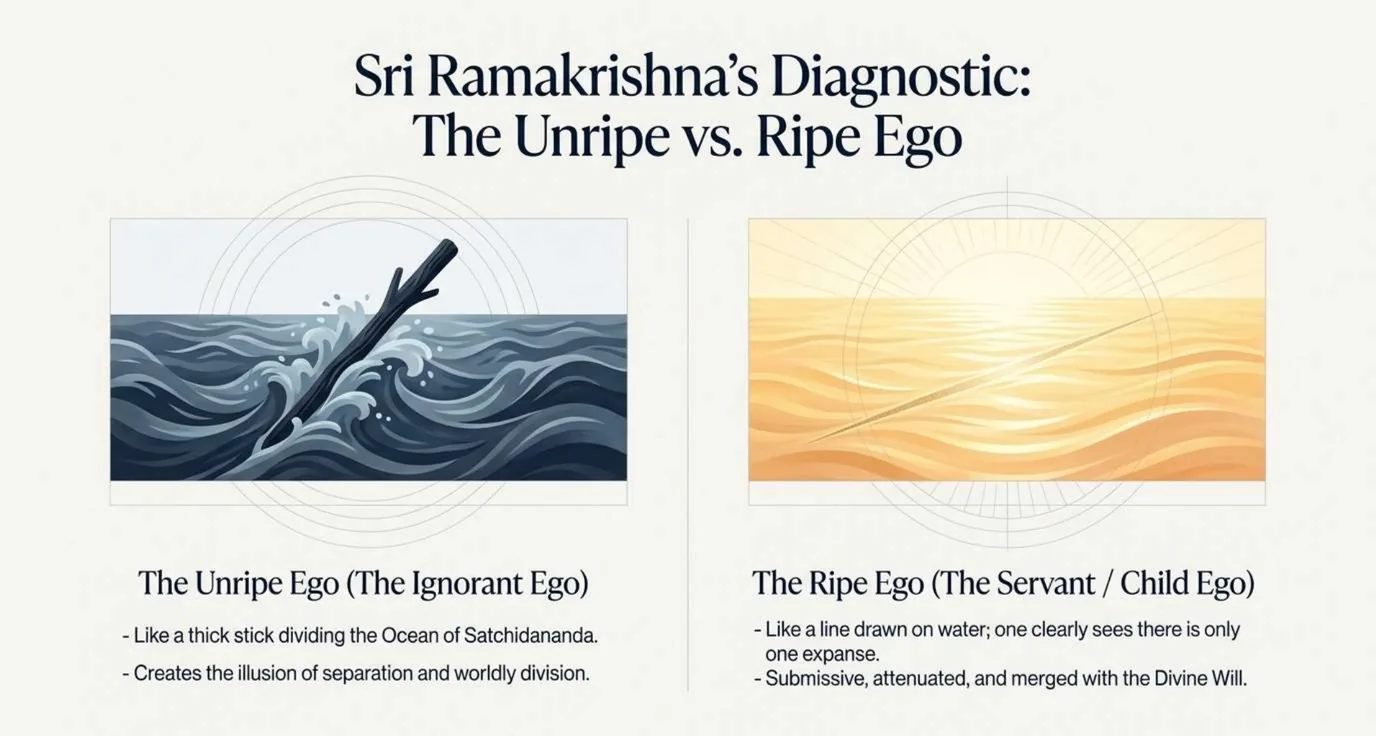
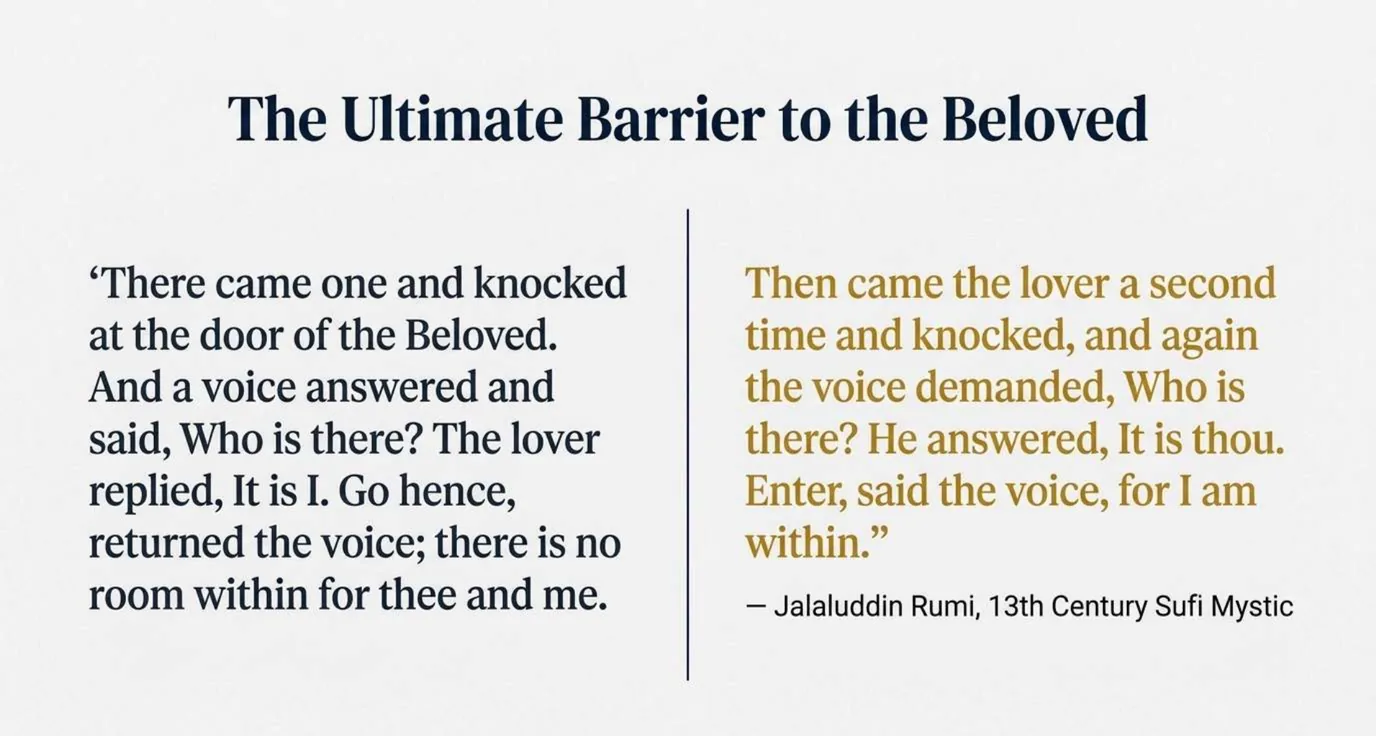
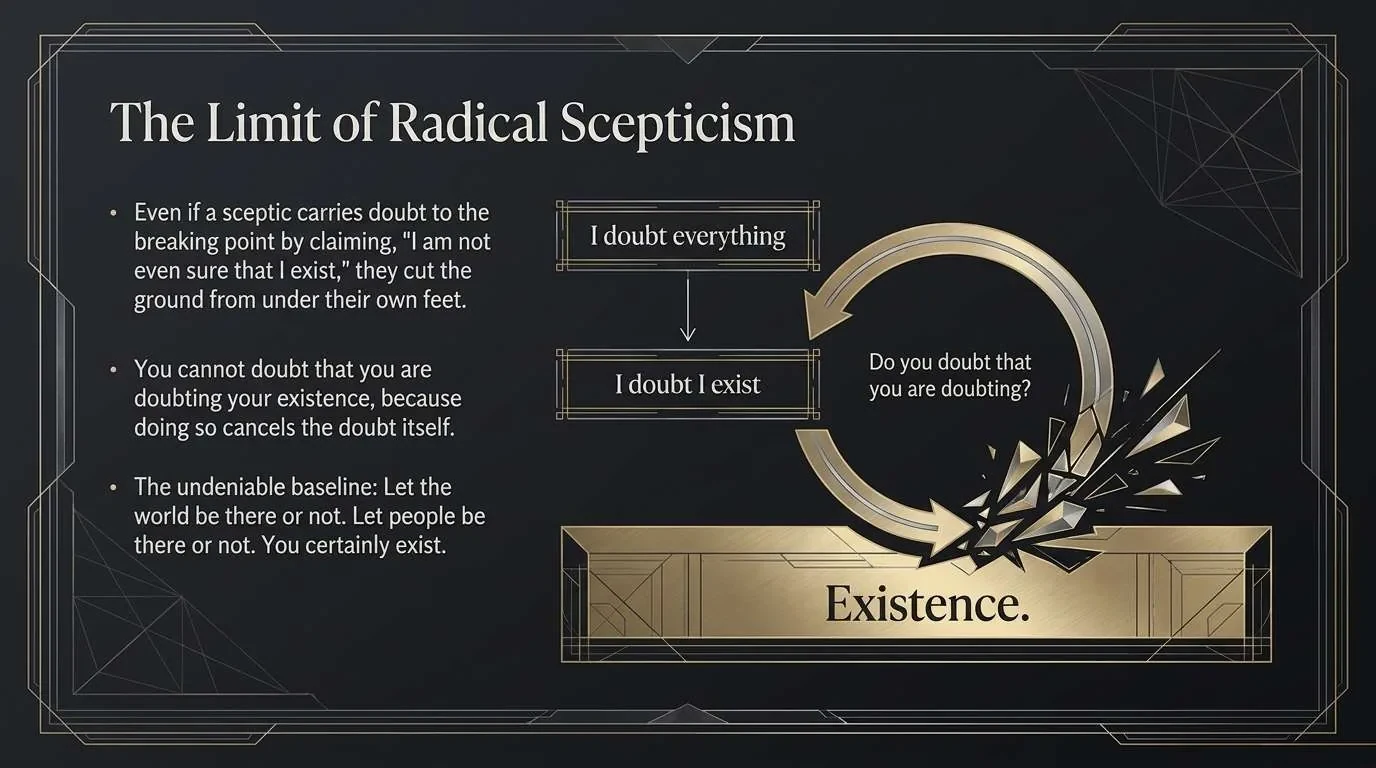
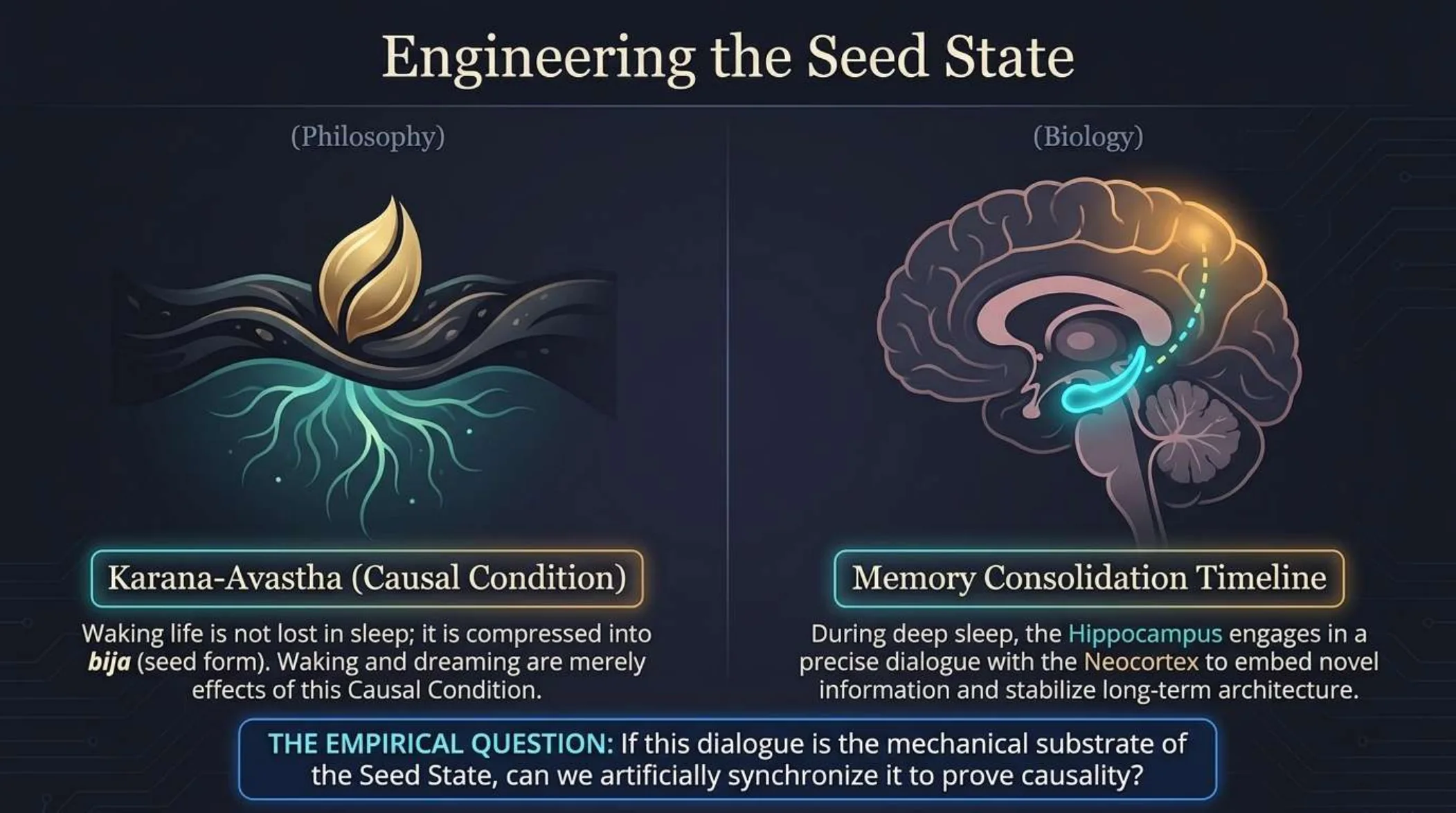
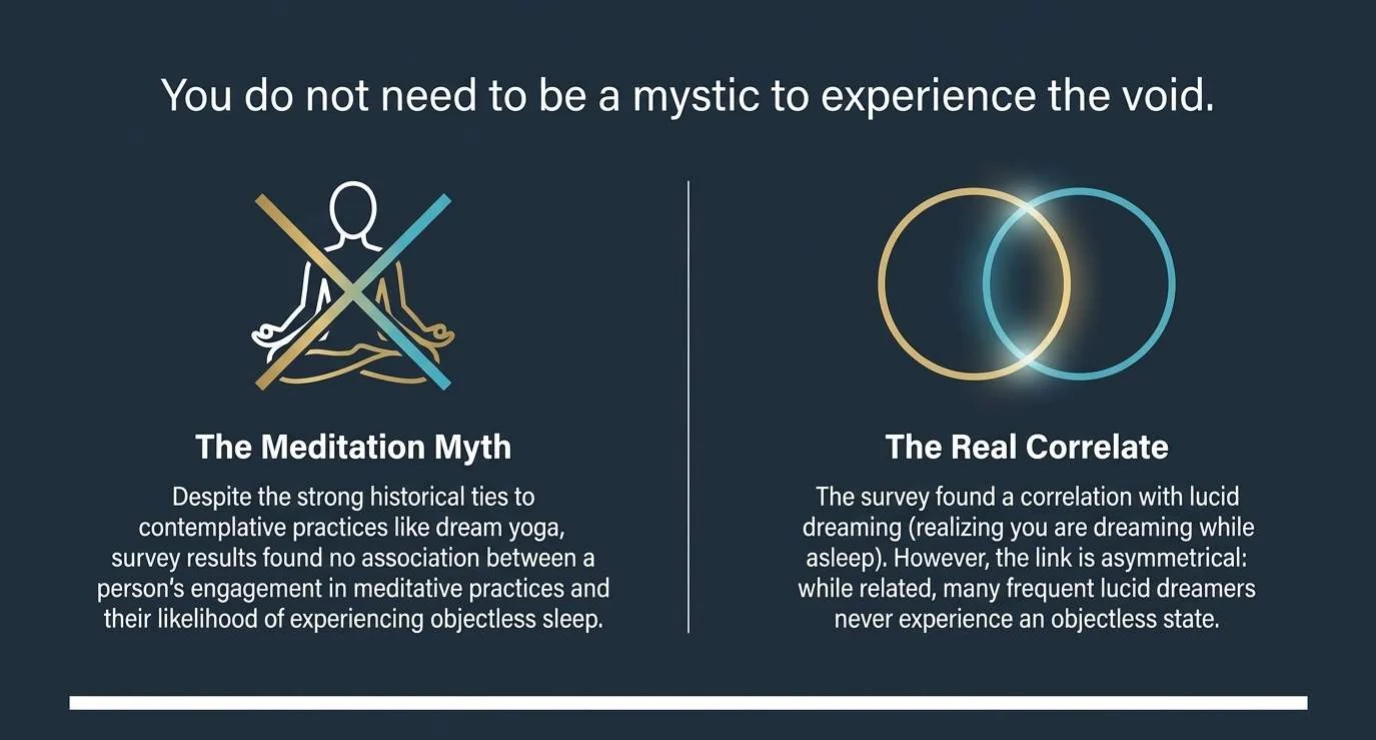
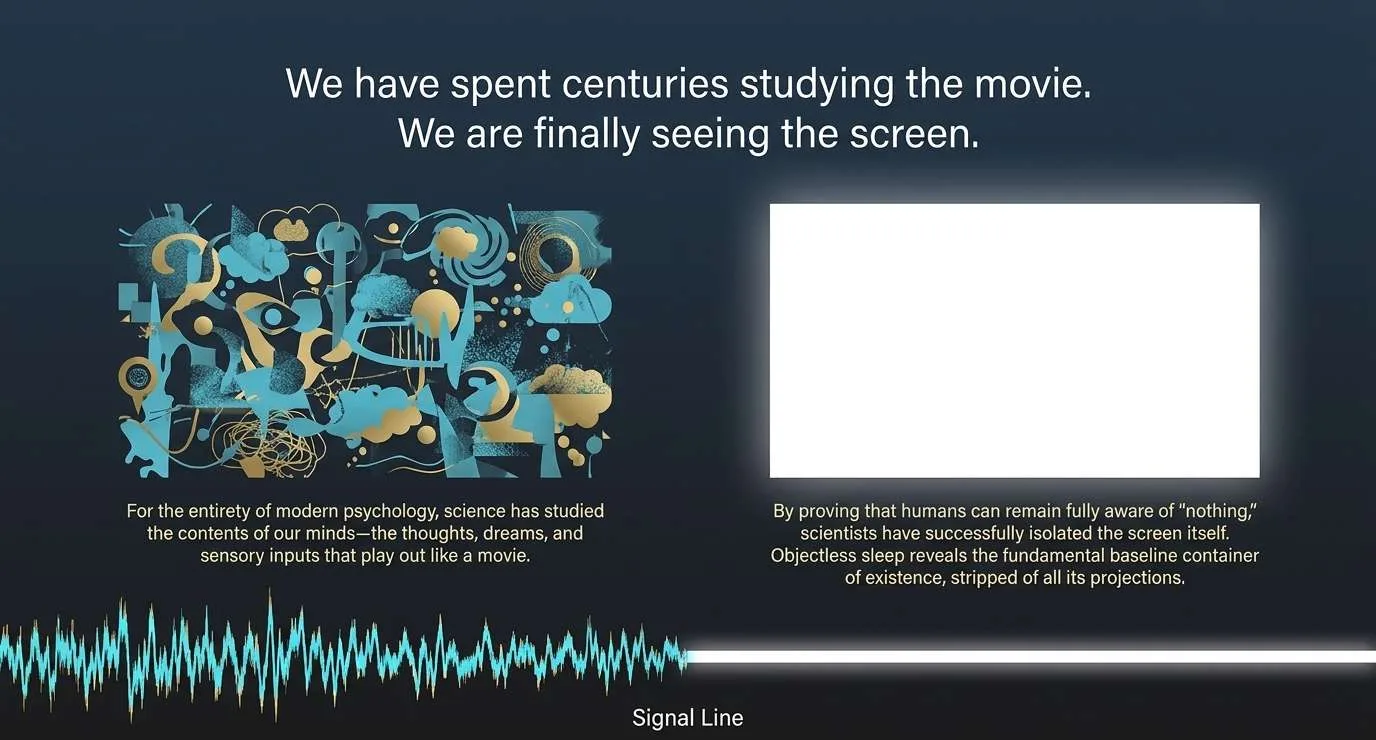
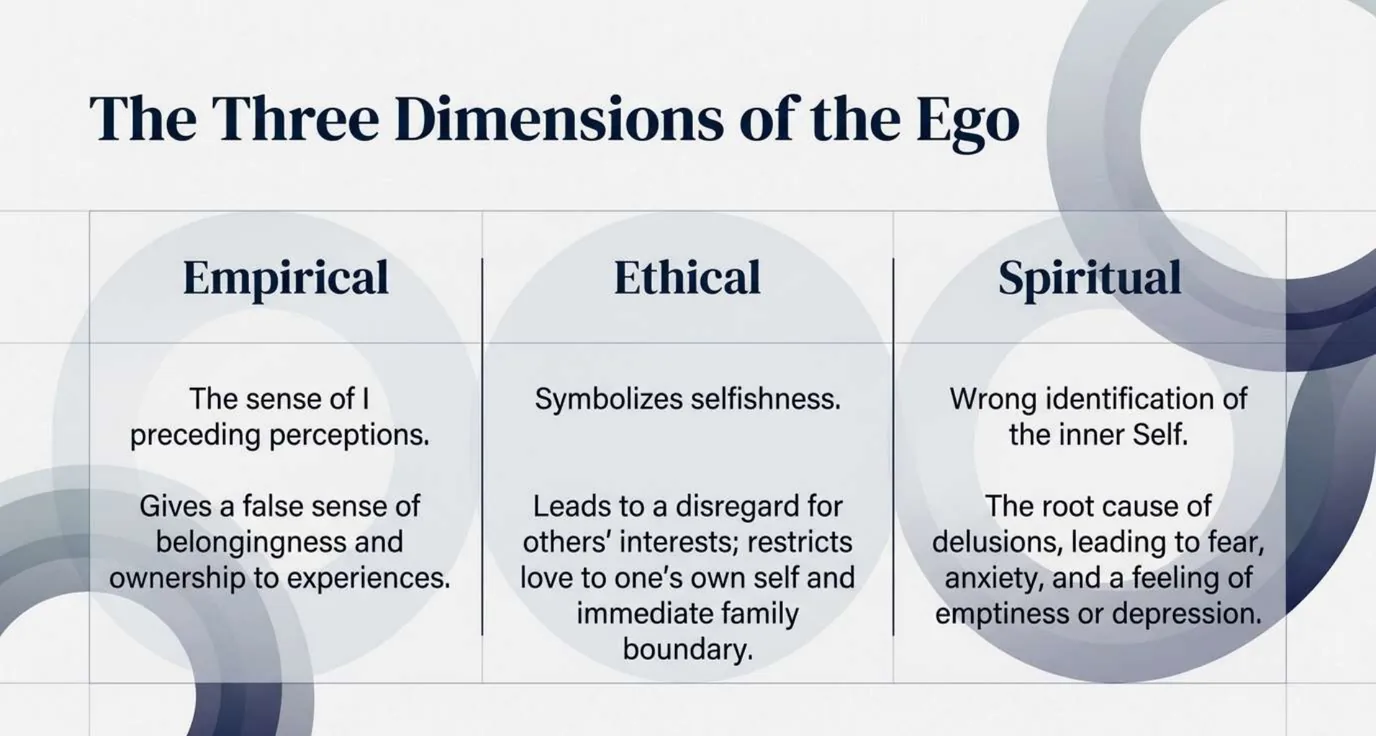
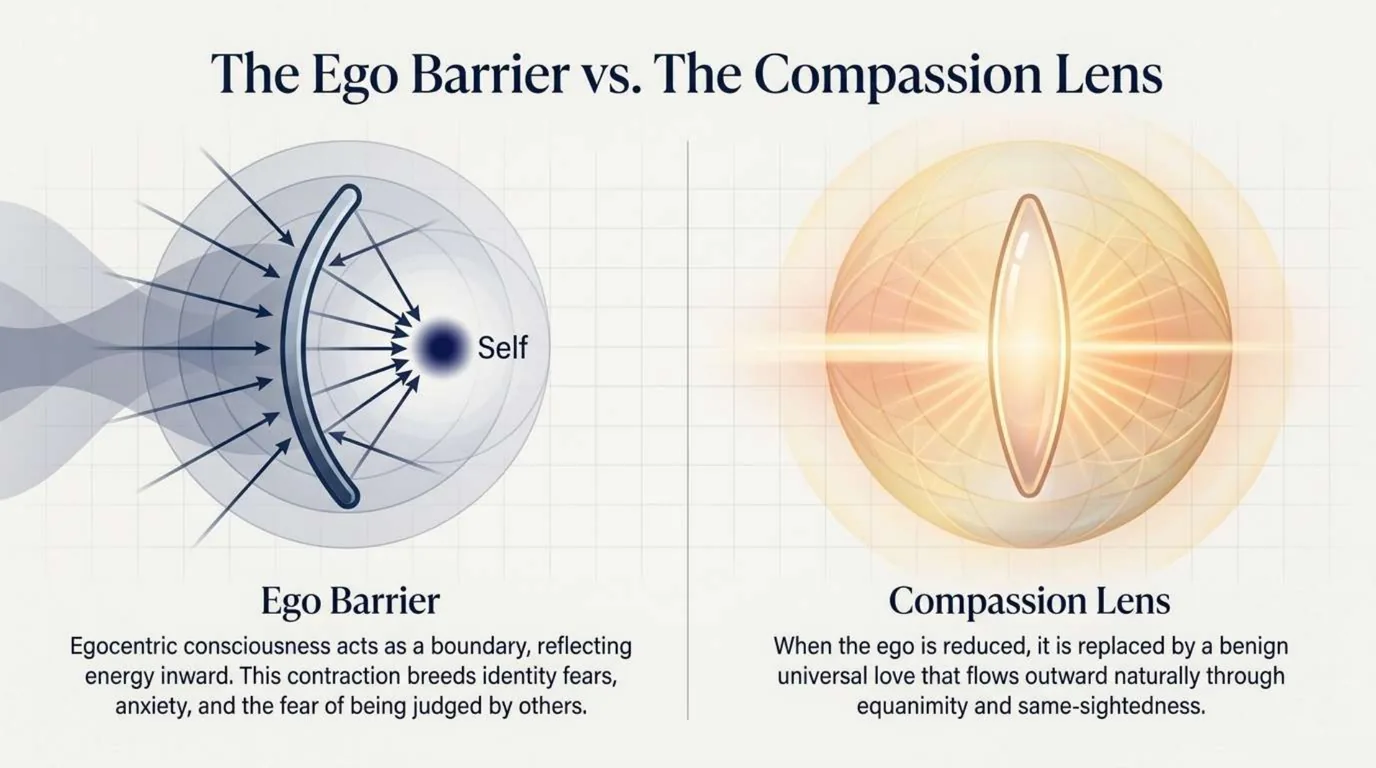
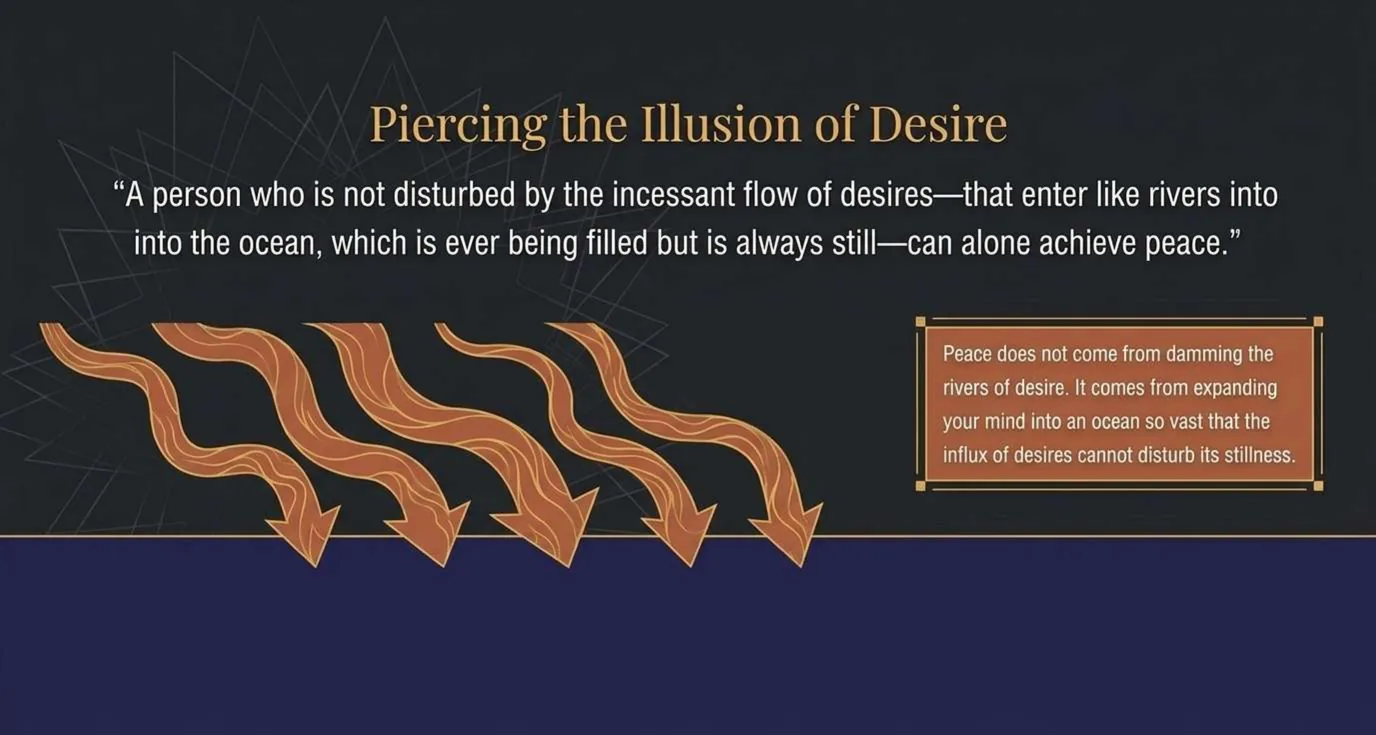
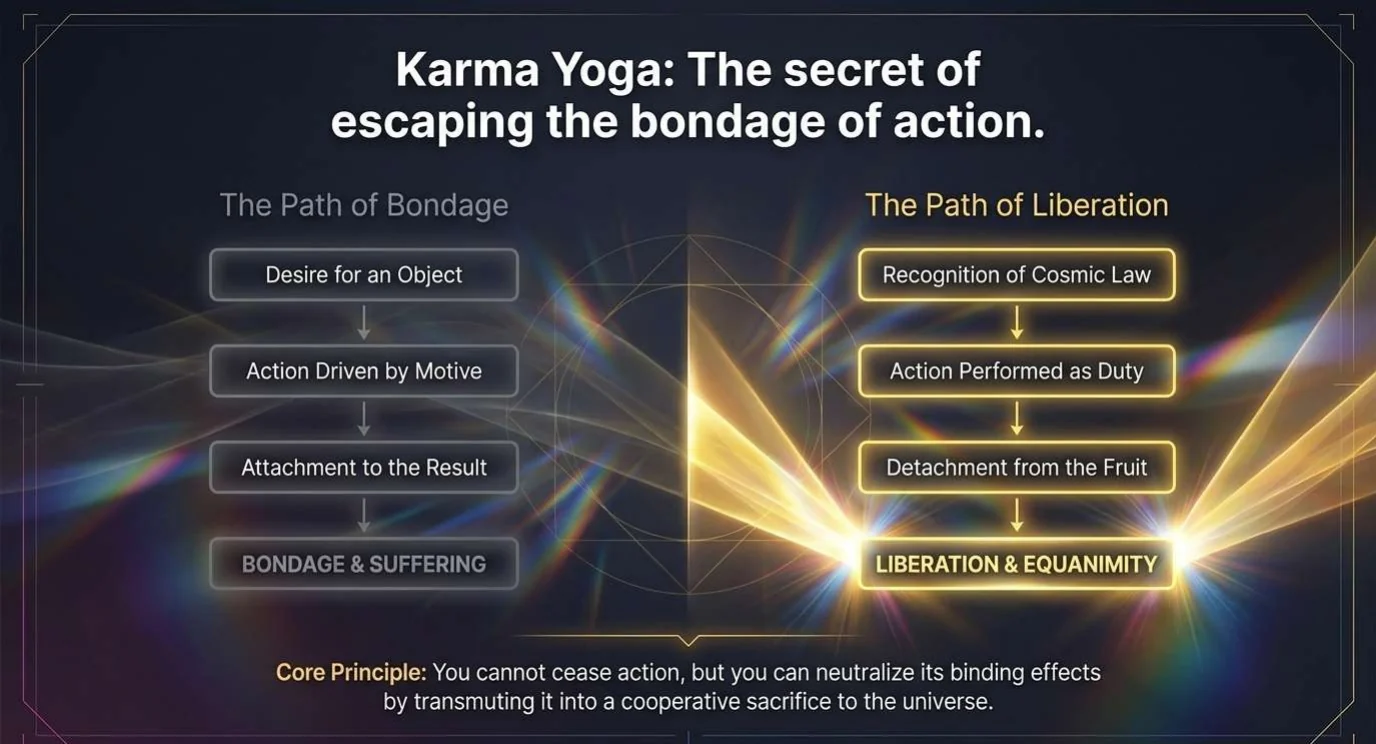
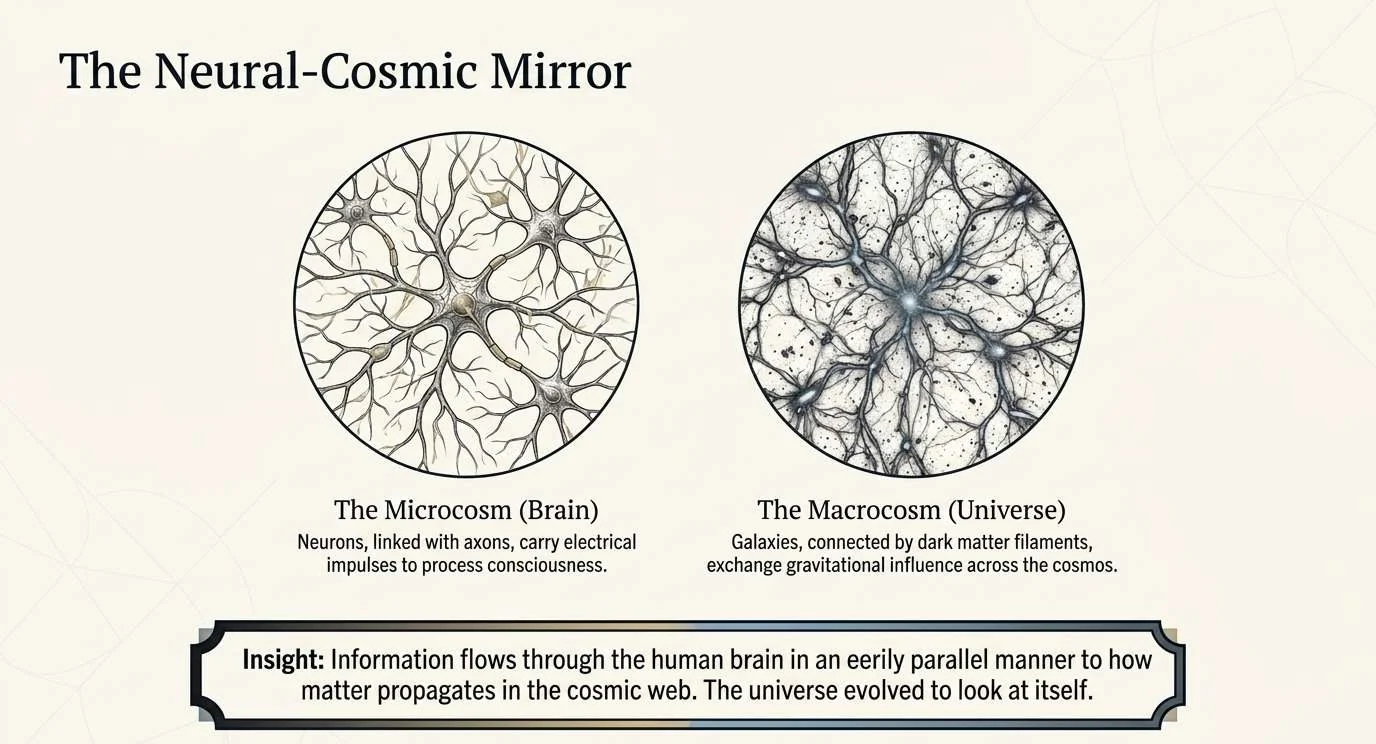
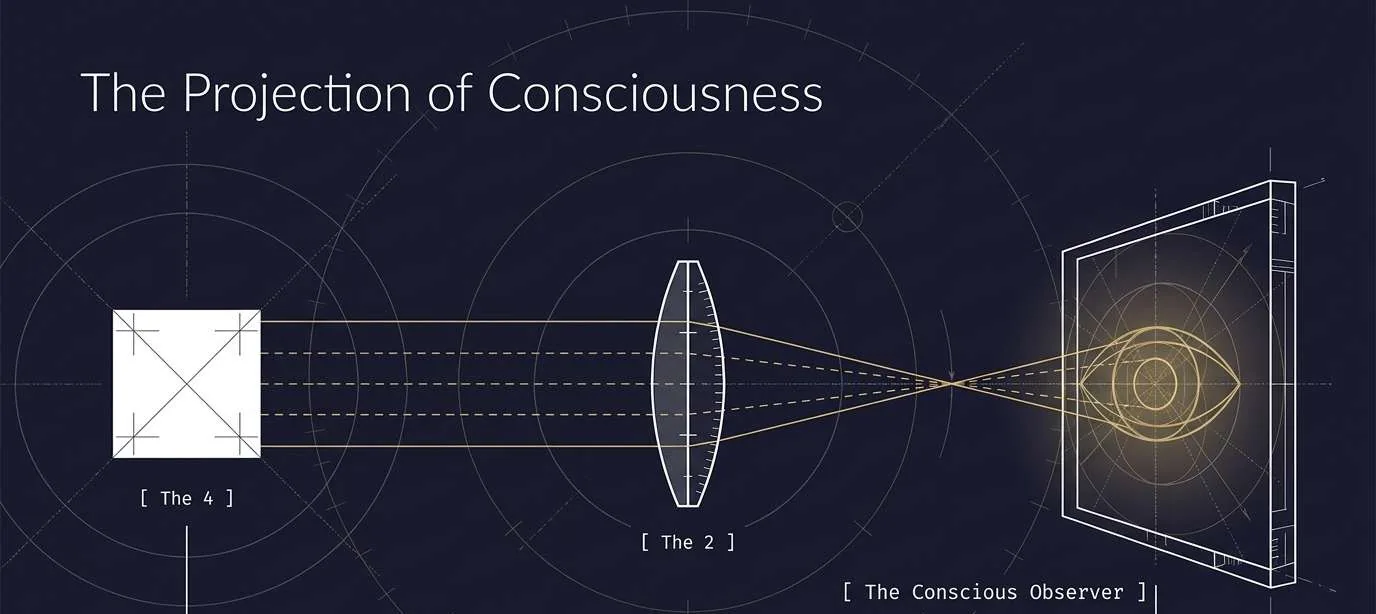
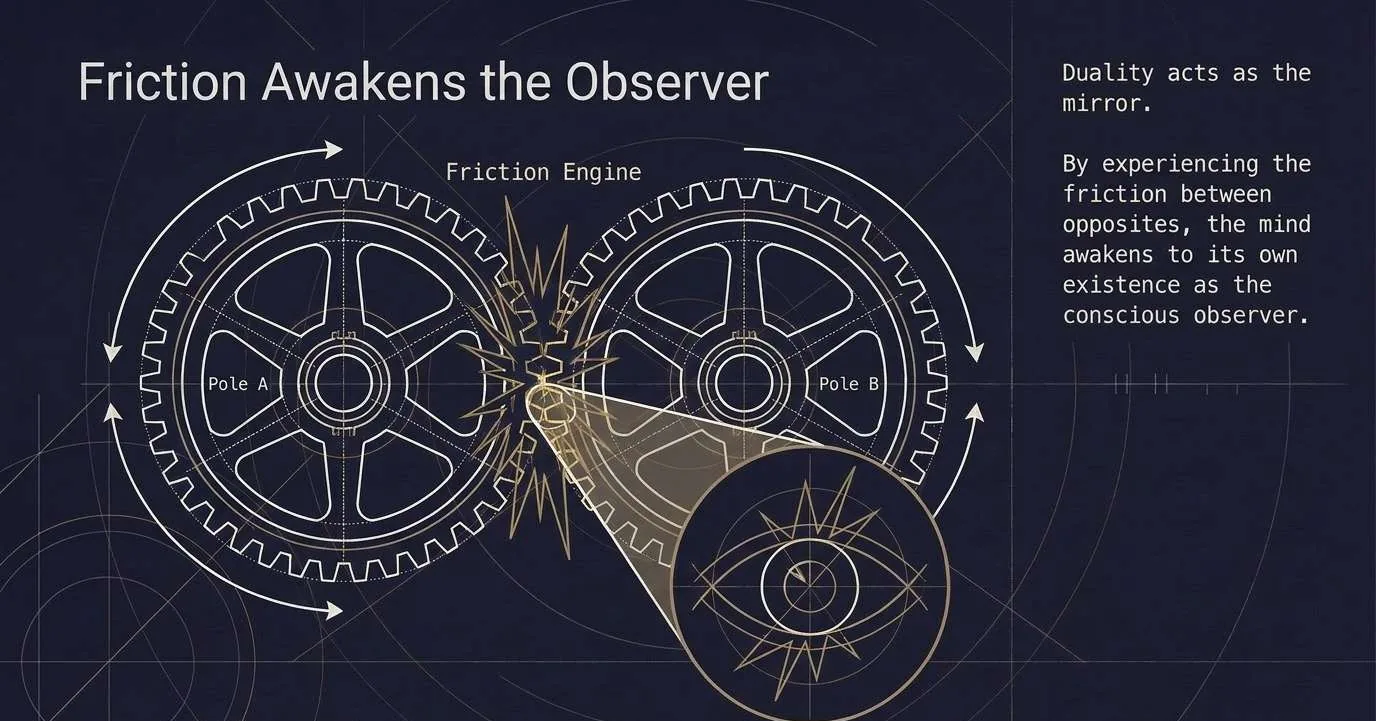

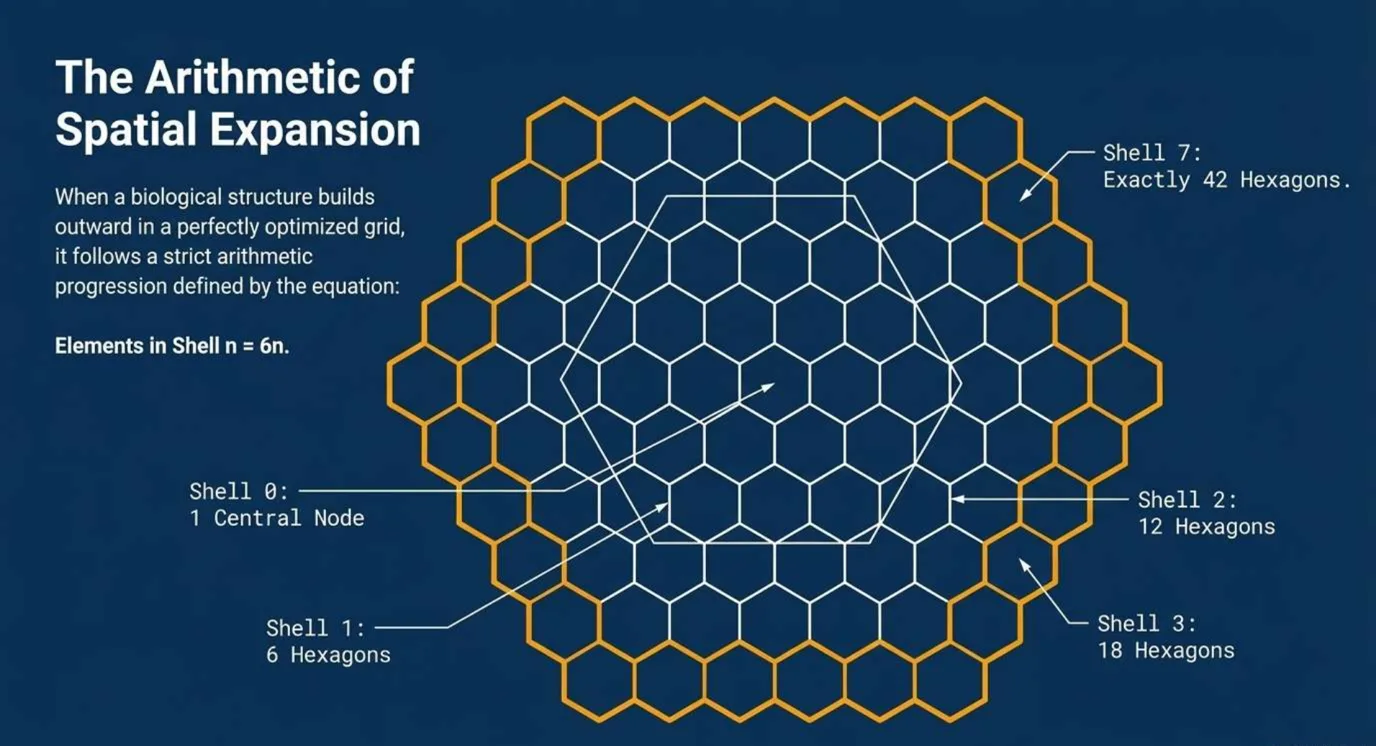
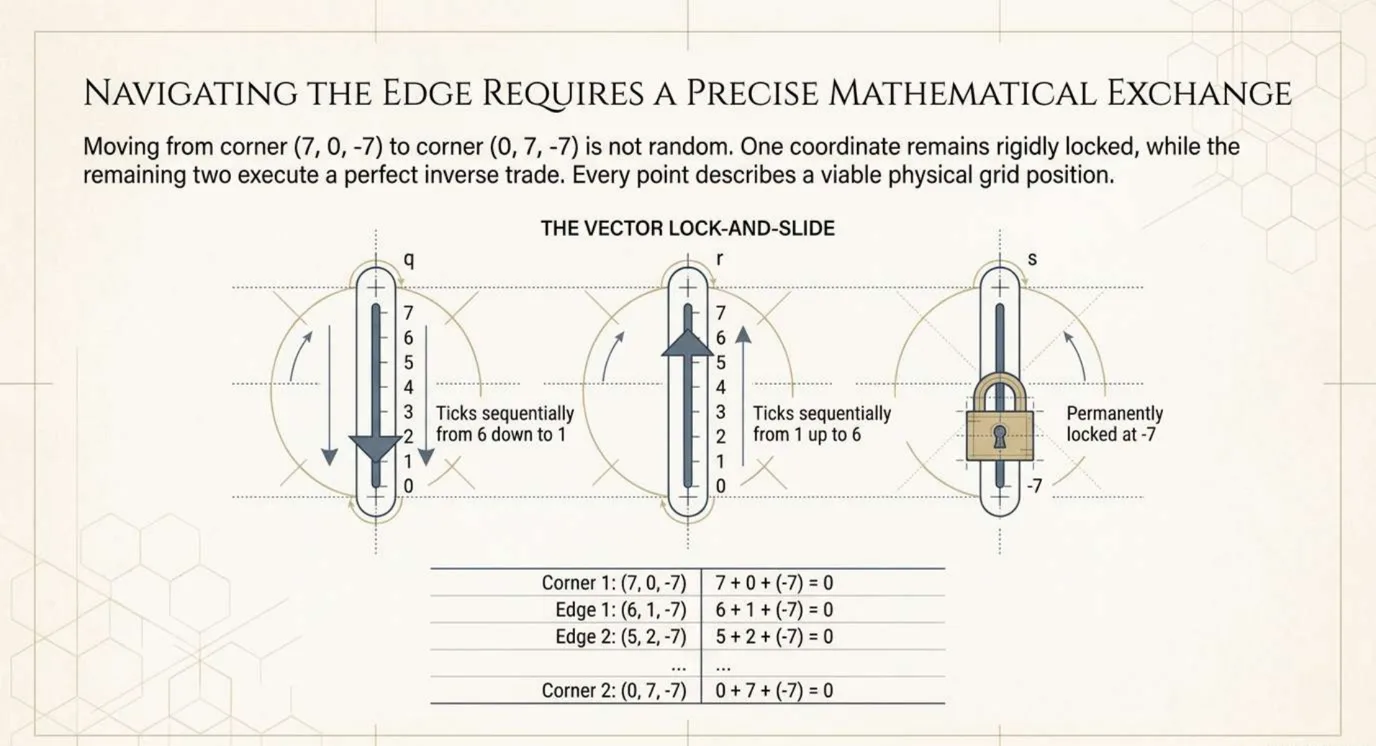
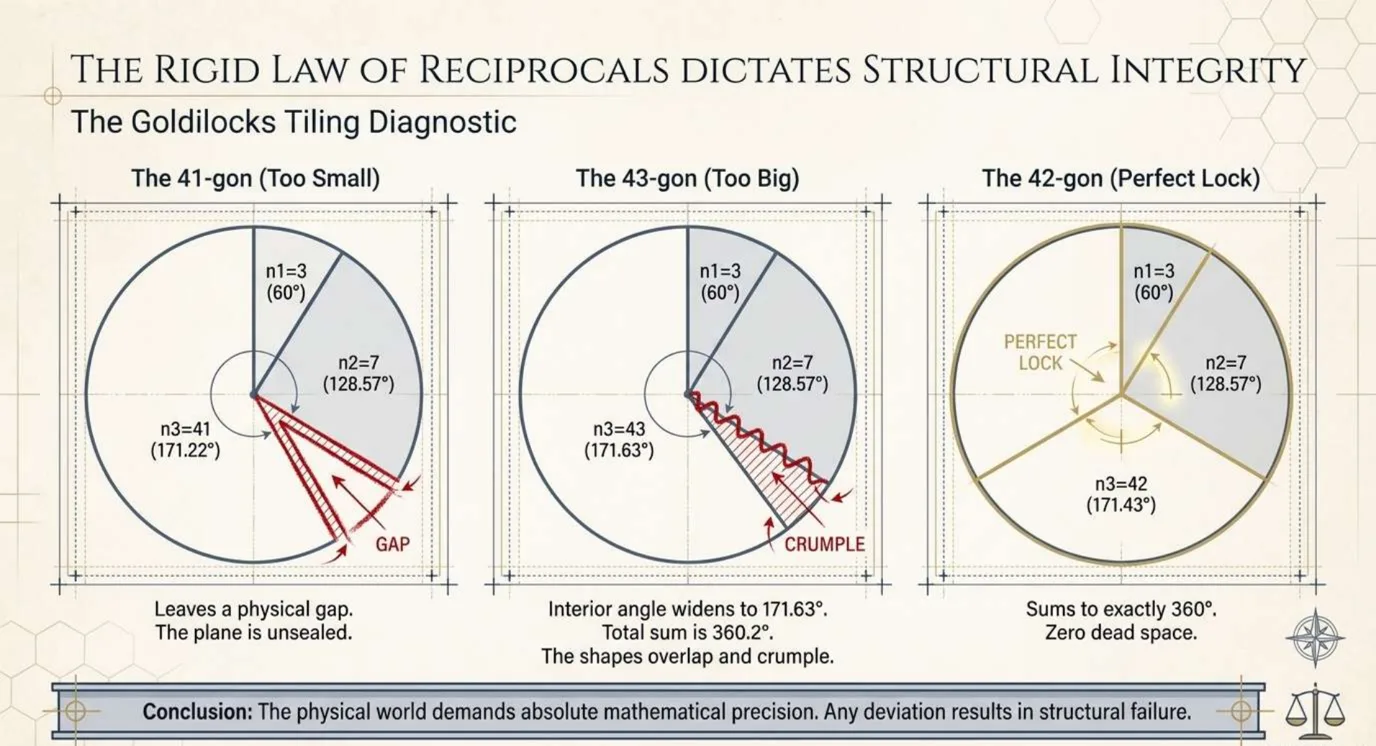
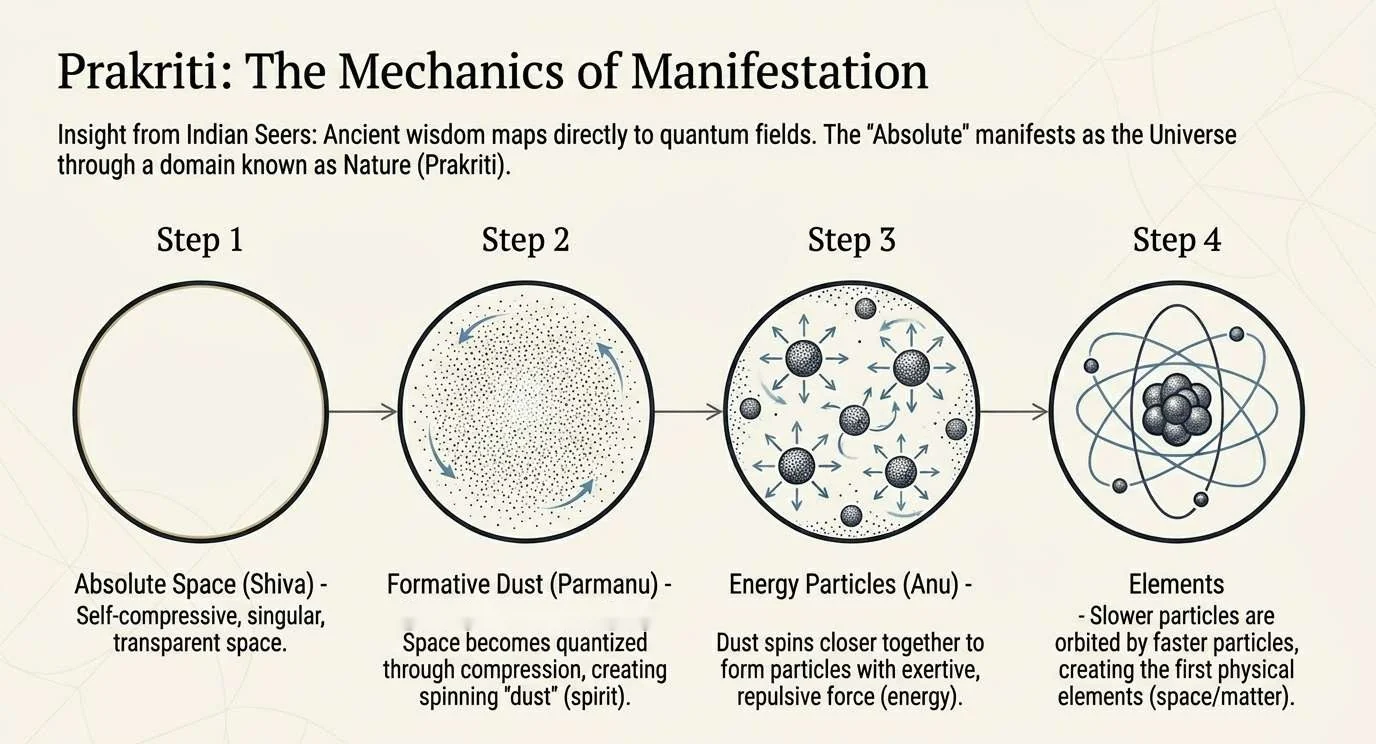
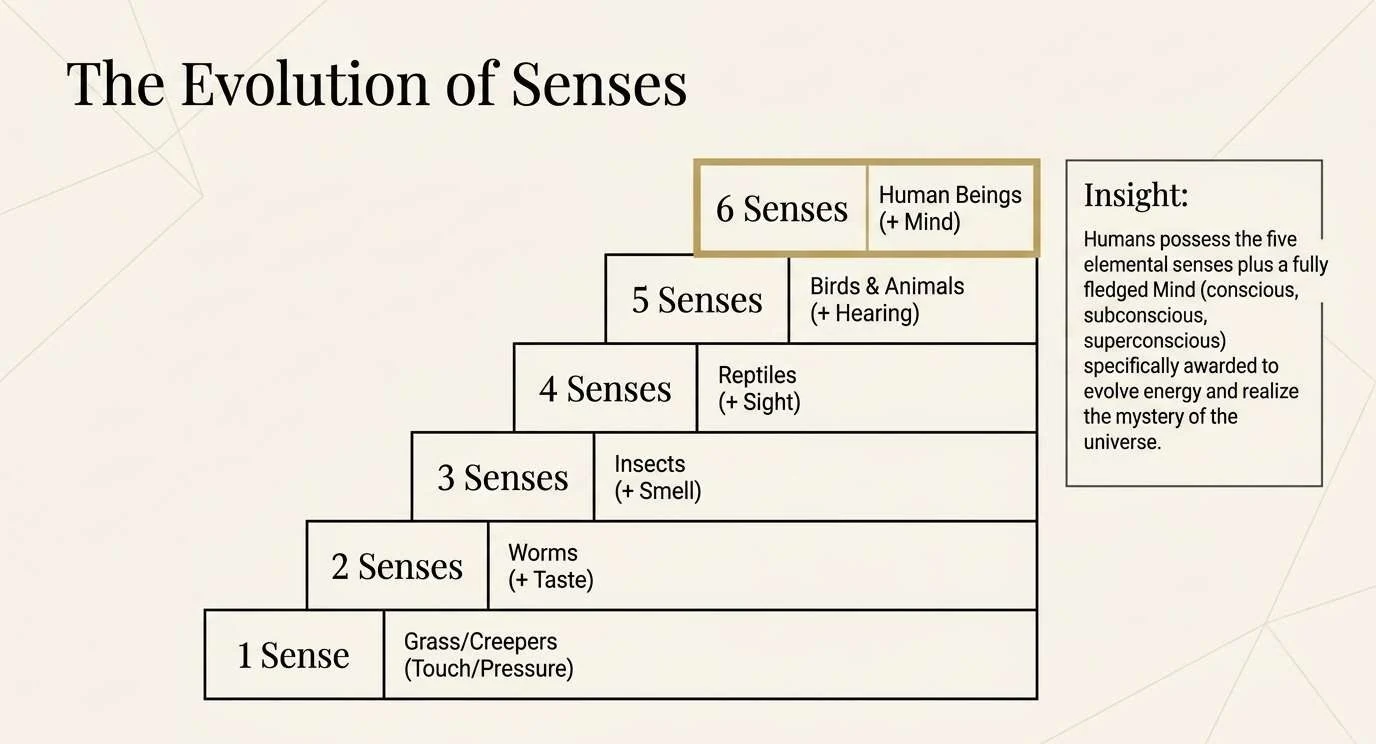
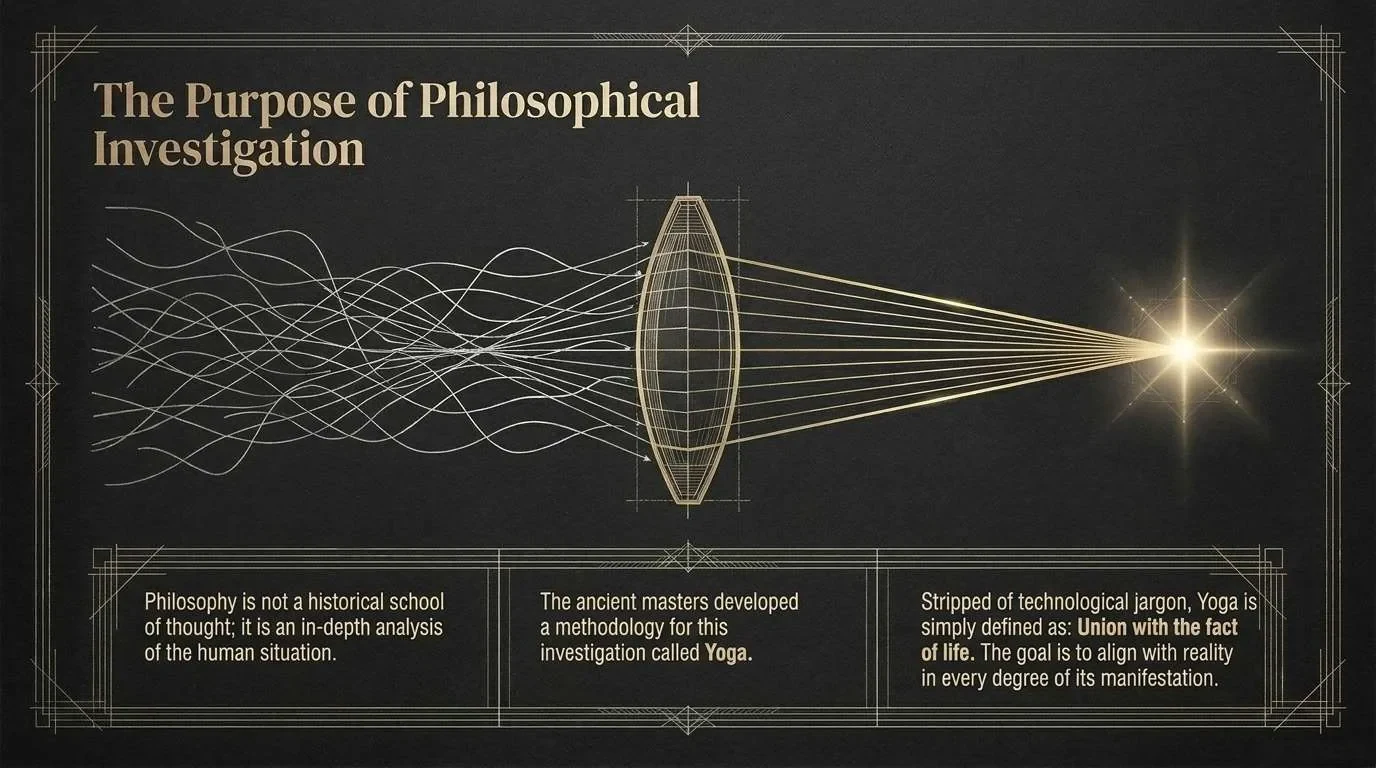
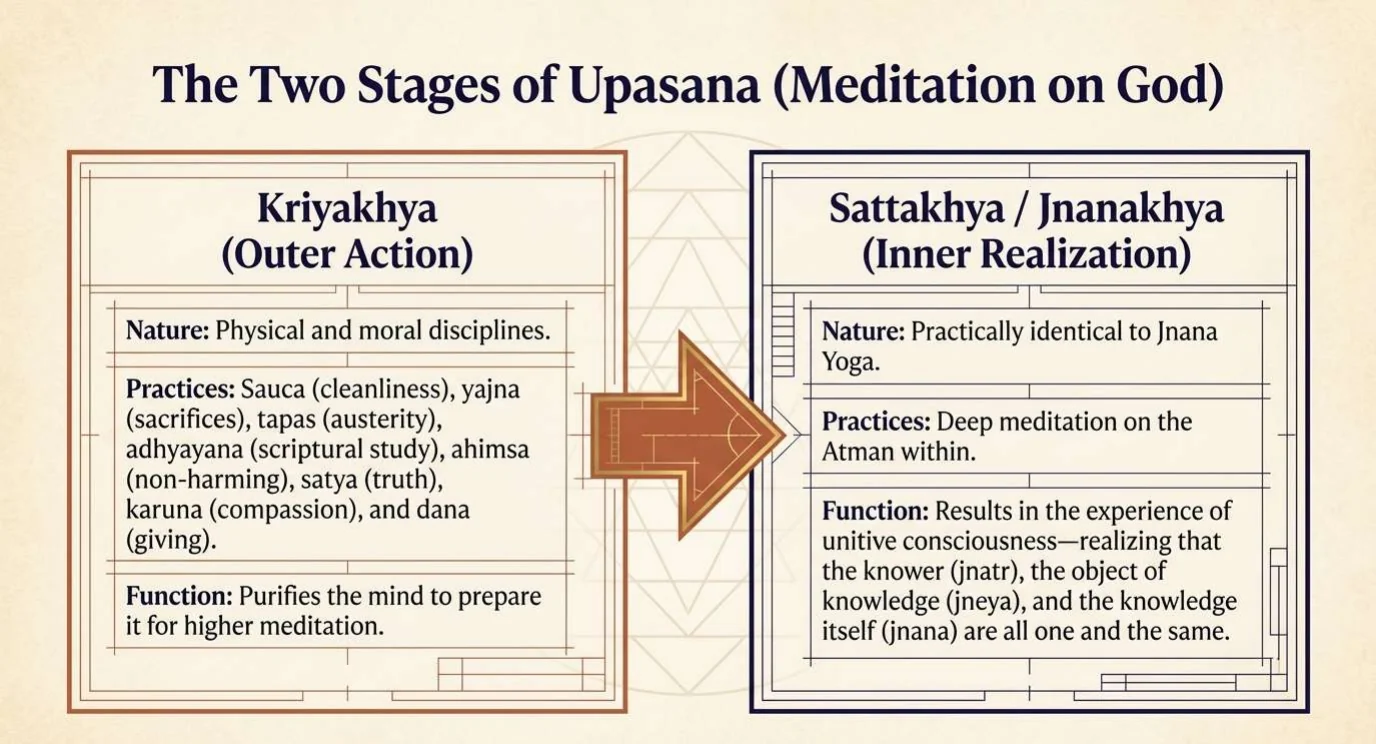

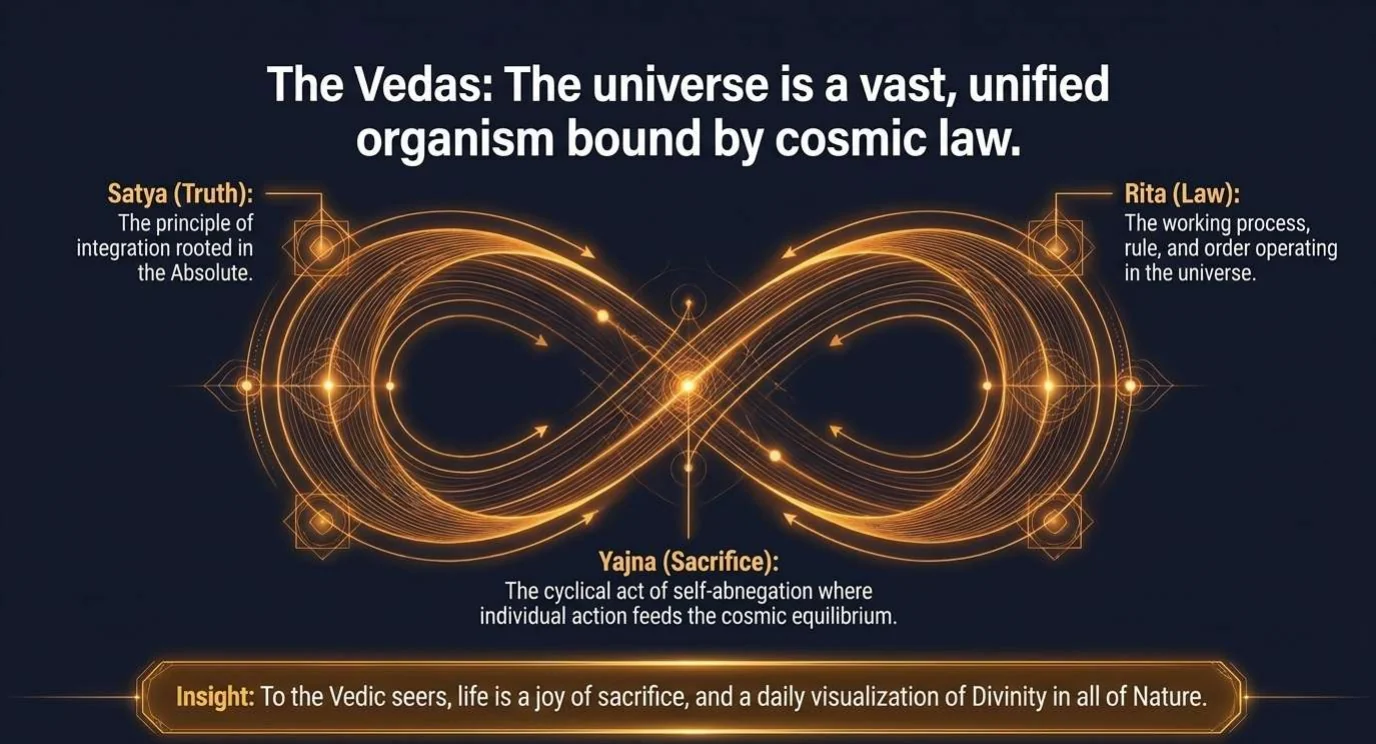
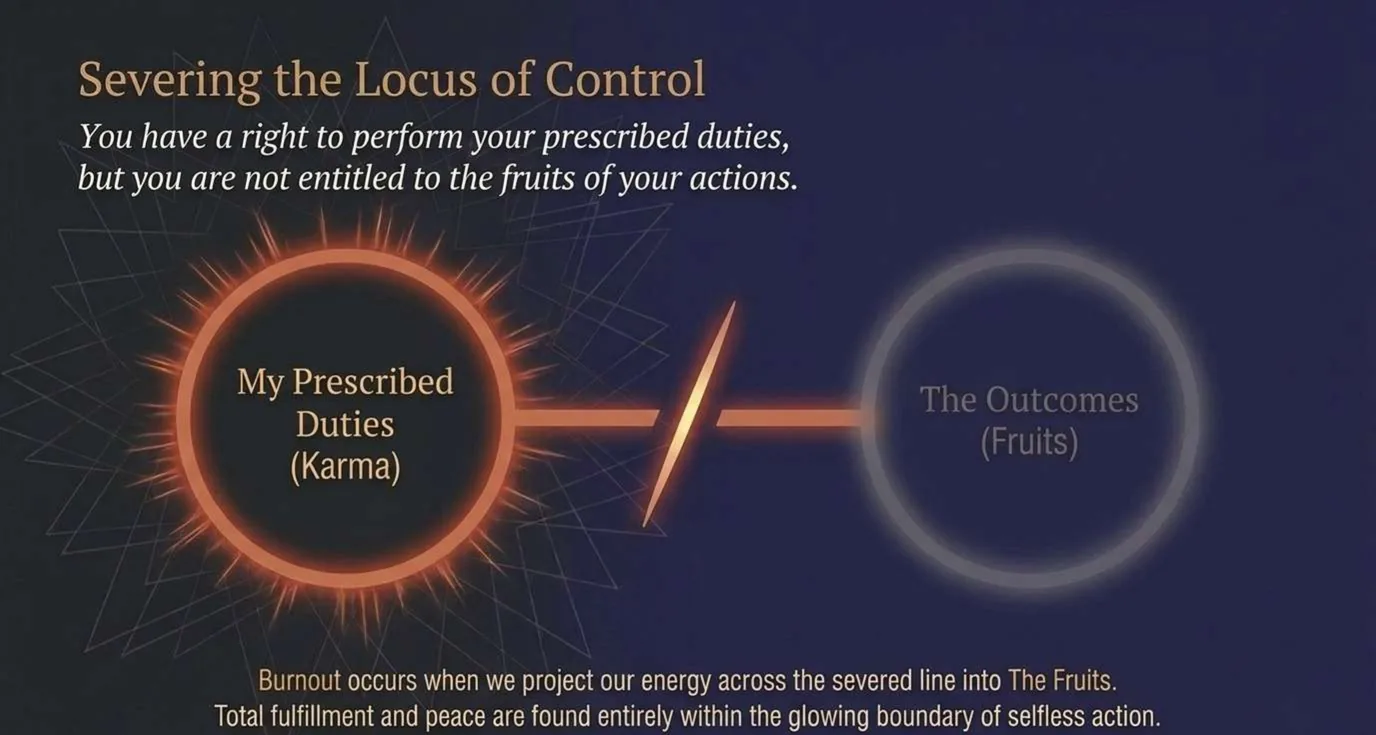
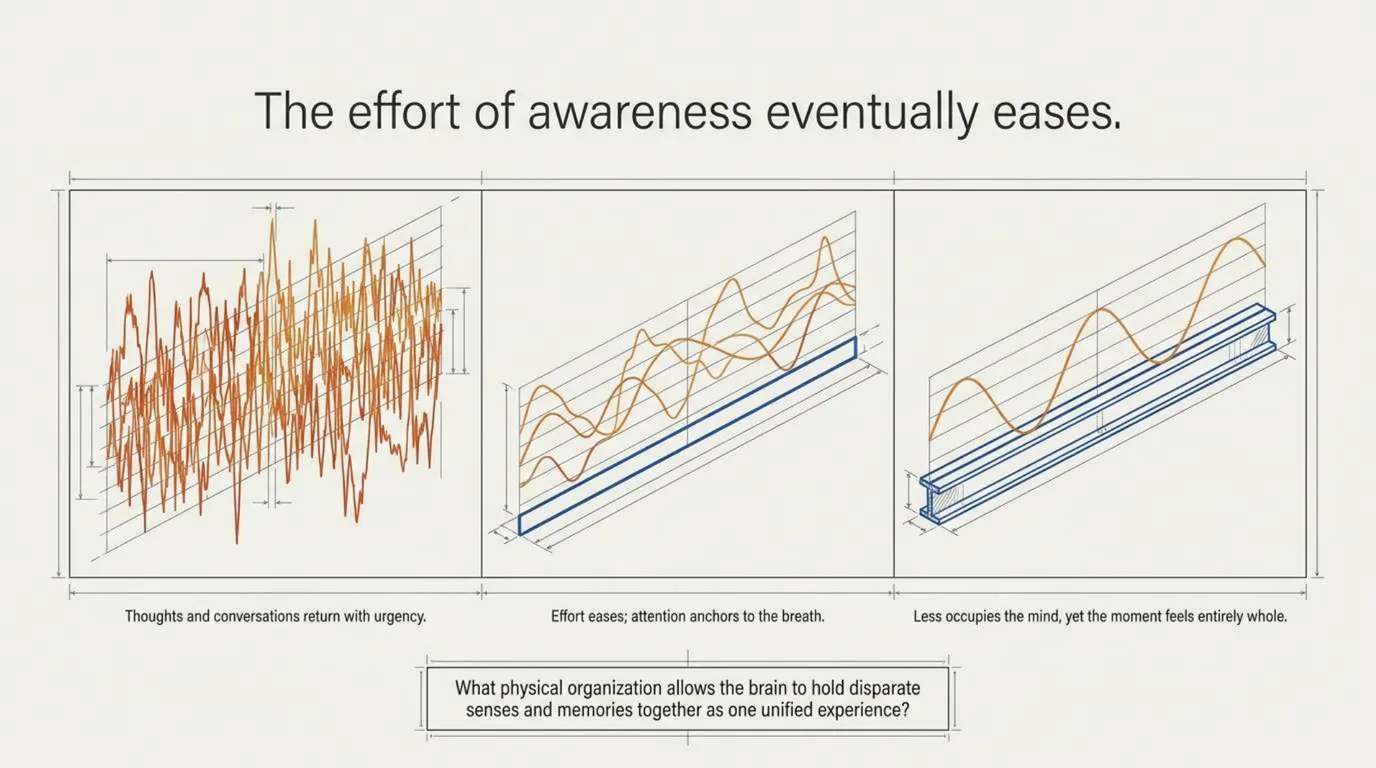
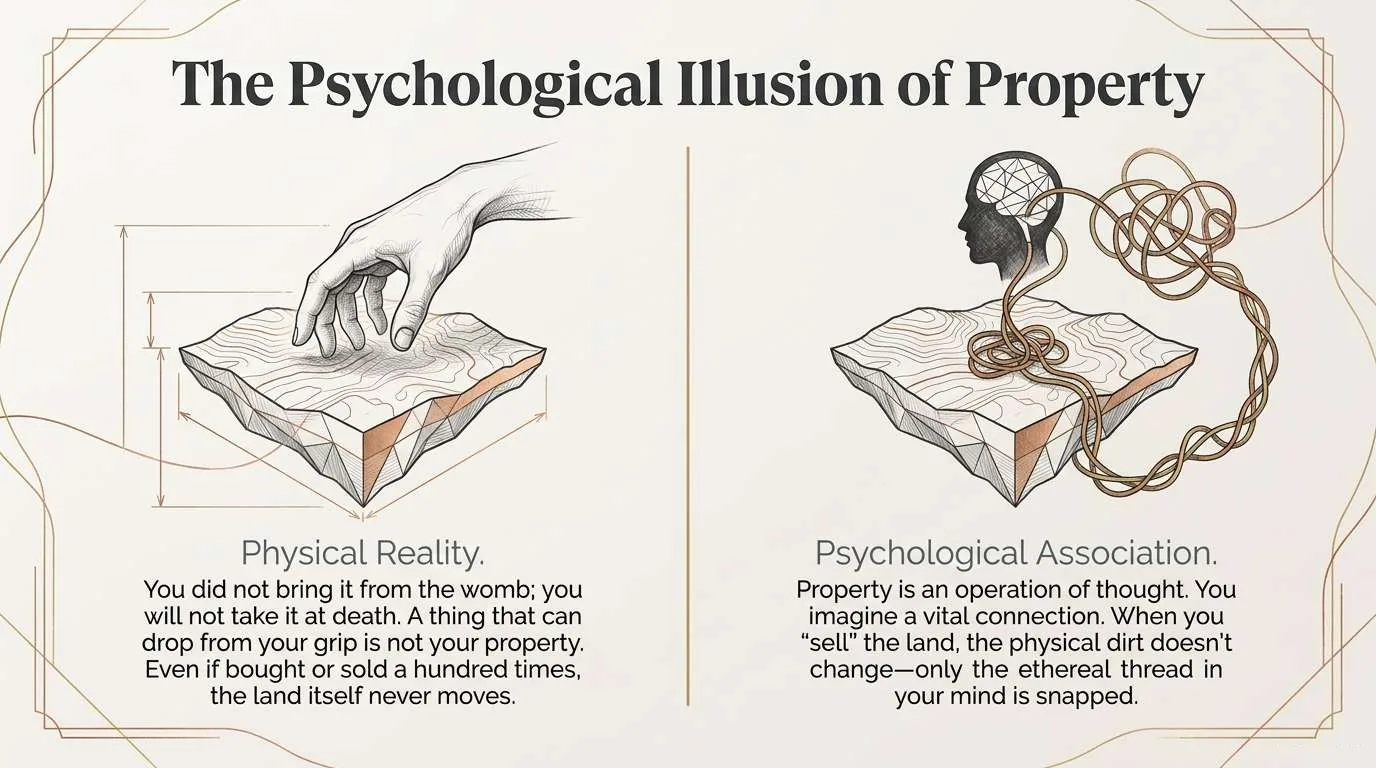
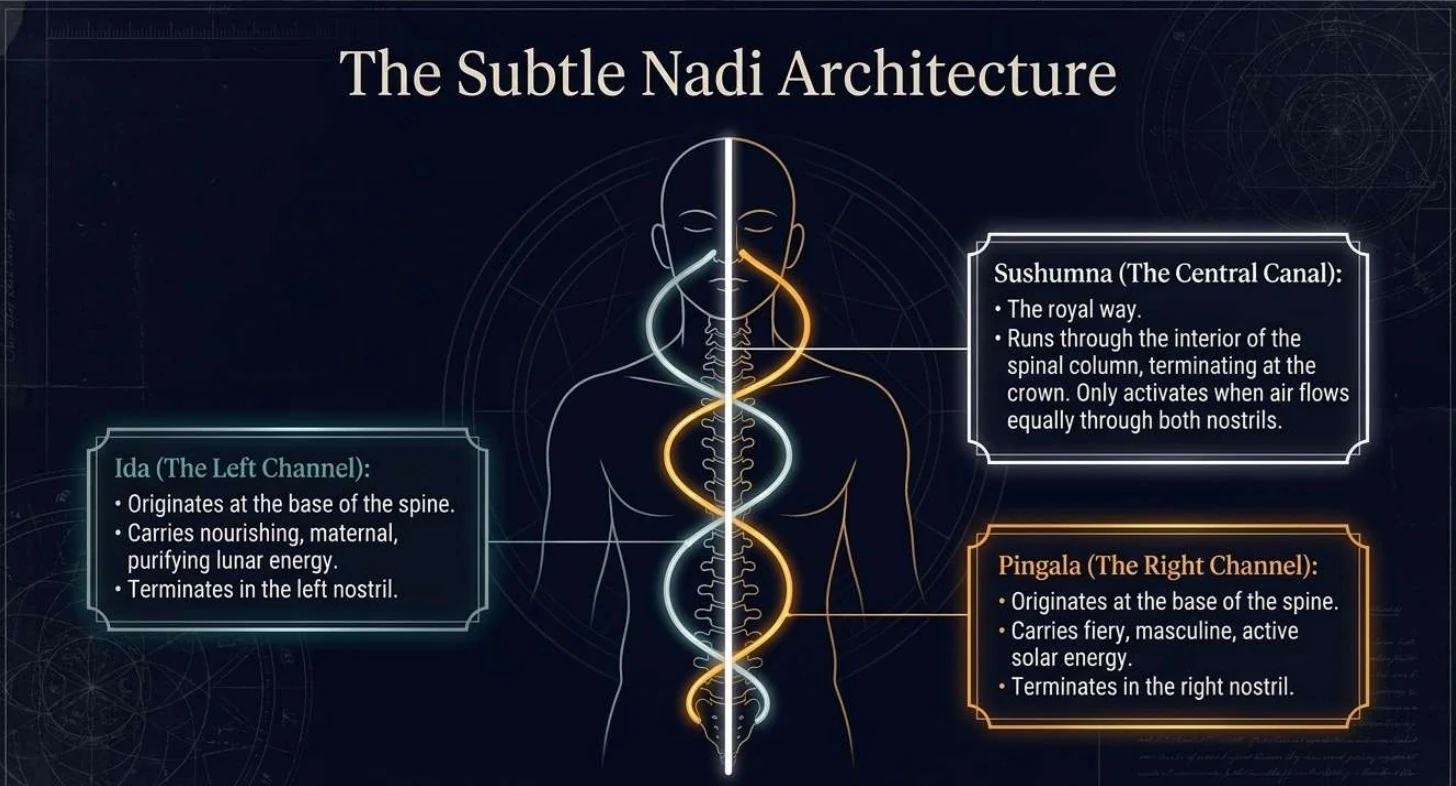
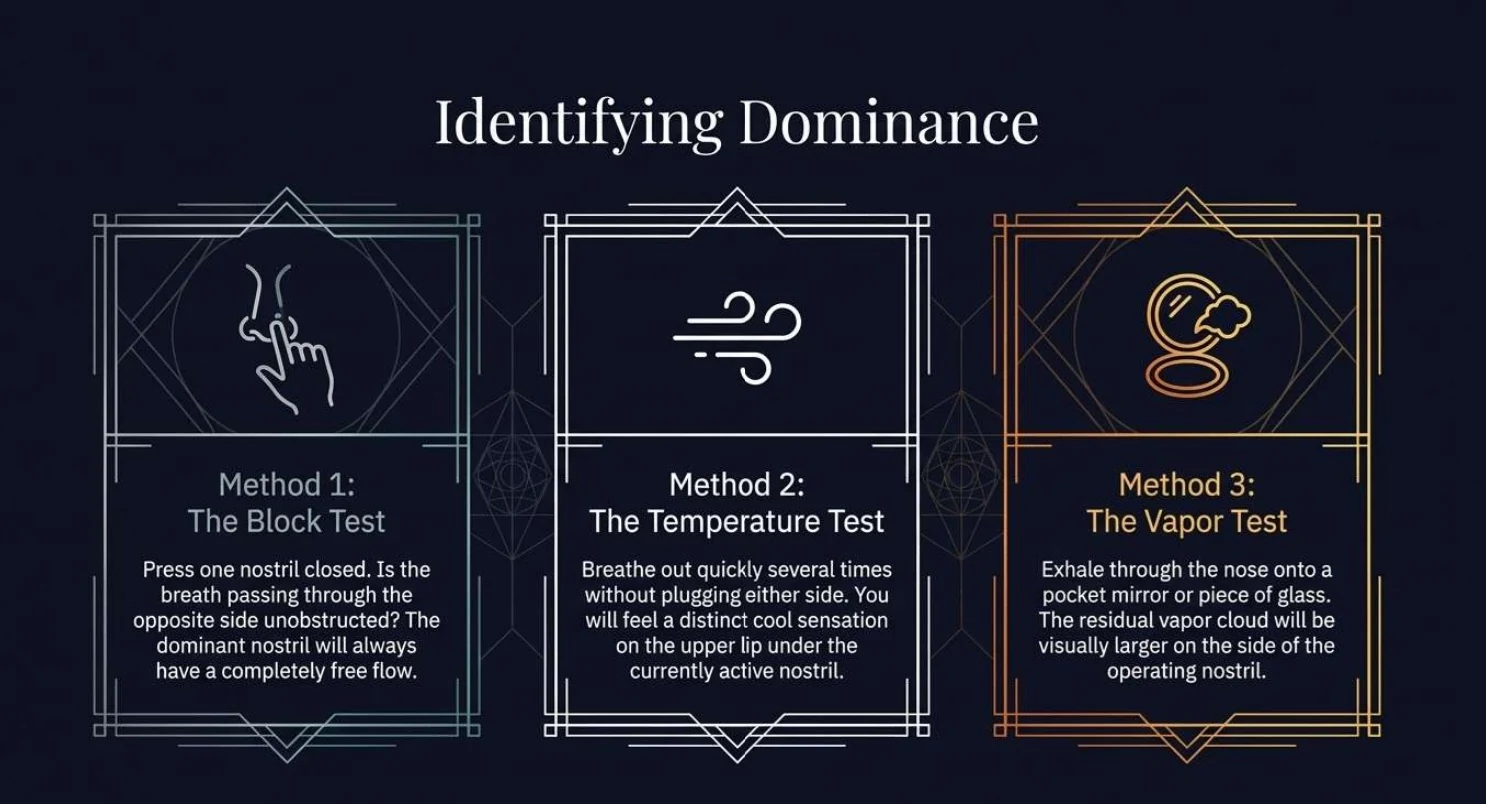
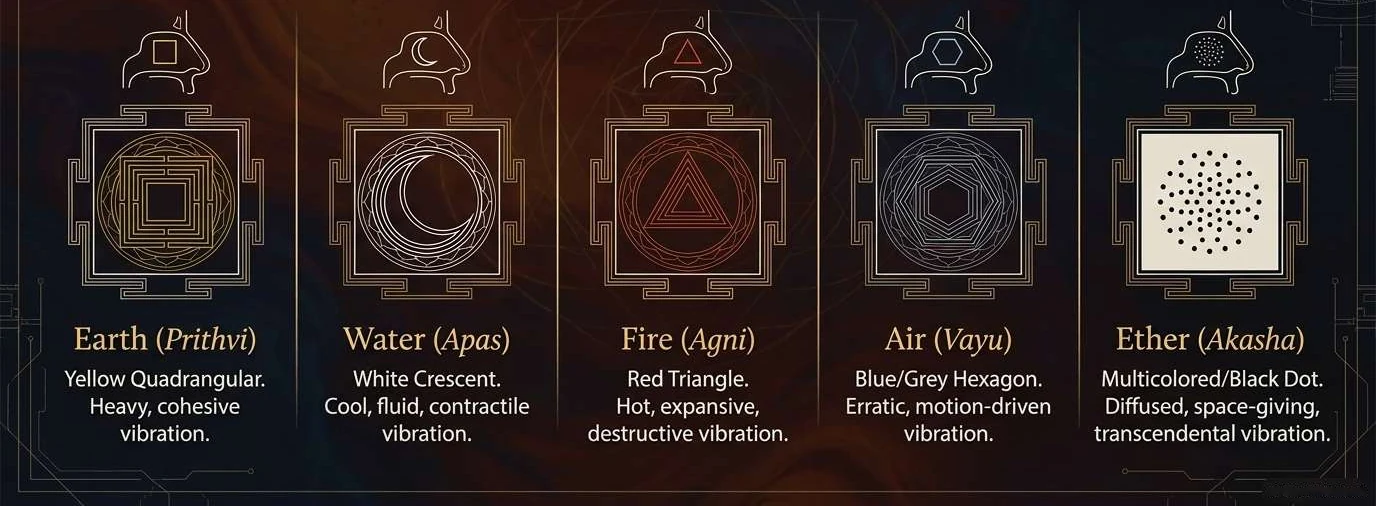
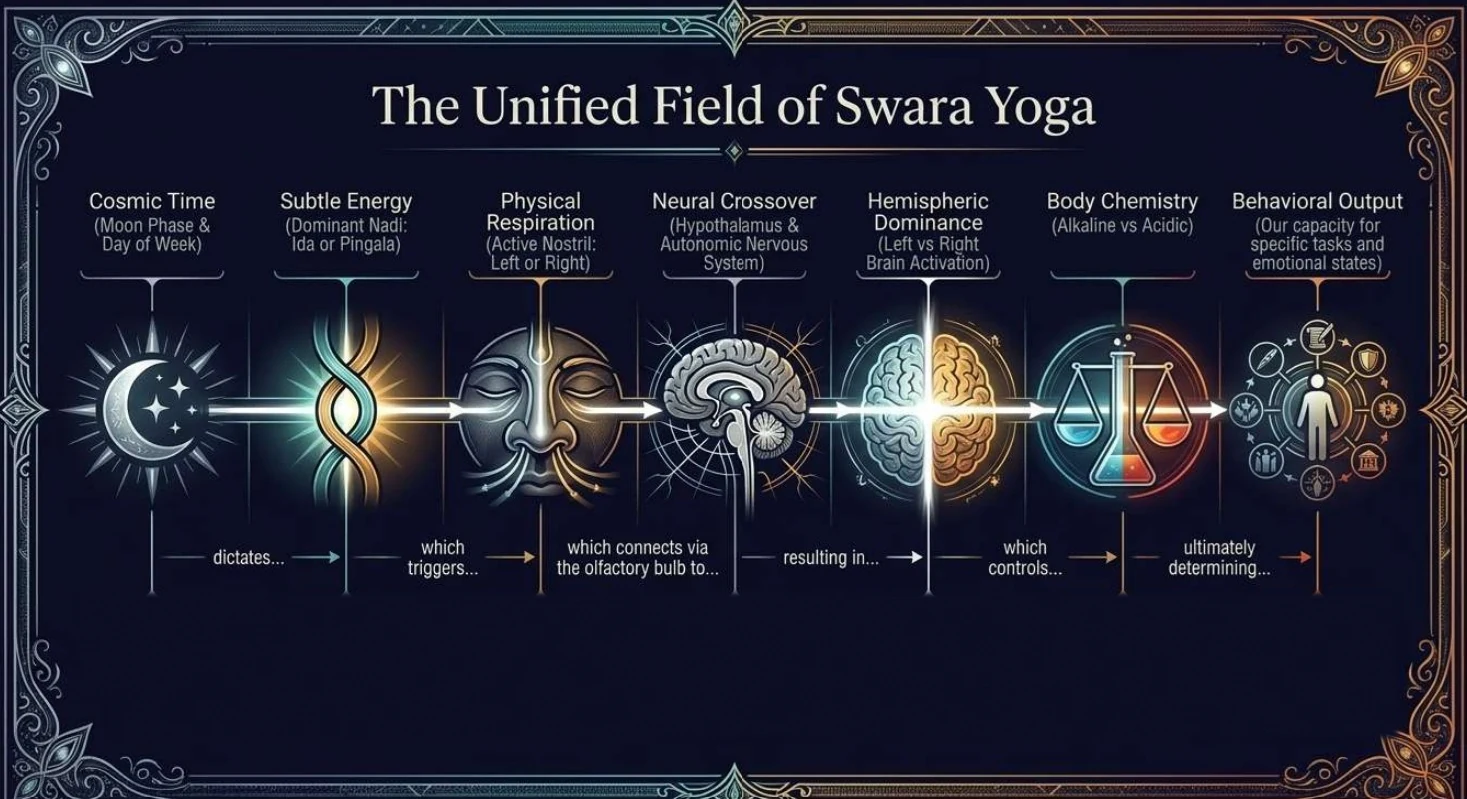
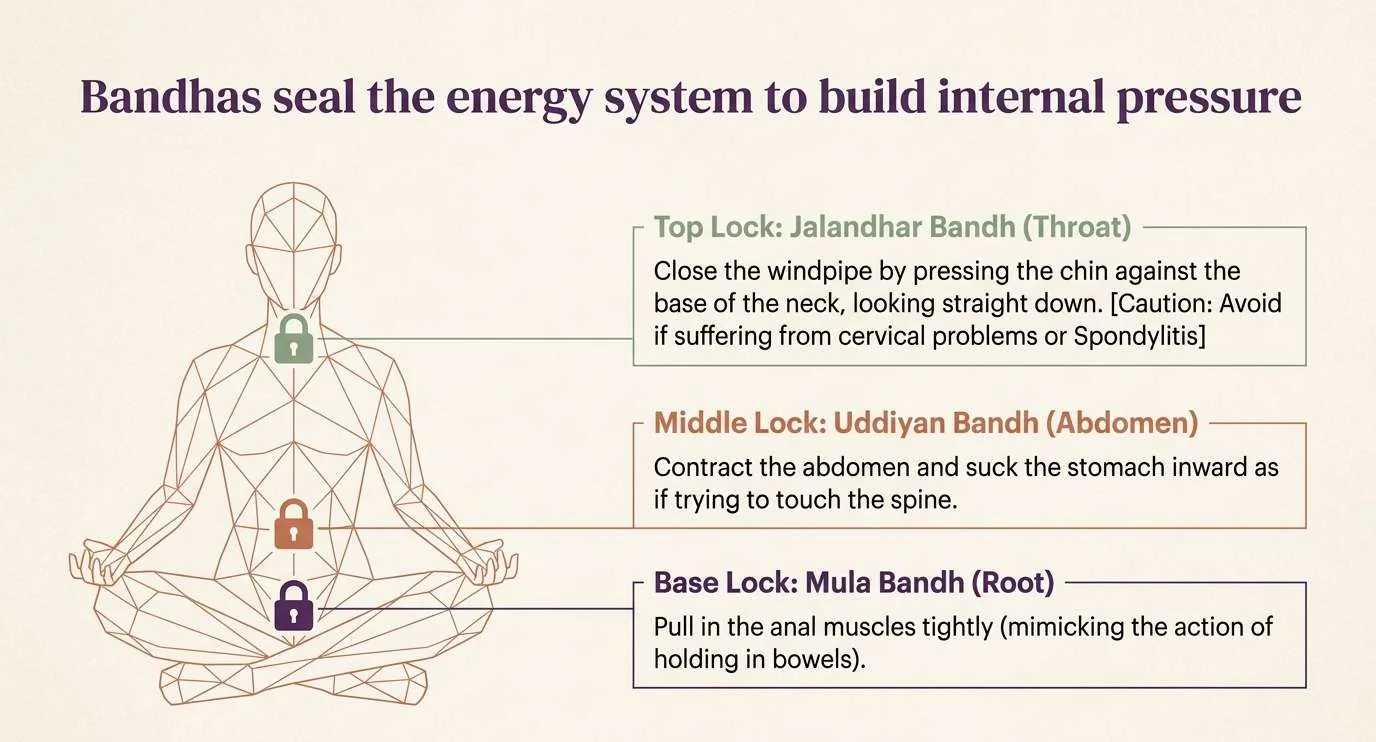
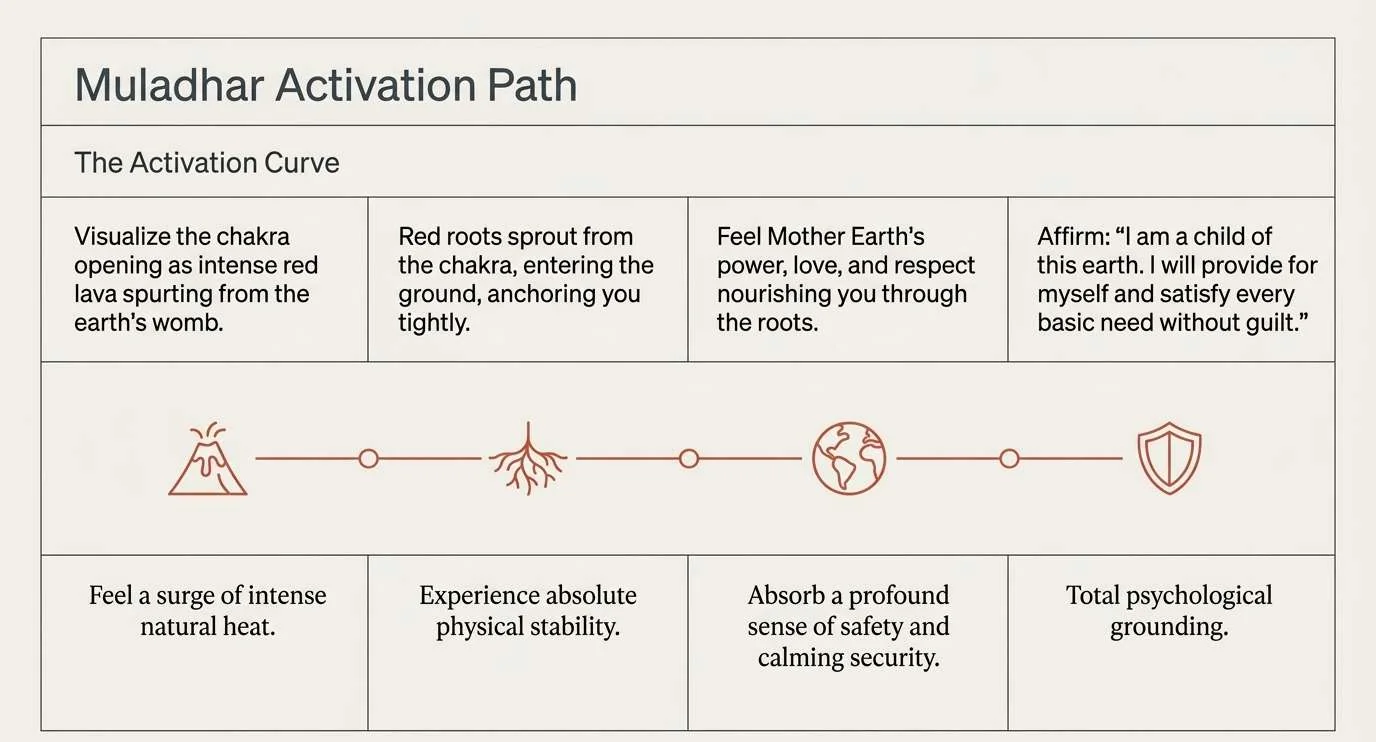
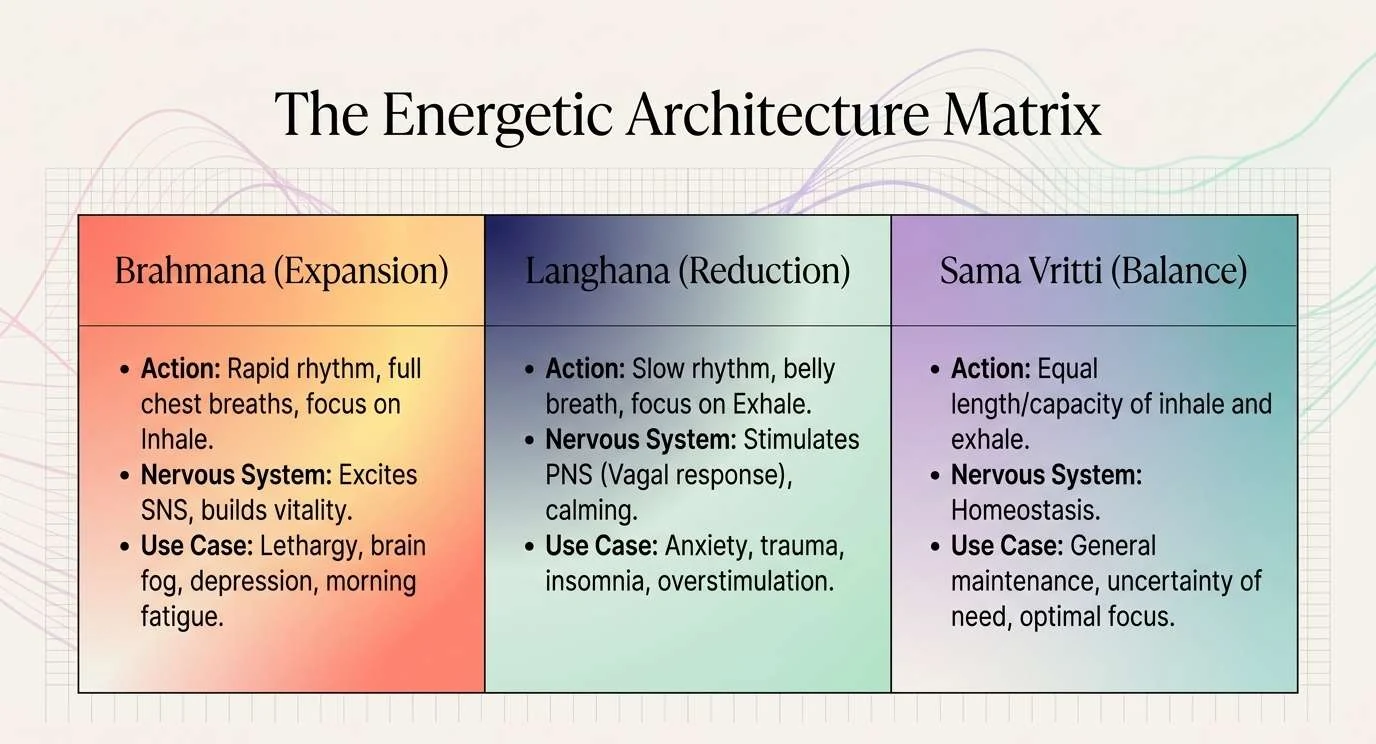
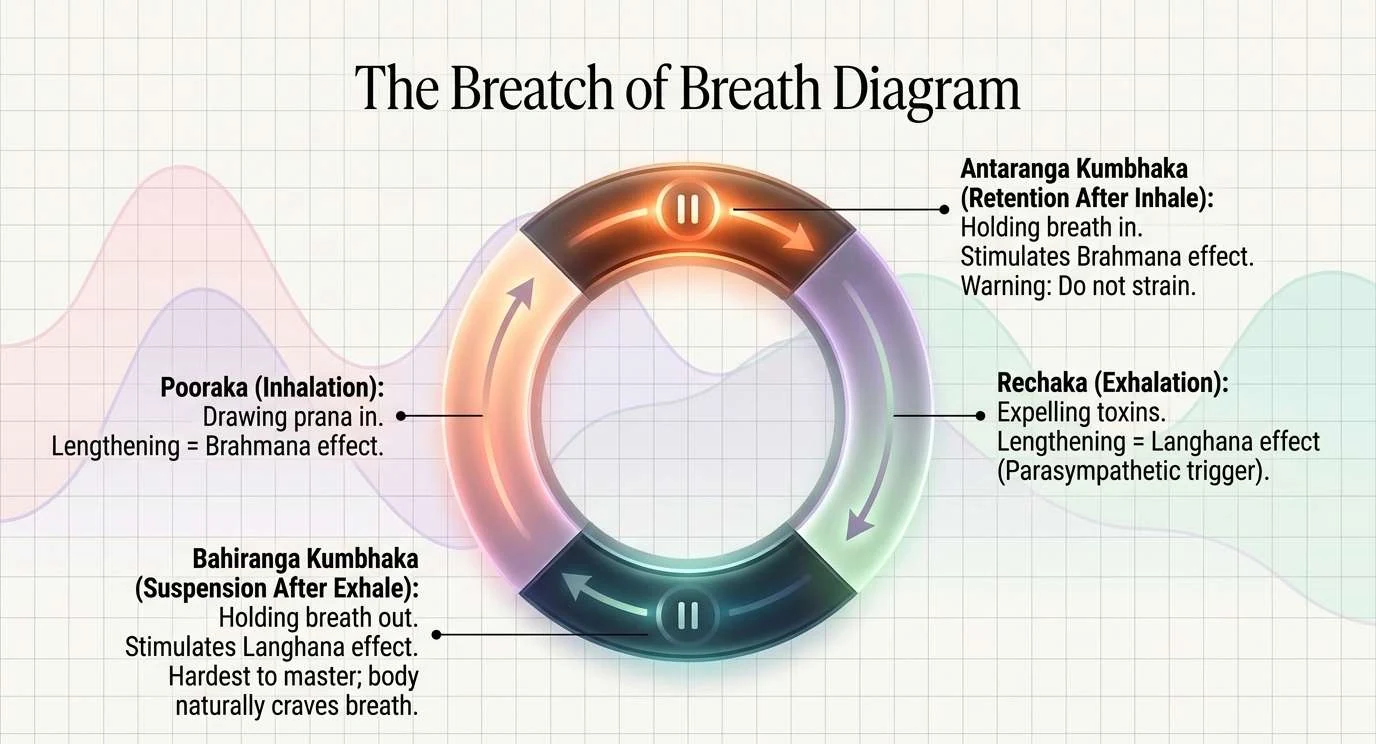
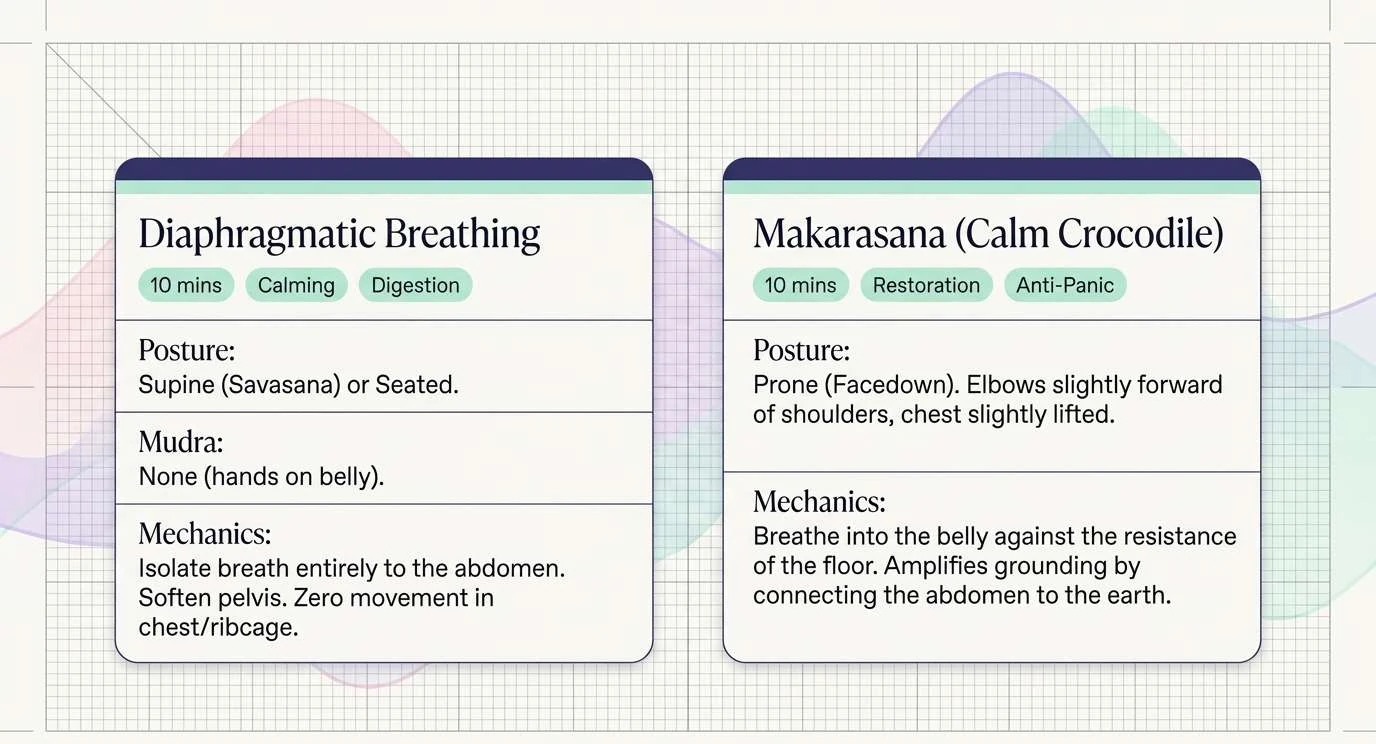
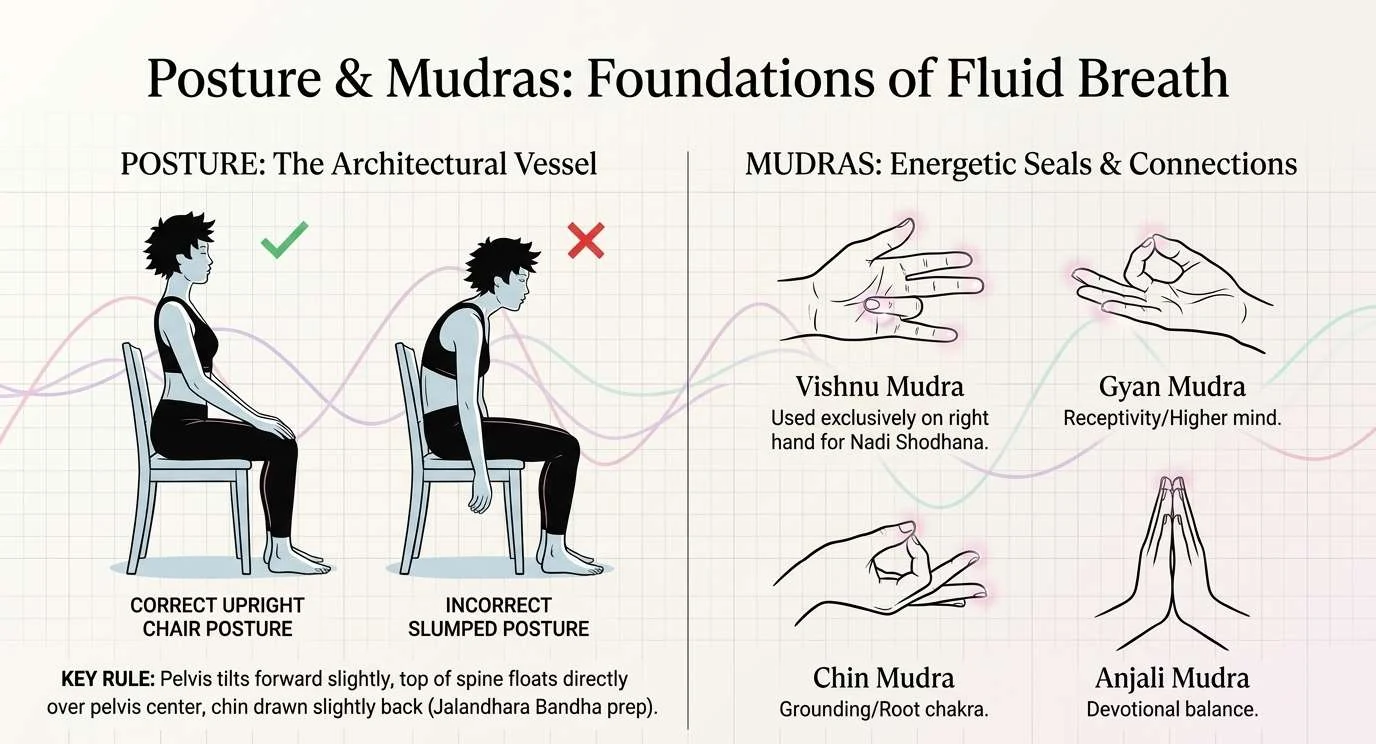
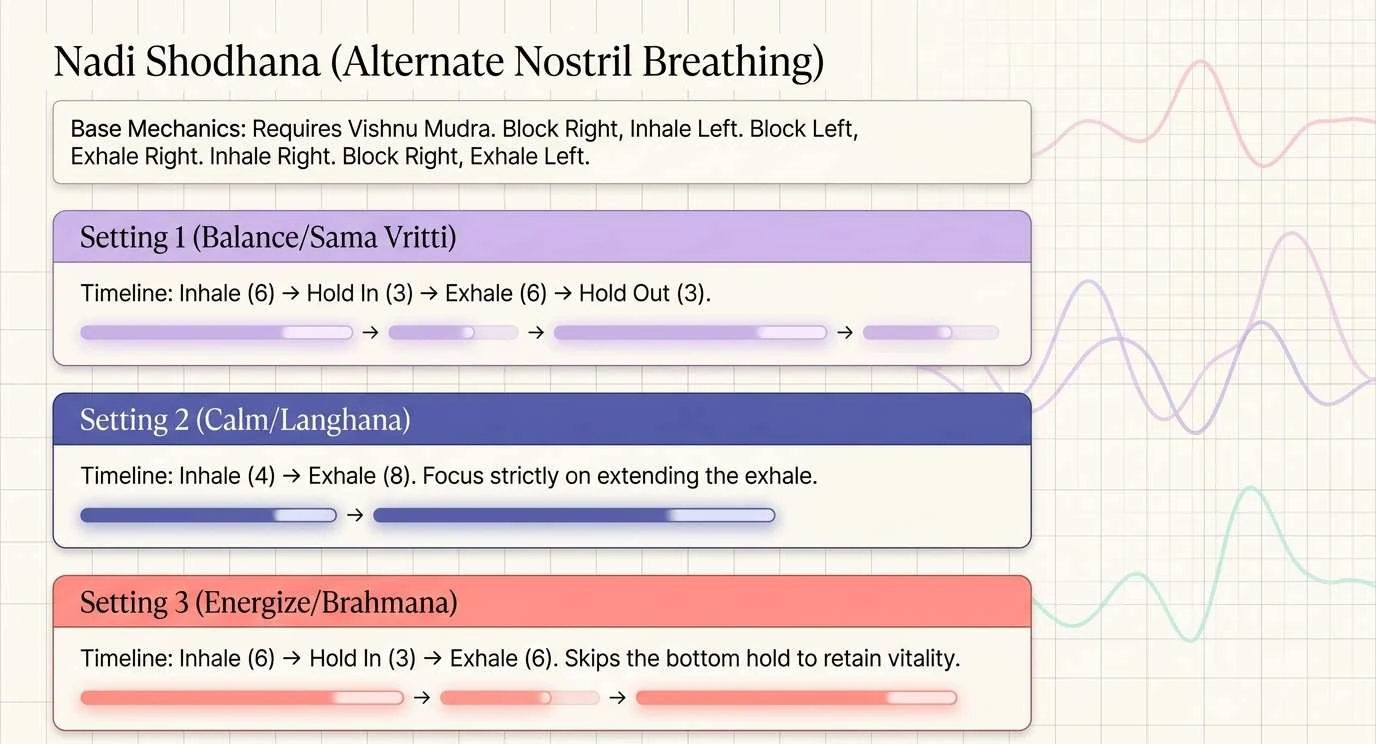
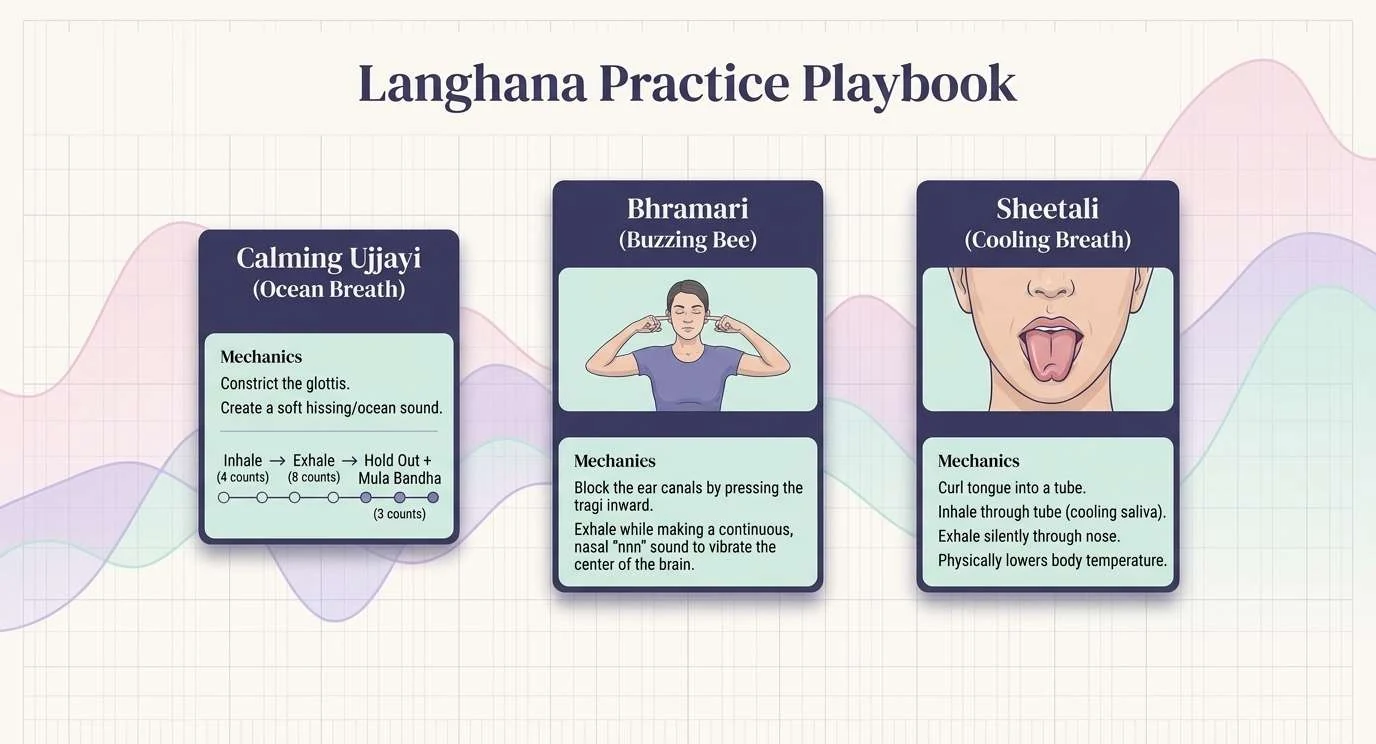
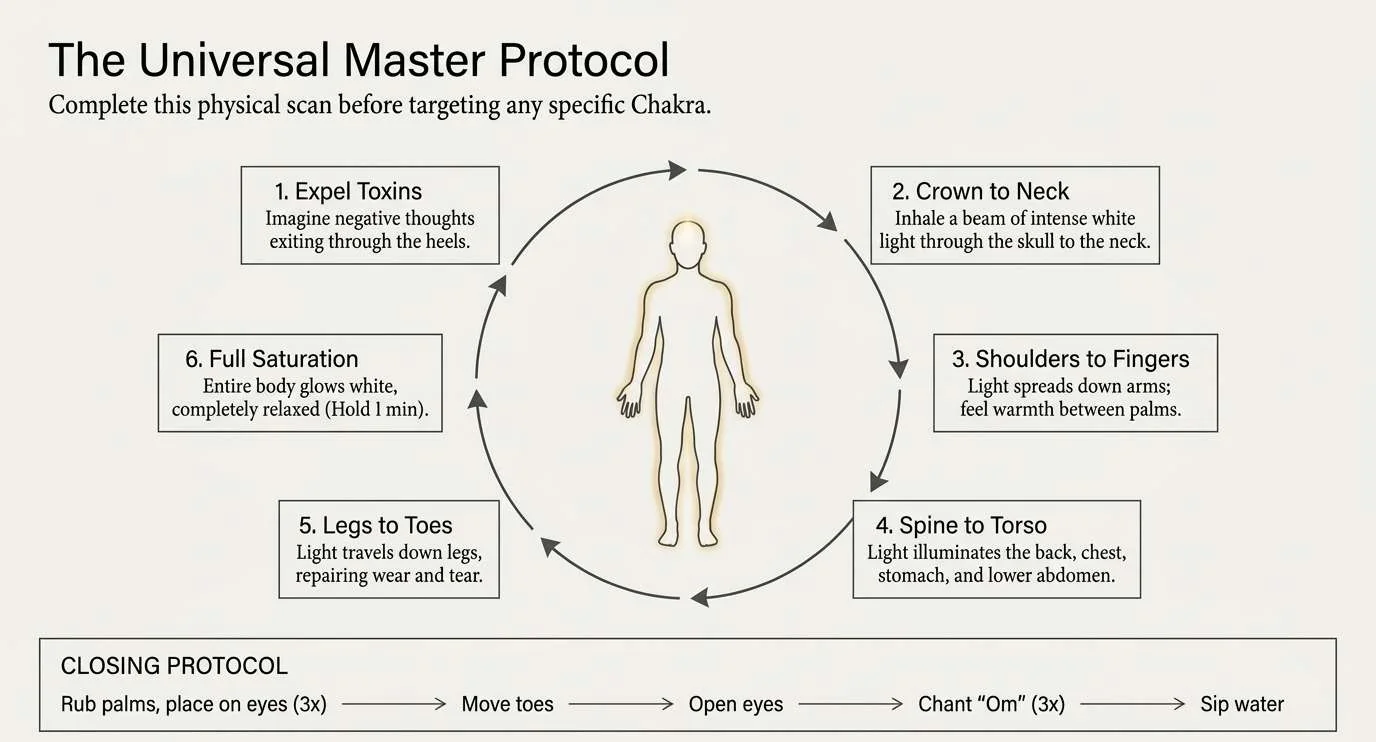
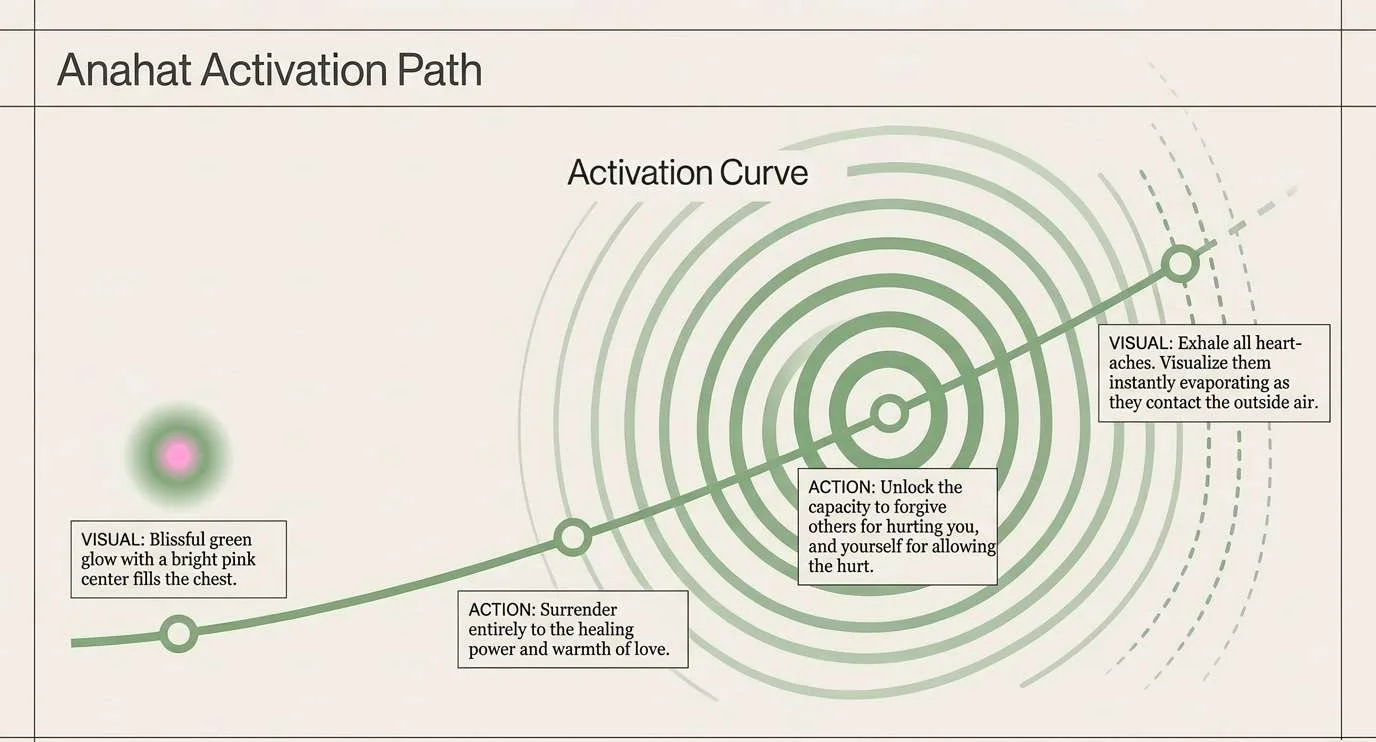
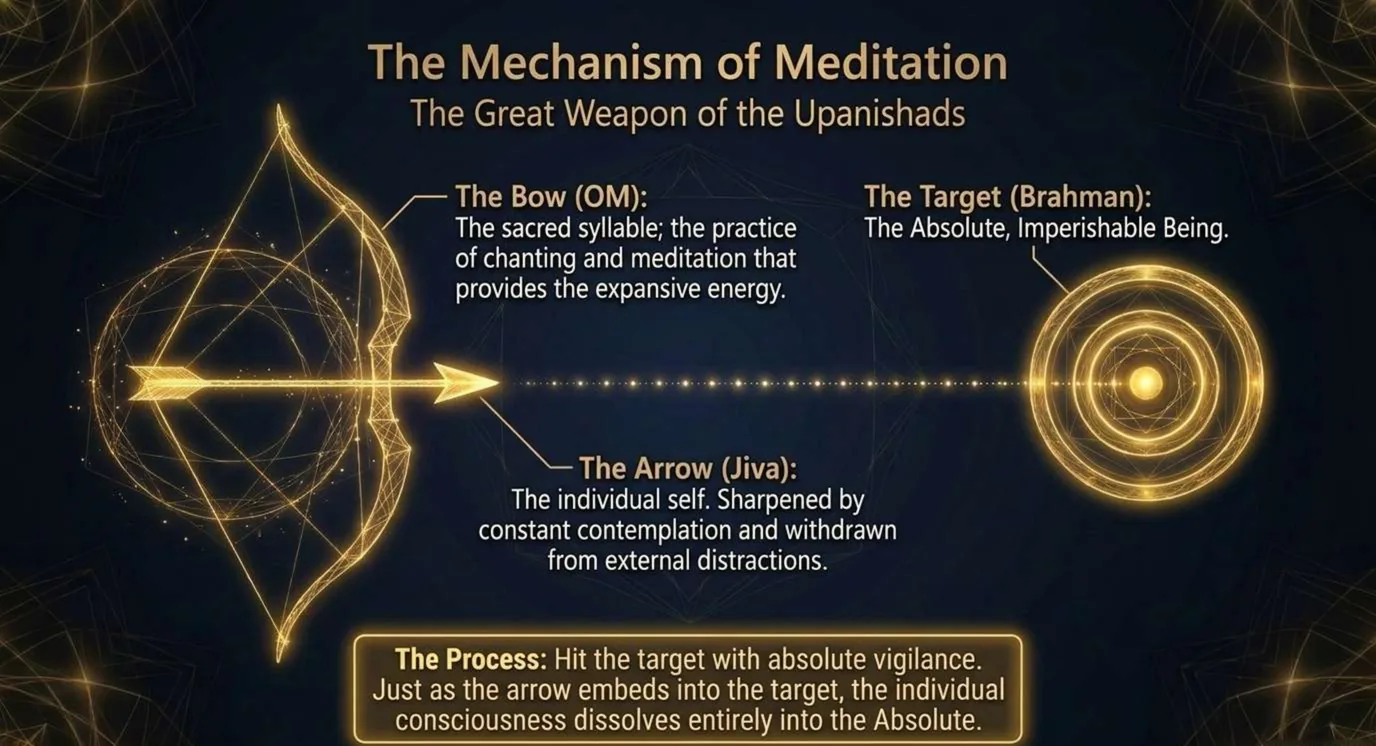
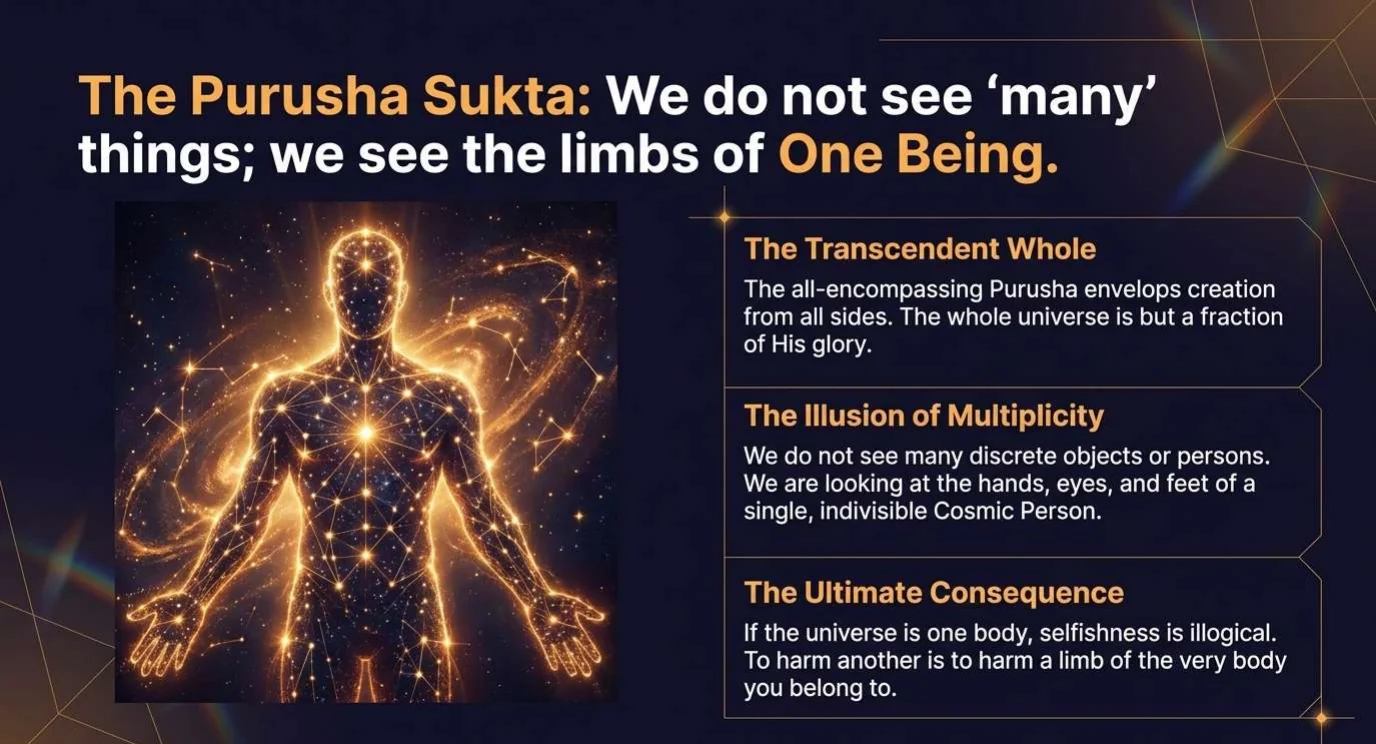

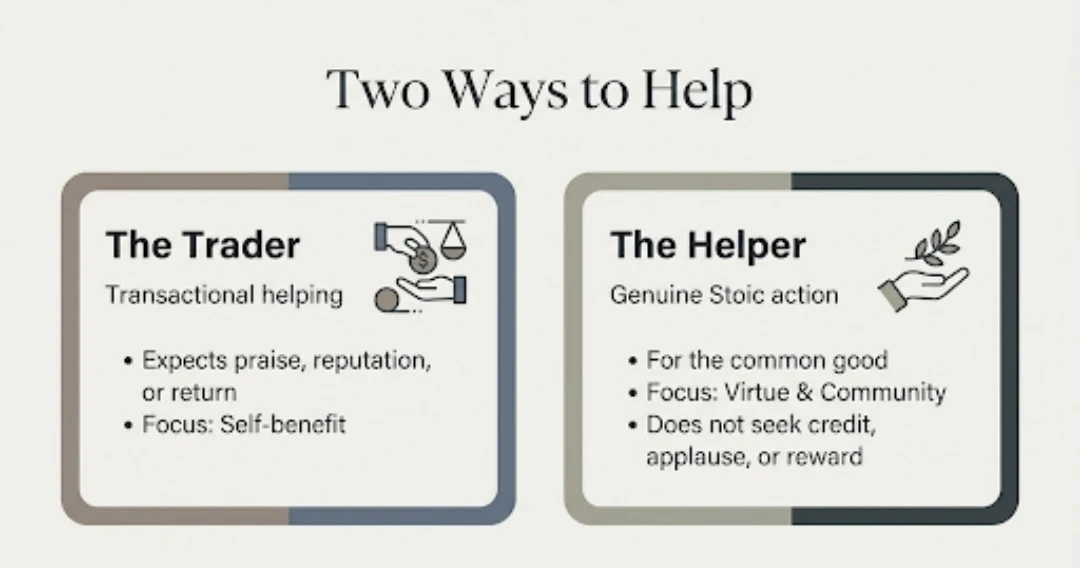
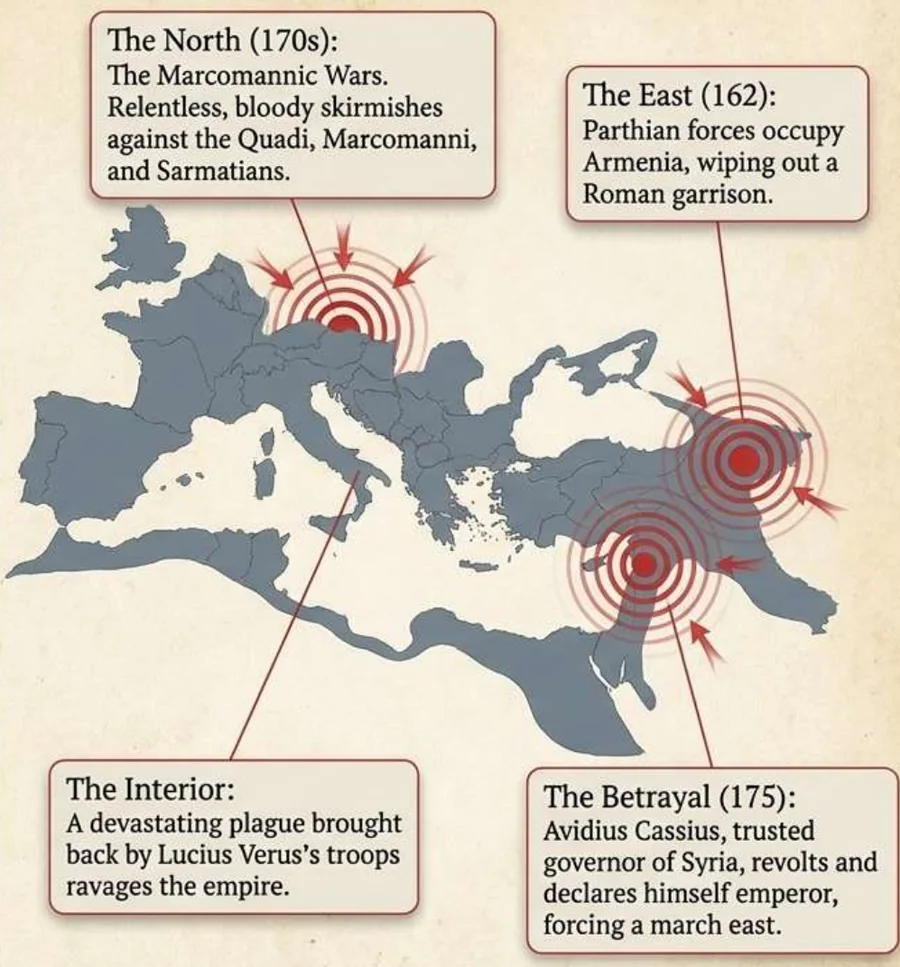
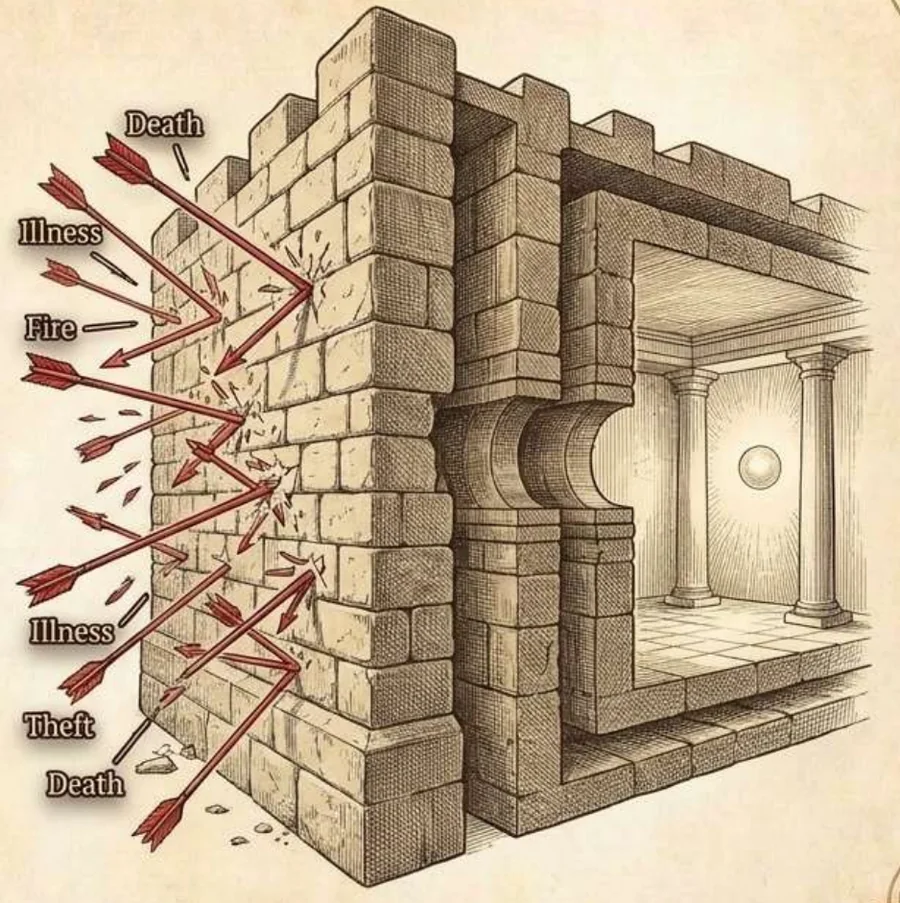
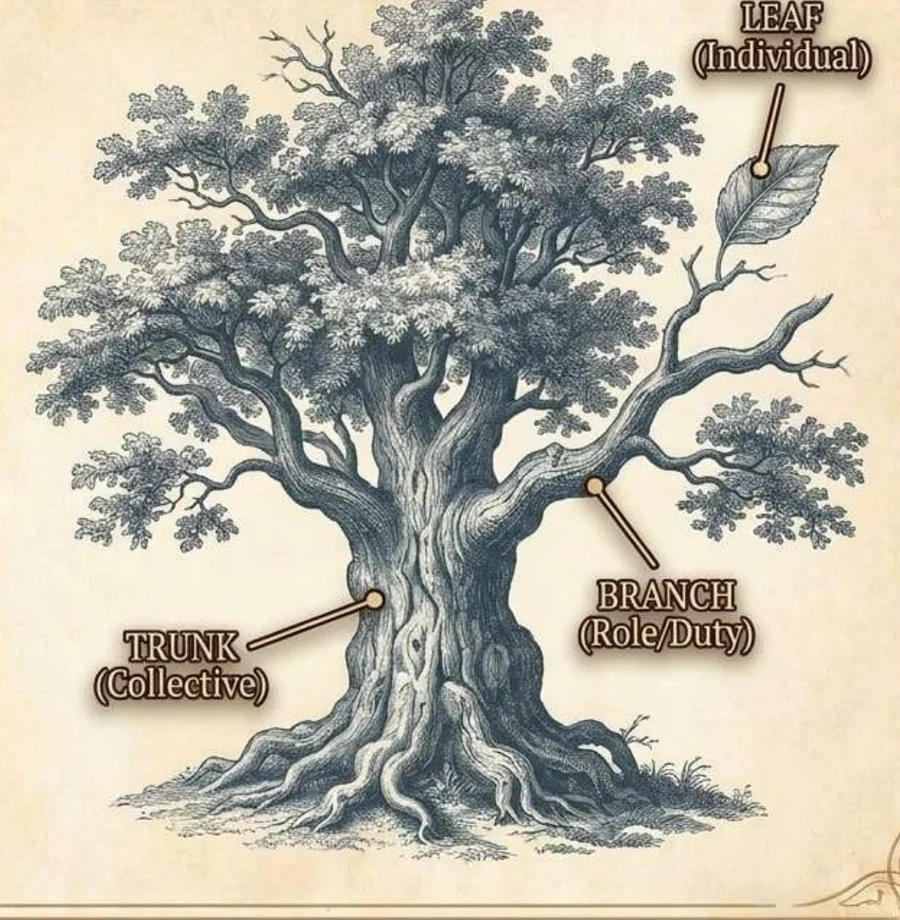
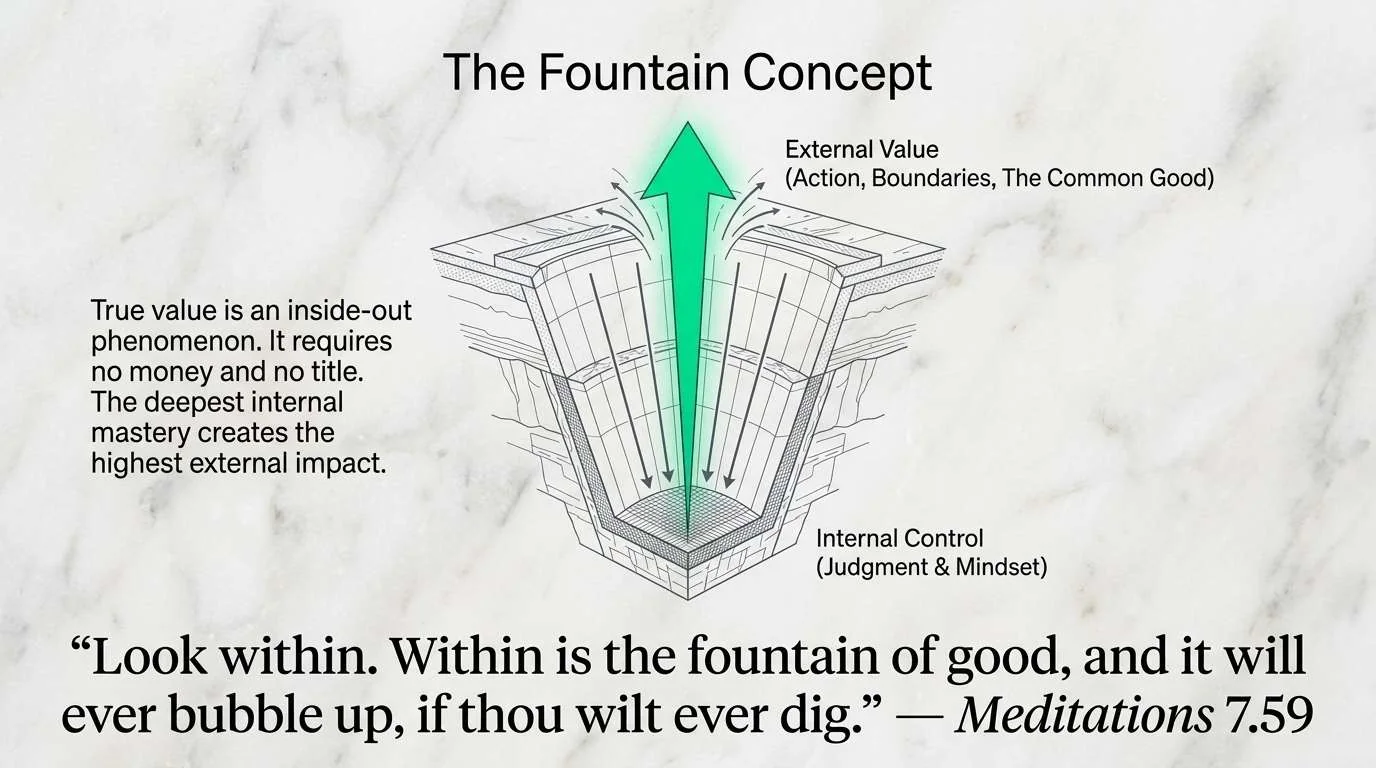
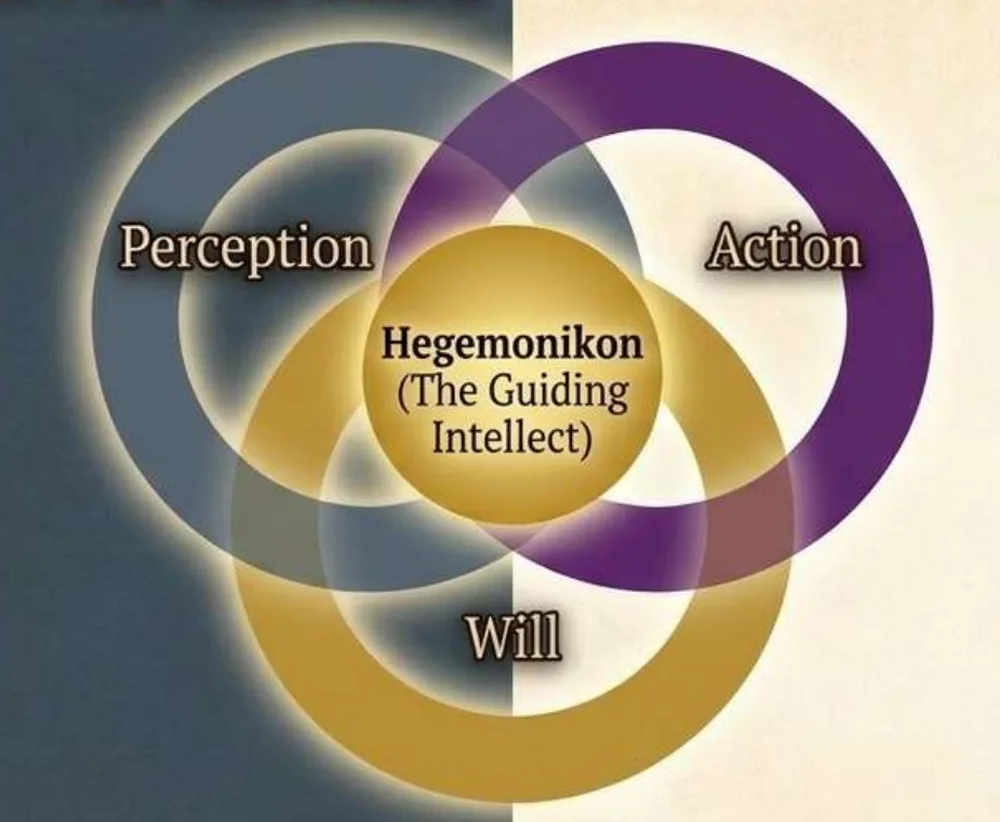
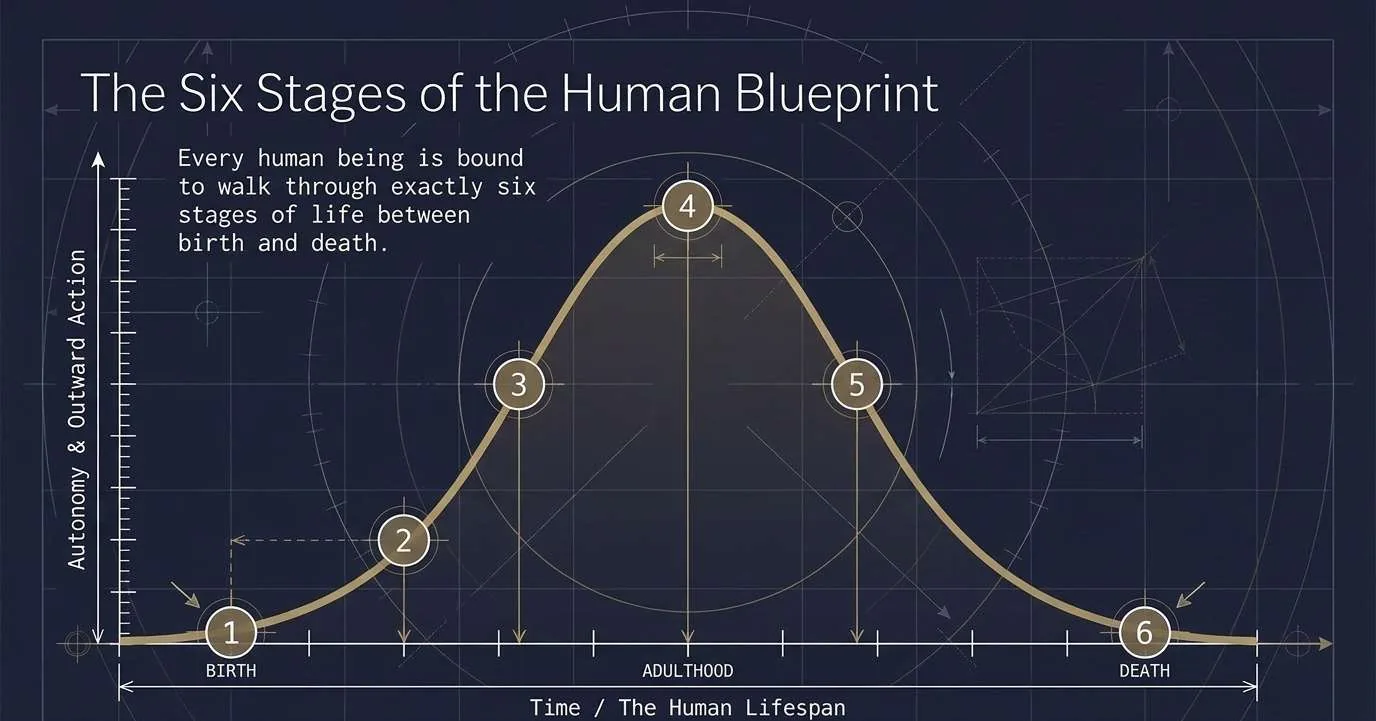
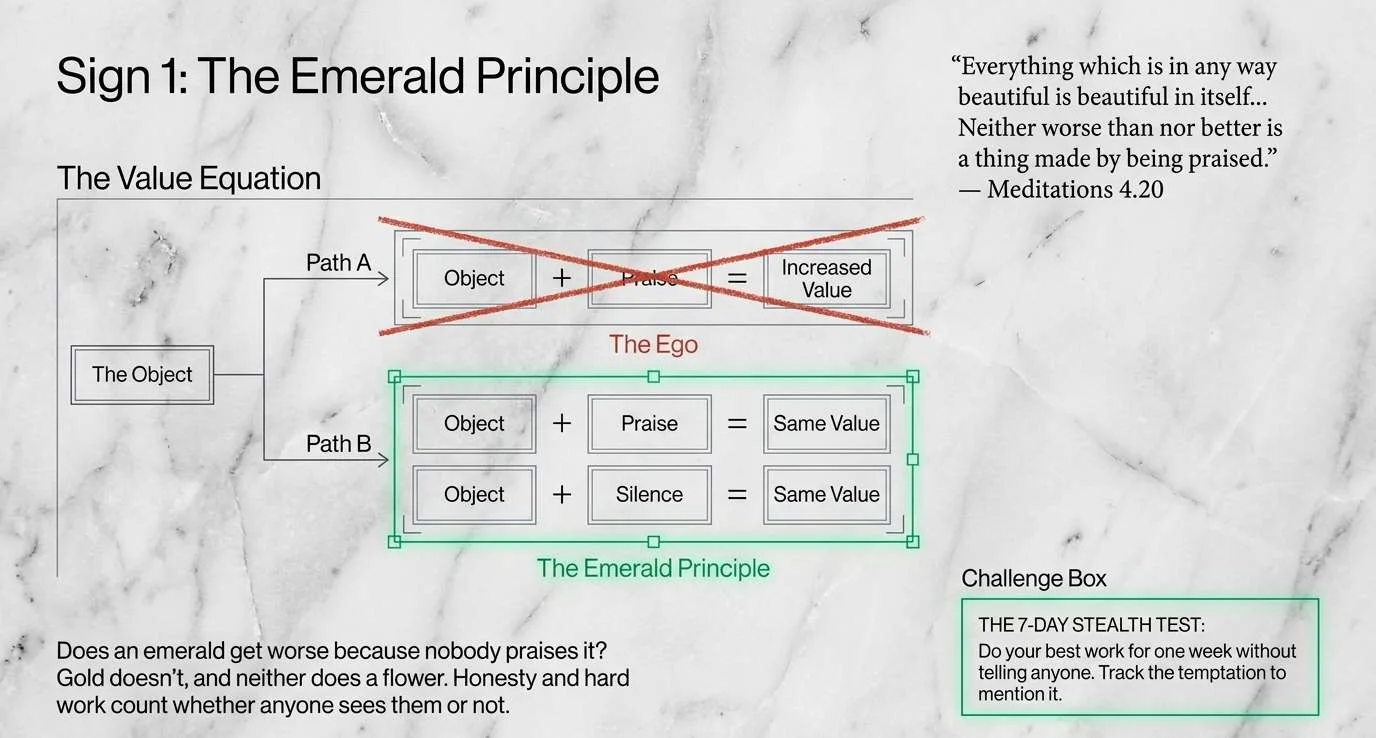
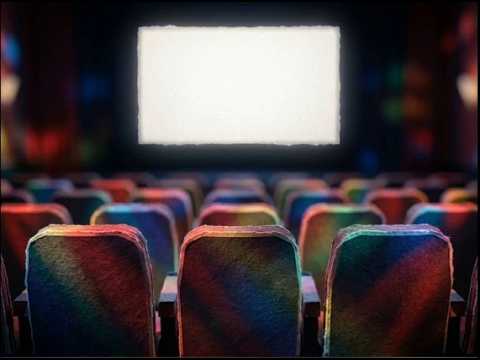
Kind Isn’t the Same as Available
Where your social energy is actually going